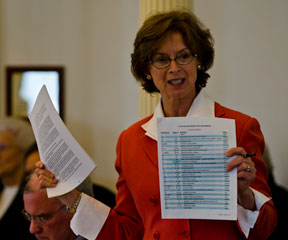
The Senate passed H.559, the health care exchange bill, Tuesday evening, 20-7.
The legislation allows Vermont to take advantage of federal subsidies and tax credits associated with the federal Affordable Care Act. The Shumlin administration plans to use the exchange as a stepping stone toward financing a single-payer health care system.
The bill requires individuals and employers with 50 or fewer workers to buy insurance through the exchange beginning in January 2014. Vermont is the only state so far to pass a mandate for companies to purchase health care coverage on the exchange. In 2016, the federal law will require all businesses with 100 or fewer workers to become part of the exchange.
Senators who support the bill said the exchange program will benefit small companies that struggle to pay health insurance premiums for workers.
Sen. Claire Ayer, D-Addison, told her colleagues that the federal government will look at 2014 participation rates in determining how much financial support to provide the state in 2015.
“We need the strongest healthiest exchange we can get,” Ayer said. “We need everybody in.”
Several attempts to delay implementation of the exchange failed, as did a proposal on Monday from Randy Brock, the Franklin Republican who is running for governor, to require the Shumlin administration to reveal its financing plans for the proposed single-payer health care system before the November election.
With the exception of three votes, the Senate approved the bill along party lines. (Sens. Vince Illuzzi and Kevin Mullin voted for the exchange; Sen. Bob Hartwell voted against it.)
Sen. Diane Snelling, a moderate Republican from Chittenden County, explained why she opposed H.559.
“I hoped by this time to be able to support the movement toward health care reform,” Snelling said as she explained her vote. “I am still deeply troubled by the process while there are many worthy changes in the bill it became too complicated and was broadened too far.”
Senators proposed a number of amendments to H.559, which evaluates the quality and cost of health insurance plans.
Here is a sampling:
Pollina Amendment
Sen. Anthony Pollina, D/P-Washington, proposed an amendment to H. 559, which would bolster insurance payments for mental health treatment. The Senate Finance Committee proposed to delay legislation on mental health coverage until next session, pending a report from the commissioner of financial regulation as to where to draw the line between primary and specialty mental health services. Pollina’s amendment gives the commissioner until October 1, 2013, to adopt rules establishing such guidelines, additionally proposing a section that would prevent health insurance plans from requiring higher co-payments for mental health services than for general medical care. The proposed changes would apply to new or renewed plans in 2014 and extend to all plans by 2015.
The Senate passed the amendment on a voice vote.
Mullin Amendment
Sen. Kevin Mullin, R-Rutland, proposed an amendment that would make it easier for prescribers to get prior authorization from insurers for medications that require such pre-approval. The final version of the amendment requires insurers to respond to urgent prior authorization requests within 48 hours and non-urgent requests within 120 hours. The language proposed by the Senate Finance committee allowed two business days for urgent requests and seven business days for non-urgent requests. That amendment passed.
Mullin also sought to limit insurers to five prior authorization request forms. Currently, insurers like Blue Cross/Blue Shield and MVP Health Care have about 100 forms, representatives said. Having numerous forms, they said, allows them to get specific information regarding the drug in question, making the process more efficient. Mullin said this system makes it difficult for prescribers to navigate the system to get prior authorization. That amendment was ultimately struck down in committee.
Sears Amendment
Sen. Richard Sears, D-Bennington, proposed to remove three sections of H.559, including a section on sports injuries. The section became a subject of heated debate on Monday, when Sears insisted the language be changed to state that coaches must have “actual knowledge” of a head injury in order to be legally required to pull student athletes from a game.
The wording was changed to “an objectively reasonable belief under the circumstances.” The Senate approved the new language.
Illuzzi-Miller Amendment
Sens. Vince Illuzzi, R-Essex-Orleans, and Hinda Miller, D-Chittenden, proposed to delay implementation of the health care exchange by one year to January 2015.
The Senate defeated the proposal by a narrow margin, 15-12.
Illuzzi Amendment
Illuzzi failed to persuade his colleagues to adopt a proposal to ensure brokers are “reasonably compensated” along with a provision that would have given the Secretary of the Administration the ability to modify the implementation planning for the health insurance exchange bill should the U.S. Supreme Court strike down the individual mandate requirement in the Affordable Care Act.
Editor’s note: Taylor Dobbs contributed to this report.
CORRECTIONS: Sen. Illuzzi was listed as a D/P. He is a D/R. Sen. Kevin Mullin voted for H.559; he was originally left off the list of supporters.


Permalink |
Good job, Senate. Now let’s move Vermont quickly to single-payer.
Anne – two quick corrections: Sen. Illuzzi is not a D/P and I believe Sen. Mullin also voted for the underlining bill (making it two Rs who supported the legislation).
Permalink |
Thanks for the corrections, Dan. Sen. Mullin did vote for the bill.
Permalink |
“Driving down the highway in a pea soup fog.”"
Perfectly sums up this poorly thought out decision by our elected officials.
Permalink |
Having witnessed house and senate committees working on these changes in health care, “poorly thought out” is not the cliche I would have used.
Permalink |
Health exchanges have implications for benefits, especially cost and utilization. http://www.healthcaretownhall.com/?p=4018
Permalink |
“Driving down the highway in a pea soup fog.””
At least we are driving there and not sitting around and saying that we cannot get there from here and letting the current system bleed us to insolvency while a few at the top get rich. At least we are on the journey.
Permalink |
I can’t understand how this was passed without knowing what the exchange will cost individuals and employers. As a small business owner, I need to offer topnotch benefits (including health packages) to attract top talent to my business – which is headquartered in Burlington, VT. These include many young people who are seeking work in PR and marketing in NYC, Boston, San Francisco and other major cities.
I understand having the OPTION to join the plan, which is great for very small companies. But, my company would not opt to do this (at least without it being a win for the employee – and allowing us to cover most or all of their health costs). My business is 10 people. Health benefits are a BIG part of our package – and we offer way above average benefits. Mandating the exchange is a huge mistake in my opinion. But an even bigger oversight is making the decision at MY (and other small business owners) expense without knowing the financials – or being transparent about what this will cost my associates and my business.
My invitation to any senator – and even Governor Shumlin – I will buy the coffee. Come by PMG and let’s talk about this. Perhaps you can provide me rational that I am not seeing, or I can clue you in on what it is like to start and grow a business in VT which is competitive on a national scale… and why making a rash decision on healthcare benefits for MY company without seeing a pro forma is just plain misguided and wrong.
Permalink |
Hi Nicole:
The proponents of single payer do not care about you or the success of your business. That is purely your problem and if you cannot compete and survive…well that’s just too bad. Business is an expendable nuisance and making money is bad and evil, according to the far left, who are currently in control of this contentious debate.
It is very difficult to argue against the constant “human rights” rhetoric being screamed by the proponents of this issue. But when you really begin to look at the practicality of their philosophy, you will see that it is unsustainable without increased fees, taxes and regulation. Look at the current federal deficits and watch VT slide further into an uncompetitive quagmire.
You should immediately contact your House Rep. and your Senators and demand that they release the financing information NOW. I have done that and received replies that offer not one ounce of financing information. They either have no clue (driving in pea soup) or are too politically scared to let it become public before the elections.
Nicole, you should plan as far in advance as you can because you may not be able to attract the workers you need. Why would anyone relocate to VT to pay a higher payroll tax than the current health insurance premiums? Maybe a few socially conscience folks would but recruiting will become that much harder and take more of your valuable time. Unintended consequences thrive.
Remember to vote in November and write your elected officials as much as you can with your concerns.
Permalink |
Nicole can most likely continue with the same insurance she has now — the only difference is she will buy it through the web portal (and there will also be non web based alterntives for people who do not want to do this electronicall). Furthermore, in 2014 tax credits will be available to small businesses under 25 emeployees who buy in the exchange. So, possibly Nicole can take advantage of that.
Permalink |
Hi Ellen,
Thanks for the reply. Unfortunately, “most likely” and “possibly” don’t allow me to budget and forecast – a necessity when you are running a business. And will the Exchange prices be the same as what I am paying for health care now for my associates? We want health care to be affordable for our associates and we ensure that now – and we know what to budget.
Without knowing costs, we just can’t support this.
Nicole Ravlin | Partner
PMG PR
Permalink |
Nicole – How do you budget for other unknowns, like , for example: future sales? I understand that running a business is challenging. But, imagine being among the 20% poorest Vermonters and not having health insurance. Imagine that you have 3 kids and one of them has a chronic illness. How do you budget for that? Being an entrepeneur or a parent requires a generous amount of faith and chutzpah. My hat is off to both.