

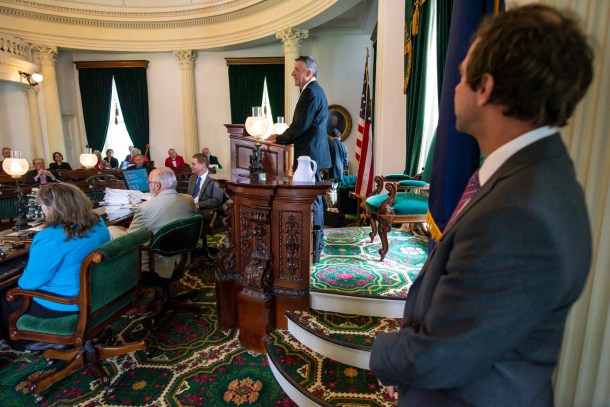
[T]he Senate adjourned quickly and quietly late Wednesday afternoon, ending a legislative session that for all intents and purposes reached its conclusion last week.
House lawmakers left Montpelier on Friday, after passing budget and tax bills, but before Democratic leaders were able to finalize a deal with the Senate on two major party priorities: raising the minimum wage and establishing a paid family leave program.
The Senate had hoped that House lawmakers would return to reach an agreement on the policies before adjournment on Wednesday. But on Tuesday, House Speaker Mitzi Johnson reiterated that legislators in her chamber would not be back until January.
The failed minimum wage and paid leave negotiations cast a shadow over the Senate’s adjournment Wednesday, though leaders of the chamber, along with Gov. Phil Scott, celebrated the other achievement of the session.
“We are sorry that we had to ask you to come back for this, but it felt important enough to us leave that possibility open,” Senate Majority Leader Becca Balint told Democratic senators during a caucus meeting Wednesday afternoon.
A number of senators didn’t make it for the final session, which lasted for about an hour as Scott and Senate President Pro Tem Tim Ashe, D/P-Chittenden, addressed the chamber.
“What we must not do is let the last week define the entire session,” the governor said.
Scott highlighted places where the Legislature and his administration successfully worked on shared priorities like finding a new source of clean water funding and investing in broadband expansion.
Ashe touted legislation the Legislature passed including a bill that would create a 24-hour waiting period for handgun purchases and a measure that could establish a constitutional amendment to protect abortion rights.
Near the end of his speech, Ashe recalled that he had once called himself the “Senate sponge” in his role as the president pro tem. In recent days, he quipped, he has instead been the Senate “punching bag,” an apparent reference to frustration over his negotiating tactics over the minimum wage and paid leave bills.

The Legislature adjourned without scheduling a possible veto session in the coming weeks.
In the event Gov. Phil Scott strikes down any of the bills passed by the Legislature this year, lawmakers would not be able to vote in an attempt to override his veto pen until January.
But Ashe said Wednesday that he has so far received “no signals” from the Scott administration that the governor plans to veto any bills this year.
Scott will likely sign the budget—the only bill lawmakers are required to pass to keep state government functioning, according to his spokesperson, Rebecca Kelley.
Sen. Jane Kitchel, D-Caledonia, who chairs the Senate Appropriations Committee, said she was confident the budget had the support of the governor. “I am very optimistic that it will be signed,” she said.
But the governor has been tight-lipped about proposals that could inspire him to break out his veto pen, which he used at a record-setting clip last year.
Scott has expressed reservations over the 24-hour waiting period, and another piece of legislation that would allow individuals to sue companies for medical costs related to toxic chemical exposure.
But he has yet to announce whether he intends to block the proposals from becoming law.
Senators said Wednesday that legislative work on issues like reducing the state’s prison population, a top priority of Ashe’s, will continue over the summer. As will work to continue to reach an agreement with the House on paid family leave and minimum wage.
“These are not just going to stay parked on the calendar until January,” Balint said of the bills.


