

This post was updated at 6:16 p.m. on July 10 with an interview with Sen. Patrick Leahy.
Vermont’s delegation greeted President Donald Trump’s nomination of Brett Kavanaugh to the Supreme Court with criticism of his record and vows to resist.
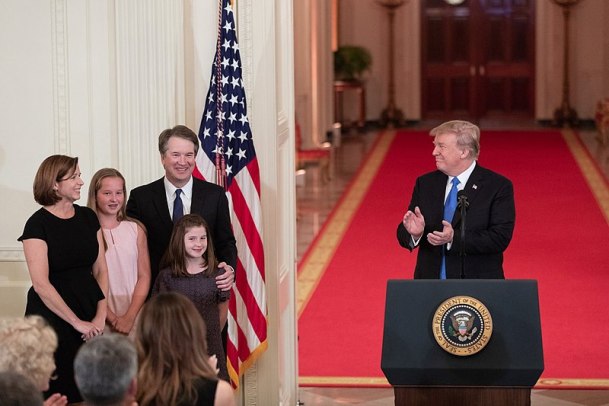
Trump named Kavanaugh as his pick to fill the seat on the court that will be vacated by Justice Anthony Kennedy later this month.
Kavanaugh, a Washington, D.C., native, is currently a judge on the U.S. Court of Appeals for the District of Columbia Circuit, a post he has held since 2006.
Before becoming a judge, he served as an aide in President George W. Bush’s administration. He also worked on the probe of President Bill Clinton led by special counsel Kenneth Starr.
The nomination sets the high court up to swing to the conservative side. Trump’s pick of Kavanaugh further escalated concerns among those who support the landmark abortion case Roe v. Wade that the 1973 decision may be in jeopardy.
In remarks at the White House, Kavanaugh vowed to approach cases individually.
“I will keep an open mind in every case,” he said.
Top congressional Republicans hailed Kavanaugh’s selection. Senate Majority Leader Mitch McConnell, R-Ky., called him a “superb choice.” McConnell has promised a vote on the nomination this fall.
Meanwhile, Democrats, including members of Vermont’s delegation, raised questions about Kavanaugh’s record and his political leanings.
Democrats, who hold 49 seats in the Senate, have few procedural tools at their disposal to block the nomination from proceeding. But members of the minority promised intense scrutiny of the nominee, and called on the public to rally against him.
In an interview Tuesday afternoon, Leahy raised concerns over Kavanaugh’s independence from the White House. He said he hears nominees through before making up his mind, but he has reservations about Kavanaugh.
“I will vote against somebody if I think they are not going to be independent as a judge or as a justice, and in this case all the way through the president’s made it clear he’s taken his name from a list of people who had been vetted to do the things that he wanted,” Leahy said, referring to a list of potential justices drawn up with consultation from conservative think tanks.
Leahy, who will have a chance to question Kavanaugh during a confirmation hearing before the Senate Judiciary Committee, said he wants to review the judge’s writings about presidential power. Kavanaugh indicated in a 2009 law review article that he believes the president should have “temporary deferral” from civil and criminal cases.
Leahy said that position merits further exploration.
“Especially if you have a president who is concerned about criminal charges coming from the Russia investigation,” he said.
It won’t be the first time Leahy questions Kavanaugh. During his confirmation hearing to the appeals court in 2006, Leahy pressed Kavanaugh about his awareness of wiretapping and torture programs during his time in the Bush White House. Leahy said he plans to revisit those issues.
Leahy, who voted against Kavanaugh during that contentious confirmation, raised questions in a statement about “how truthful” he was about his involvement in detention policies during his hearing. Vermont’s other senator at the time, Jim Jeffords, also voted against Kavanaugh.
Leahy stayed mum Tuesday about Democrats’ strategies to oppose Kavanaugh’s nomination, deferring to the ranking member of the Judiciary Committee.
“I’ll let Sen. Feinstein speak to that,” he said.
Leahy said he has concerns about the long-term implications of Kavanaugh on the court.
“I think it would make a totally predictable court,” he said.
In a video on Facebook Monday night, Sen. Bernie Sanders, I-Vt., called for the public to put pressure on Republican senators to encourage them to oppose Kavanaugh.
“We’re in the fight of our lives here,” Sanders said.
Sanders charged in a statement that Kavanaugh “will be a rubber-stamp for an extreme, right-wing agenda pushed by corporations and billionaires.”
Sanders brought up Kavanaugh’s rulings in high-profile cases, including one involving a migrant teen’s right to an abortion and the constitutionality of the Consumer Financial Protection Bureau.
“I do not believe a person with those views should be given a lifetime seat on the Supreme Court,” Sanders said.
Rep. Peter Welch, D-Vt., who as a member of the House will not have an opportunity to vote on Kavanaugh, also critiqued Trump’s consultation with outside groups on his list of candidates for the court.
Welch called for the Senate to reject Kavanaugh.
“If confirmed, Judge Kavanaugh’s elevation will cement a right-wing majority on the Supreme Court for a generation or more,” Welch said. “At risk are long-established civil liberties and hard-won rights and opportunities for women, minorities, LGBTQ Americans, workers, and many others.”

