

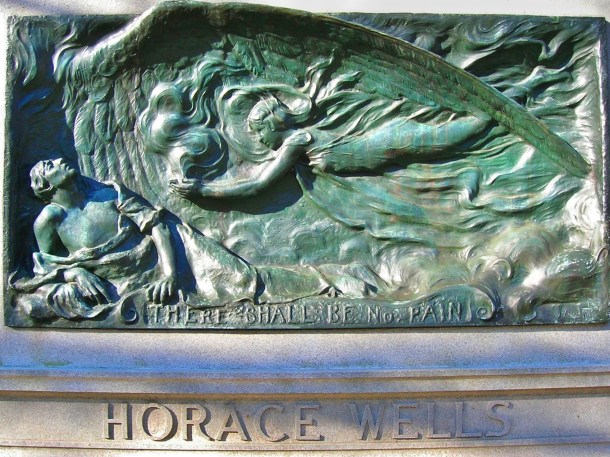
Editor’s note: Mark Bushnell is a Vermont journalist and historian. He is the author of “Hidden History of Vermont” and “It Happened in Vermont.”
[T]he letter was everything Horace Wells could have wished. A friend was writing to report that Wells had gained a valuable ally in his fight to be recognized as the doctor who pioneered the use of anesthesia.
“I have just returned from a meeting of the Paris Medical Society, where they have voted that to Horace Wells … is due all the honor of having first discovered and successfully applied the use of vapors or gases whereby surgical operations could be performed without pain,” wrote Christopher Starr Brewster on Jan. 12, 1848. Brewster, an American dentist in Paris, wrote breathlessly that Wells had won the honor over his chief rival for the claim, his former student William Morton. “[T]o the last day of time,” Brewster wrote, “must suffering humanity bless [your] name.”
Wells never read the letter. Less than two weeks after it was written, and before it could arrive by ship, he had killed himself.
That’s where the story of Horace Wells and anesthesia ends. Its beginning was much more joyous.
Three years earlier, on Dec. 10 1844, Wells, a dentist, had attended a demonstration of the effects of nitrous oxide, also known as laughing gas, whose basic properties had been known for four decades. Gardner Colton, a chemist and showman who hailed from Georgia, Vermont, entertained a large crowd in Hartford, Connecticut, by calling forward volunteers who would ingest the gas and, their inhibitions lost, entertain the audience by cavorting about.
Colton called on several men to join him, including Wells, a fellow Vermonter. On the carriage ride home, Wells’ wife reproved him for his antics. Whatever he did under the effects of the gas has long been forgotten. But the actions of another volunteer, Samuel Cooley, helped make history.
Cooley had run and jumped about the room, barking his shins on some wooden chairs in the process. When he returned to his seat beside Wells, the dentist asked whether his shins hurt. Cooley lifted his pant legs to reveal bloody scraps, but said he hadn’t felt a thing.
After the show, Wells approached Colton, asking, “Why cannot a man have a tooth extracted under the gas and not feel it?” Colton didn’t see why not, but had never before given the subject any thought. Wells asked him to bring a bag of the gas to his office the next day for a trial run. Colton still didn’t grasp the significance of the experiment, and was only cajoled into helping when Wells suggested they both could become wealthy by offering painless dental procedures.
In retrospect, it seems amazing that the huge medical breakthrough that lay just ahead had been left for a man from small-town Vermont to make. Wells had been born in 1815 in the town of Hartford and spent most of his youth in Westminster. The Wellses were well off, by Vermont standards, and valued their children’s schooling highly. Horace’s parents sent him away regularly for the sake of his education. He attended schools in Hopkinton and Walpole, New Hampshire, and Amherst, Massachusetts. As a young man, he moved to Boston to study dentistry, then settled in Hartford, Connecticut, to start his practice.
That practice, he knew, would gain immensely if his experiment with Colton’s gas succeeded. Wells at the time was suffering from a troublesome wisdom tooth, which, given the situation, was fortunate. He would be his own volunteer.

Photo courtesy of the Vermont Historical Society
Colton arrived at the appointed hour and administered the nitrous oxide. Once Wells lost consciousness, his partner, Dr. John Riggs, reached in with a pair of dental pliers and removed the offending tooth. Shortly afterward, Wells regained consciousness and began talking excitedly, “I did not feel it so much as the prick of a pin! A new era in tooth pulling!” He also called it “the greatest discovery ever made!”
Wells’ exhilaration was understandable. In the days before anesthesia, people faced a trip to the dentist or the surgeon with fear and loathing. On operating days at hospitals, patients’ screams filled the hallways and rattled the nerves of family members and the medical staff. People equated medical skill with speed. A saying held that “the quicker the surgeon, the greater the surgeon.”
From that time forward, patients would confront surgery without fear of pain and Wells would be remembered as the one who had liberated them. Or that’s the way it should have been.
But the ambitions of others, and a crucial mistake by Wells, would rob him of much of the credit and, some claimed, his sanity.
Eager to share his discovery, Wells arranged with a Harvard Medical School professor to demonstrate the benefits of nitrous oxide. In January 1845, at Massachusetts General Hospital in Boston, Wells anesthetized a student who needed a tooth pulled. But something went wrong. During the procedure, the young man cried out in pain. His shriek drew whistles from the students who were watching. They shouted that the demonstration had been a “humbug,” a sham, even though upon waking the volunteer said he couldn’t tell when the tooth had been yanked.
The demonstration had been a debacle. It had secured for Wells the wrong kind of fame. He returned to Hartford, his reputation in tatters. But he remained confident in the effects of nitrous oxide. The slipup at Harvard had perhaps been the result of nerves or inexperience. Wells and his partners continued to offer their patients nitrous oxide, which most apparently accepted eagerly.
That summer, the Boston Medical and Surgical Journal mentioned that dentists in Hartford were using nitrous oxide to block patients’ pain – the word “anesthesia” hadn’t been coined yet. Despite the report, the Boston medical establishment dismissed the notion that a pain-free form of surgery had been created – until one of their own demonstrated that it could be done.
Enter William Morton. Morton, who had studied with Wells and discussed nitrous oxide with him, had established a dental practice in Boston. In 1846, he followed Wells’ lead and demonstrated a “painless” tooth extraction at Massachusetts General. Morton used a different substance, ether, distilled ethyl alcohol, to anesthetize his patient. The demonstration went well and the establishment crowned Morton the inventor of painless surgery.
Wells needed to get away from New England. He traveled to Paris, then the site for the world’s medical elite. There he said he would relinquish any right to profits from his discovery, which is the opposite of what Morton was attempting to do. Morton had secured a patent for the use of ether and was seeking federal funding for its use by military doctors.
Upon returning to the United States, Wells moved his practice to New York and continued to experiment with anesthetics. Chloroform was the newest entrant in the field and Wells began inhaling it along with nitrous oxide. Then, on his 33rd birthday, Jan. 21, 1848, he overdosed himself with chloroform and became deranged. Police arrested him for throwing sulfuric acid onto the dresses of two prostitutes.
While in jail, he was permitted to gather some items from home, including his razor. He also smuggled in a bottle of chloroform. Back in his cell, Wells sliced open an artery in his leg, having first dosed himself with chloroform to blot out the pain.
Today, Wells and Morton continue to have their supporters – as does Crawford Long, a surgeon in Georgia who supposedly operated using ether in 1842.
In at least one sense, Wells won his fight with Morton. Nitrous oxide still plays a key role in medicine today. In the operating room, anesthesiologists mix it with oxygen to supplement the main anesthetic, isoflurane. Nitrous oxide has clear advantages over chloroform, which can cause liver trouble and heart arrhythmia, and over Morton’s favorite, ether, whose main downside is its explosiveness. Wells would feel particularly vindicated if he walked into a dentist’s office today, where nitrous oxide continues to make its case to patients that it is “the greatest discovery ever made.”


