

This story was updated at 11:06 p.m. Updates will continue into the night of Aug. 11, 2026.
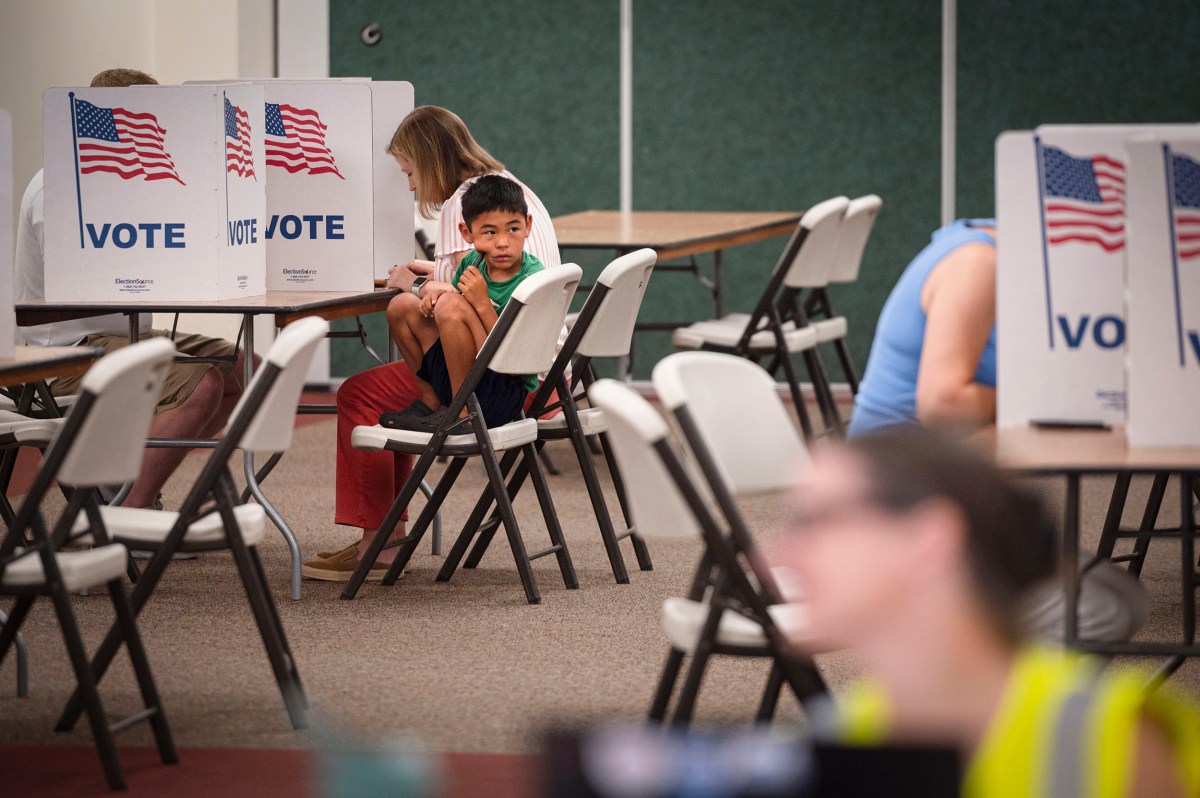
Across Vermont, thousands turned out for primary day, casting ballots in contested races for U.S. House, governor, lieutenant governor and many more county and local positions.
The VTDigger newsroom covered the primary election with reporters, editors and photographers across the state.
Read all of our coverage leading up to primary day.
Democratic governor primary
Amanda Janoo narrowly won Vermont’s Democratic primary for governor Tuesday, according to the Associated Press, after a campaign that called for sweeping progressive policy changes and limiting how much the state relies on federal funding.
Janoo, an economist, has never run for office before and was virtually unknown before announcing her campaign. She beat out Aly Richards, the former head of a prominent child care lobbying and advocacy group who also had the backing of a well-endowed political action committee, with 49% of the vote as of 11 p.m., the AP reported. Richards had 46% at that point.
Janoo framed herself on the campaign trail as the race’s anti-establishment choice. She was openly critical of the power of and influence of large technology companies, calling for a new tax on their digital advertising and new state regulations on large data centers used for artificial intelligence.
She also made the case that the federal government could not be trusted to fully fund key human services programs and proposed finding new revenue at home instead. That includes using a surcharge on personal income over $500,000 to pay for free primary care for every person in the state, her campaign has said.
Read the full story here.
Lieutenant governor
Molly Gray prevailed in a closely-watched Democratic primary for Vermont lieutenant governor Tuesday evening. She will face incumbent Lt. Gov. John Rodgers in November’s general election.
The Associated Press called the race just after 8 p.m., with roughly 24% of votes counted. Gray held 59% of the vote at that time.
Gray, who previously held the position from 2021 to 2023, weathered challenges from Ryan McLaren, a former top aide to U.S. Sen. Peter Welch, D-Vt., and Esther Charlestin, who was the Democratic nominee for governor in 2024.
Read the full story here.
U.S. House
Gerald Malloy won Vermont’s Republican primary for U.S. House on Tuesday, according to the Associated Press, setting up the Weathersfield veteran and defense contractor to challenge Democratic U.S. Rep. Becca Balint in the general election this fall.
Malloy beat out Mark Coester, a logger and sugarmaker from Westminster. As of just before 8 p.m., Malloy had 76% to Coester’s 22%, according to unofficial results from the Vermont Secretary of State’s Office. Vermont has only one seat in the U.S. House.
With his win Tuesday, this fall’s election will be the third in a row in which Malloy has run for a seat in Congress. He was the Republican nominee for one of Vermont’s U.S. Senate seats in 2022 and 2024, losing both contests.
Malloy has said his experience working with the military and other parts of the federal government gives him the know-how to be an effective member of Congress. He argues Balint spends too much time criticizing the Trump administration as opposed to finding ways to work with the president and his allies.
In an interview after the race was called, Malloy said he thought Republican voters recognized that experience when casting ballots on Tuesday and that he was looking forward to debating Balint in the coming months.
“She has not produced results for Vermont from Washington, D.C. She has not supported our Republican governor,” Malloy said. “I have many things that I’m going to do in Washington, D.C. to address affordability for Vermonters — and turn it around so the economy and Vermont as a whole can start to thrive.”
Balint easily won Vermont’s Democratic primary for U.S. House on Tuesday. The Associated Press called the race for Balint, who did not have any opponents on the ballot.
Since President Donald Trump took office a second time, Balint has been among the administration’s most ardent critics in Congress, including for its focus on expanding immigration enforcement and waging a costly war in Iran alongside Israel.
Balint has said that if she’s elected again, she’ll continue to stand against the administration’s priorities and advocate to nullify the 2010 U.S. Supreme Court ruling Citizens United v. Federal Election Commission as well as to bar members of Congress and their families from trading stocks.
In a statement Tuesday night, Balint said she was “focused on the work ahead of the November election.”
“I’m grateful to Vermonters for their continued trust and support,” she added. “It’s an incredible honor to represent our state in Congress, and I never take that responsibility for granted.
— Shaun Robinson
Chittenden County sheriff
Chittenden County Sheriff Dan Gamelin, a Democrat, appeared to fend off a challenge from progressive contender Kevin Bloom in the Democratic primary.
According to unofficial results from the Vermont Secretary of State’s Office, Gamelin had 51% of the vote to Bloom’s 34% as of 10:45 p.m. Seventeen of 18 towns had reported vote totals.
Gamelin spent more than 40 years as a sheriff’s deputy before becoming sheriff in 2022. Bloom runs a music studio, works for an audio software company and does not have a law enforcement background.
— VTD Editor
Windsor County Senate
In the Windsor County Senate Democratic primary, incumbent Sens. Becca White and Joe Major finished first and second respectively in the three-seat race, according to unofficial results from the Vermont Secretary of State. Current Rep. Elizabeth Burrows, D-West Windsor, finished third.
The district drew a crowded Democratic primary field. Former Chester House member Heather Chase, Pomfret Selectboard Chair Ben Brickner and Chris Dube, a Hartford firefighter and labor organizer, ran unsuccessfully for the party’s nomination.
— VTD Editor
