

Political parties are quick to declare victory when the bills they support make it into law. But for Vermont’s Republican minority in the Legislature, it was the laws they succeeded in rolling back this year that seem to have the party celebrating just as much.
In a newsletter to supporters last month, Paul Dame, chair of the Vermont Republican Party, adopted a sweeping tone as he reflected on the 2026 legislative session that had ended just days before.
“If Vermont’s Republicans are not the most effective minority in any legislature in the country, then I’d like to hear who is,” Dame wrote in the email. The GOP accomplished its goals, he went on, “in ways that seemed impossible just two years ago.”
Two years ago, Vermont’s 2023-24 legislative biennium ended with Democrats enacting six bills into law that Republican Gov. Phil Scott had vetoed and that Scott’s GOP allies in the House and Senate broadly opposed. Democrats were able to do so because they had a supermajority of seats in both chambers.
But then, voters elected a wave of additional Republicans to the House and Senate that November — many if not all of them maligning some of those new laws on the campaign trail — and the political dynamic in the Statehouse changed.
In the two years since, Republicans enjoyed more committee leadership roles, which dictate which bills get airtime, and found an easier path to get some of their party’s priorities into law. Dame pointed, for example, to a 2025 law expanding state tax breaks for military retirees, something Scott had backed for years with no success.

Democrats still held a majority of seats in both chambers and so could set the agenda as they liked. They had their own priorities that they pursued, at times over many Republicans’ opposition, such as a new legal avenue for Vermonters to sue federal agents whom they allege have violated their constitutional rights.
But Republican leaders said that one of, if not their biggest, win of the 2025-26 biennium, which started last January and ended this May, was slowing or reversing some of the policies passed in the prior two-year period.
“Most of what Republicans did was apply the brakes,” Dame wrote in another newsletter last month. Even if the party succeeded in some ways, though, “there is still work to do in order to turn the car around and start moving toward prosperity instead of away from it,” he added.
Senate President Pro Tempore Phil Baruth, D/P-Chittenden Central, said the results of the 2024 election made it clear to him that his GOP colleagues would try to change some of what his caucus passed before.
“And that’s part of the democratic process,” he said in an interview. “The voters are the ones who decide. And so, given the change in the chamber, I think they accomplished some of their goals.”
Baruth agreed Republicans had a stronger voice in the Statehouse the past two years, but said he didn’t think that meant the legislative process was more confrontational.
“By and large it was not, every day, a struggle with an emboldened minority,” he said. “We worked very smoothly together — on what amounted to the Democrats’ agenda.”
The policies Republicans repealed was a focus for Gov. Scott at a press conference the week after the Legislature adjourned.
“We’ve now spent an entire session undoing harmful policies passed by the previous supermajority rather than making meaningful progress,” he said in early June.
‘The highlights of the session’
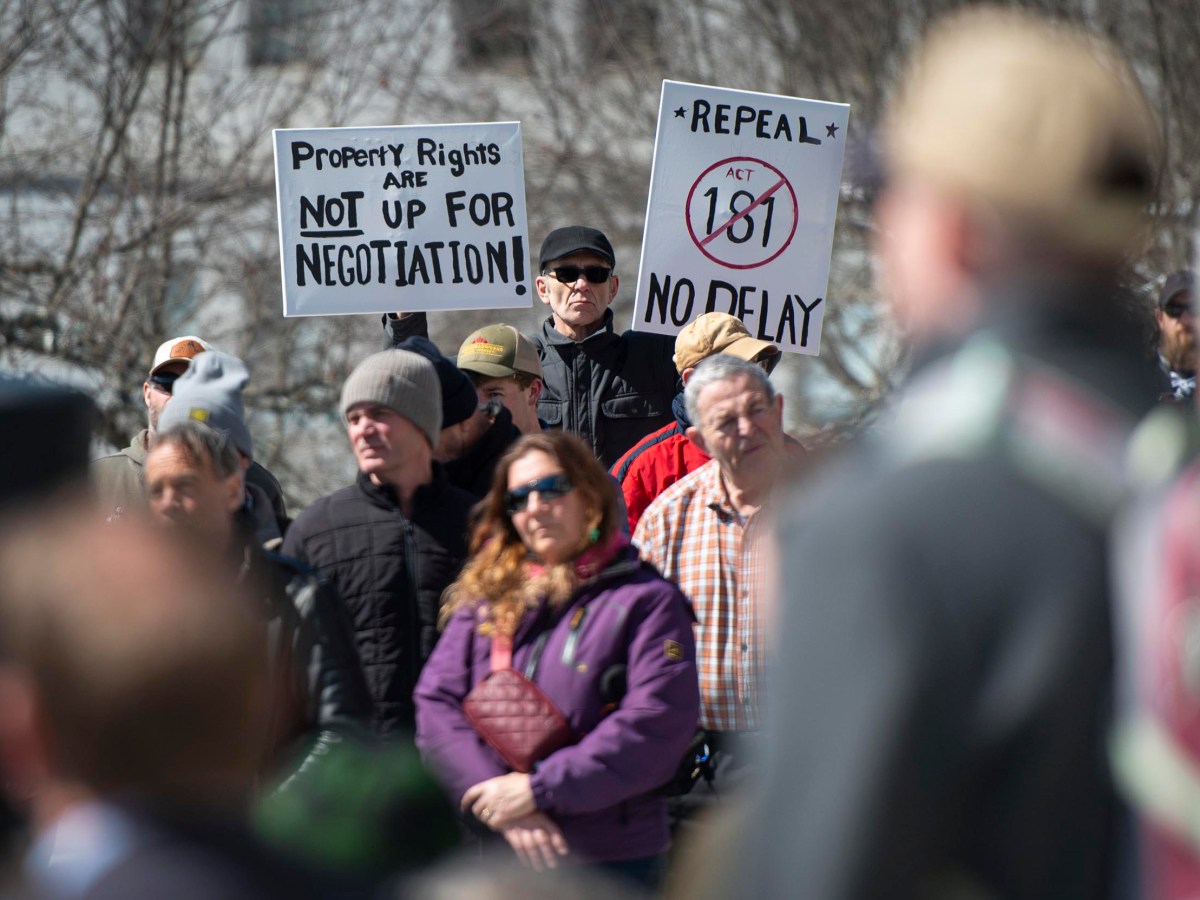
The most significant reversal Republicans say they won this year was to a slate of conservation measures included in a 2024 land use law, Act 181. That was one of the laws Democrats passed over Scott’s veto and opposition from the GOP.
Parts of the law aimed to loosen state reviews for new housing in already-developed areas. But at the same time — in response to climate change and habitat loss — the law added environmental protections for building projects in sensitive areas.
As state officials rolled out draft maps of these areas, ire from rural landowners, local officials and housing proponents bubbled up. Their opposition, which was echoed by Republican Lt. Gov. John Rodgers and GOP members of the House and Senate, also drew a large protest on the Statehouse steps in March.
After the Senate passed a bill delaying the implementation of some of those provisions, Democratic House leadership went a step further, and in an unexpected about-face approved a rollback of those measures entirely. That’s what lawmakers ultimately passed in May and Scott then signed into law.
Dame also pointed, in an interview, to how the 2025-26 biennium marked the end for the Clean Heat Standard, a 2023 law that Democrats also enacted over Scott’s red pen aimed at reducing the carbon emissions that come from heating and cooling buildings.
Democrats came into the 2025 session understanding the policy was dead. The state’s Public Utilities Commission had recommended against moving it forward over concerns about its cost to consumers and the fact Vermont had little to model the initiative on.
Many Republicans, who cited concerns over costs of the policy on the campaign trail in 2024, pushed for a formal repeal over the past two years, which would have been largely symbolic but that they argued would show a spirit of compromise. Language repealing the policy passed the Senate, but the House did not take it up before adjournment.
“Things like the Clean Heat Standard would have made things more expensive for Vermonters,” Senate Minority Leader Scott Beck, R-Caledonia, said in an interview. “So the ability to knock back those types of increases, and actually move the other direction a little bit — and then also to get (parts of Act 181) repealed — were probably the highlights of the session for Republicans.”
Republicans also flexed their legislative numbers in at least one other key instance this year. That was over a bill that sought to largely bar federal law enforcement officers, including U.S. Immigration and Customs Enforcement agents, from wearing masks.
When House Democratic leaders tried to bring a final version of the bill up for a vote on the final day of the session in May, House Republicans used a procedural move to block its consideration, killing the legislation. The move drew ire from Democrats, though not all of them supported the bill due to concerns a judge would find it unconstitutional.
Scott’s veto pen
At the same time, because Democrats could no longer override Scott’s vetoes on their own over the past two years, the likelihood of a bill getting rejected was at times enough for lawmakers not to advance it. A veto threat, for instance, was the reason at least some legislative leaders gave for why they did not pursue any policies that would help the state get on track to meet its carbon emissions reduction goals this year.
Scott leveraged that power throughout this year’s session. He spent months threatening to veto the state budget and key property tax rate-setting legislation if lawmakers did not advance a version of this year’s marquee legislation — an education reform plan — that he liked. Democratic lawmakers for a time contemplated whether the state government might shut down as a result, but they reached an education deal with time to spare.
The veto threat loomed over lawmakers’ decision to use more state revenue this year to again reduce property tax increases — a move backed by Scott. Lawmakers put $101 million in the coming fiscal year’s budget to “buy down” the average education property tax rate increase statewide.
Beck said Republicans’ increased numbers in the House and Senate could be directly tied to lower average increases in property tax bills. He contrasted the tax-rate setting legislation that Democrats enacted over Scott’s veto in 2024, which resulted in a 13.8% average increase in bills, to the versions of the annual bill enacted in 2025 and 2026, which set out an average increase of 1.1% and 3.5%, respectively. (Actual tax rate increases — or even decreases — have and will vary widely by town.)
“I think those are huge, huge wins,” he said Thursday.
To be sure, some Democrats, particularly in the Senate, voiced support for buying down property tax rates to the greatest extent possible from the beginning of this year’s legislative session.
“I told people on election night that I heard the message — and I do believe the message was primarily around the burden of the property tax,” Baruth said, referring to 2024.
The governor ultimately vetoed fewer bills over the 2025-26 biennium than he did in 2023 and 2024. In the more recent period, he rejected 13 bills, though one was over a technical error in how the bill was drafted and not a policy disagreement. Over the two years before that, he rejected 17. In 2023, that included the state budget bill, which lawmakers overrode.
Democrats came close to succeeding on one veto override attempt this year, over a bill that proposed a new regulatory framework for large data centers. Scott said he rejected the bill, which passed both chambers with overwhelming bipartisan support, because he thought the state’s existing land use regulations would be sufficient.
The House came just seven votes short of the threshold needed to overturn Scott’s veto. Senators did not attempt an override vote. Beck — who voted for the bill — said in a post-session newsletter to his constituents that he understood the governor’s decision, and that he was OK letting the legislation fall by the wayside.
The bill could well be an issue on the campaign trail this year. The Vermont Democratic Party slammed Scott’s decision in a social media post in early June, saying that the governor “sided with big tech and corporations over Vermonters.”
Baruth, who is not running for reelection, echoed that criticism.
“I think the Legislature should go hard on that next session,” he said.
