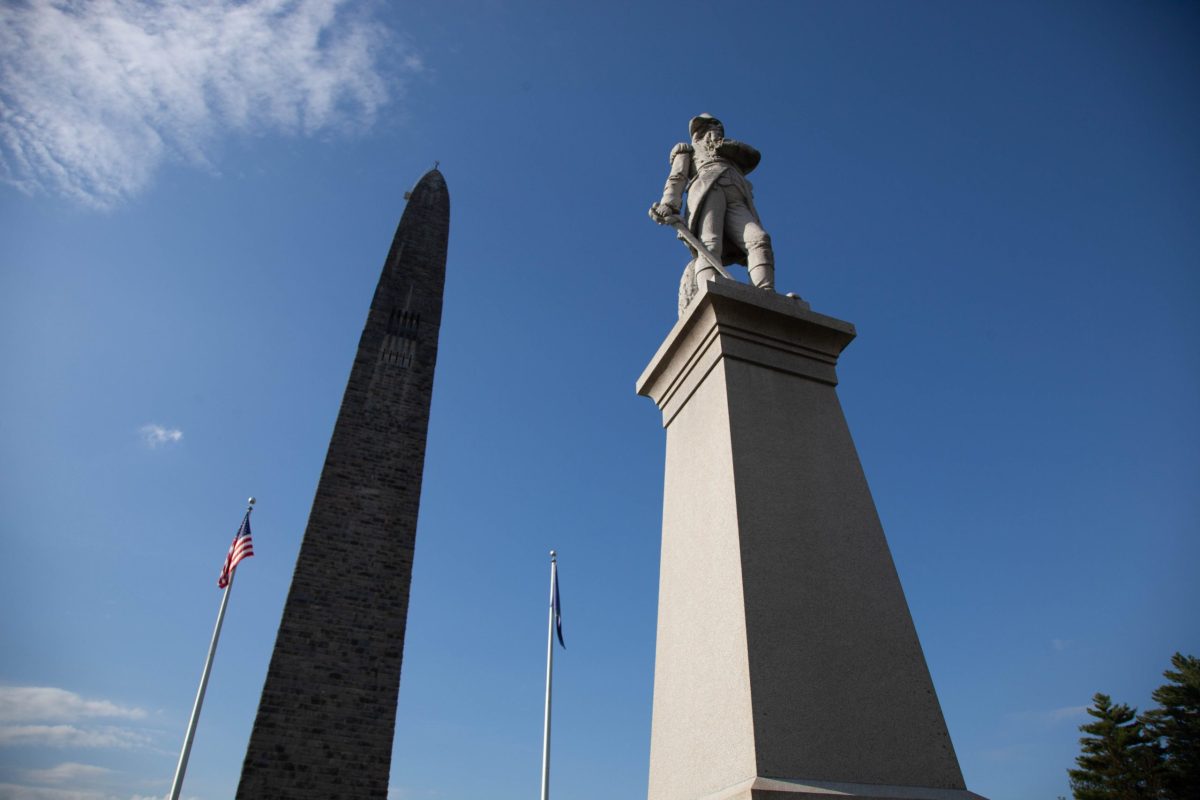
Last year, state officials went to the Legislature with a problem: The 306-foot Bennington Battle Monument — an obelisk commemorating the 1777 Battle of Bennington — was saturated with 66,000 gallons of water. At the time, the cost to restore the monument was estimated at $40 million.
The high price fueled debate over whether to restore the monument or deal with the challenges of the waterlogged, more than a century old structure another way. Vermont art collector and proprietor of the Vermont Country Store Lyman Orton proposed disassembling the mostly limestone monument and projecting a hologram instead. Rep. Shawn Sweeney, D-Shelburne, pitched coating the structure in copper to protect it from further water damage.
A year later, the question of what to do with the second-tallest unreinforced masonry structure in the country — after the Washington Monument — remains. The state is picking up the thread, hosting public meetings on April 29 and May 12 to inform people on the current condition of the structure. Vermonters can also offer feedback on what they want for the monument’s future.

After that public process, the state plans to host a meeting Oct. 6 to lay out next steps.
The monument is typically the most visited state-owned historic site and provides an economic benefit to the state and Bennington region, but visits dropped last year because the elevator is not functional, State Historic Preservation Officer Laura Trieschmann said.
While the state is considering all alternatives, Trieschmann said in an interview that the goal remains complete restoration, though what comes next depends on donations and funding. The Bennington Selectboard adopted a resolution last summer to support full restoration of the monument.
The initial design and construction needed to dry out the monument will require $15 million, but the potential costs of the mechanical systems for that work and of addressing the cracking need to be studied further, Trieschmann said.
“We need to do it right, and we need to have a maintenance plan that comes out of this,” Trieschmann said. “It’s a big undertaking. It’s going to take many years and a lot of dollars. I want to open it up to the people of Vermont, and also keep in mind what our capacity is.”
Correction: A previous version of this article incorrectly stated the age of the Bennington Battle Monument.