


When Bill Mares was headed off to college, his father shared a piece of advice: “Do whatever you want as an individual, but be a professional, an expert, in one thing.”
Mares went on to do the opposite, taking on “a number of things modestly well, but nothing really grand,” he wrote in a forthcoming memoir. He was a Marine, newspaper reporter, photojournalist, state legislator, high school teacher, traveler, singer, marathoner, humorist, board member, beekeeper, brewer and even a bagpiper. He chronicled many of those passions and pursuits in the 20 books he wrote or cowrote over the course of a remarkably eclectic career.
“I just kept collecting friends, experiences, and books,” he wrote in the memoir, mischievously titled, “Better to Be Lucky than Smart.”
Mares died Monday at his home in Burlington. He was 83 years old. He is survived by his wife of 53 years, Chris Hadsel; their two sons, Timothy and Nicholas; and three grandchildren.
Though he experienced heart problems and, more recently, had been treated for lymphoma, Mares was proud to have left this world on his own terms. As his health faded and he entered hospice, according to friends and family, he decided to make use of Vermont’s medical aid-in-dying law. And in his final days, he became an evangelist for it, contacting reporters to discuss the experience of dying.
In an interview with VTDigger’s David Goodman a week before his death, Mares said he was “in better shape than most” and grateful to “have the chance to drive the bus of my own disappearance.”
“I’ve enjoyed life and I’m ready to go, and I’m just happy to go without any pain,” he told Goodman. “And if any of these experiences help other people, it’s joyful for me.”
Mares’ late-life desire to discuss his own death was a remarkable shift for a man who “didn’t like to talk about his infirmities,” according to Don Hooper, a longtime friend and collaborator. When Mares had faced previous health setbacks, Hooper said, he would tell those around him, “Don’t worry about me and for God’s sake don’t call.”
Until recently, Mares concealed his declining health from even his closest friends. A longtime board member of the Vermont Journalism Trust, the nonprofit that operates VTDigger, Mares showed up to a farewell party for a departing editor a month before his death. He held court, as usual, chatting up reporters, sharing story ideas and betraying not a whiff of the challenges he faced.
But as his lymphoma treatment began to degrade his quality of life and affect his personality, according to Hooper, he made a decision.
“He said, ‘This isn’t working and I’ve had a great life. Why prolong it with this kind of fragile persistence about hanging on?’” said Hooper, also a former board member of the Vermont Journalism Trust. “And he was joyous about that. He felt like he had a little bit of purpose in his exit.”
Asked by Goodman what advice he might share with a young person about how to live a meaningful life, Mares was quick to answer: “Start by serving other people.”
“I think we’re all put here as individuals, and I think that we’re all put here to serve others,” Mares said. “It doesn’t mean you have to serve others at the exclusion of yourself, but you always have to remember, there’s you and the rest of the planet. It’s not just you there to serve you.”
‘To live two lives’
William J. Mares was born Nov. 8, 1940, in St. Louis, but he spent most of his childhood in Texas. There, his parents instilled in him an early love of books. He learned to hunt and fish, played a variety of sports, and once convinced his parents to buy him a 10-year-old blue roan, which he rode nearly every day — until the horse’s “independent streak” and tendency to run away led to her rehousing, Mares wrote in his memoir.
His mother, Delia, was a teacher and activist, speaking out against isolationism at the outset of World War II and later penning a book about the threat of communism. His father, Joe, was a chemist and patent attorney who became an executive at the Monsanto Chemical Company. (Mares recounts in his memoir how Joe narrowly escaped the deadliest industrial accident in U.S. history, when an explosion at the port of Texas City killed close to 600 people, including 145 of Joe’s colleagues at the Monsanto plant he managed.)
Mares grew up in privilege. “He knows he was born on second base and he doesn’t squander his lead-off double,” Hooper wrote in a forward to the memoir. As a teen, Mares’ parents took him and his older brothers, Jan and Tom, on a summer-long journey through Europe, crammed into their 1953 Ford station wagon.
“That trip was life-changing for me,” Mares wrote. “Even after fifty years, my skin tingles with its stiletto images.” It was in keeping with a favorite expression of his father’s — “Only two things to spend money on: travel and books” — and launched a lifetime of roaming the Earth.
He also experienced tragedy at a young age. When Mares was 16, Tom drowned while working as a lifeguard at a local pool.
“Who was I now, one son or two?” Mares wrote. “Part of me felt obliged to make up for that loss to my parents, to live two lives.”
He did so for a time by pursuing careers that were never quite the right fit. After graduating from Harvard, he sought to join the State Department but was twice rejected. He worked briefly at a bank and attended law school but dropped out. “The law was a good profession … for someone else!” he wrote. The only place he seemed to fit in was the U.S. Marine Corps, which he joined in 1962.
Mares eventually heeded the advice of a high school track coach, who told him to stop trying to please his parents and instead to be “the captain of your destiny.” So he did something radical: He became a journalist.
As a rookie reporter at the City News Bureau in Chicago, Mares covered fires, murders and riots — and again fell in love with the written word.
“By this time, I saw that words were not museum pieces to be put on a shelf and worshiped, mute things to be strung together randomly,” he wrote. “They had real utility. They were claws, brushes, nets, chains, and other tools for capturing the reality before me. More than anything, they were mine, even as I turned them over to rewrite editors to transform into real prose.”
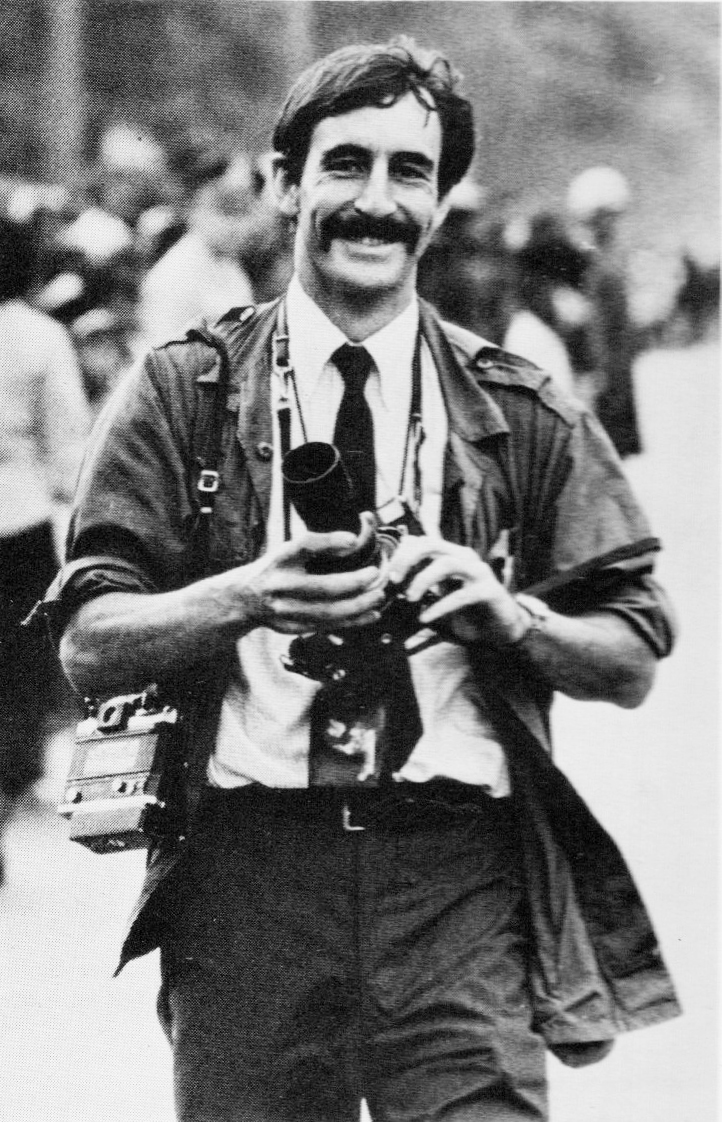
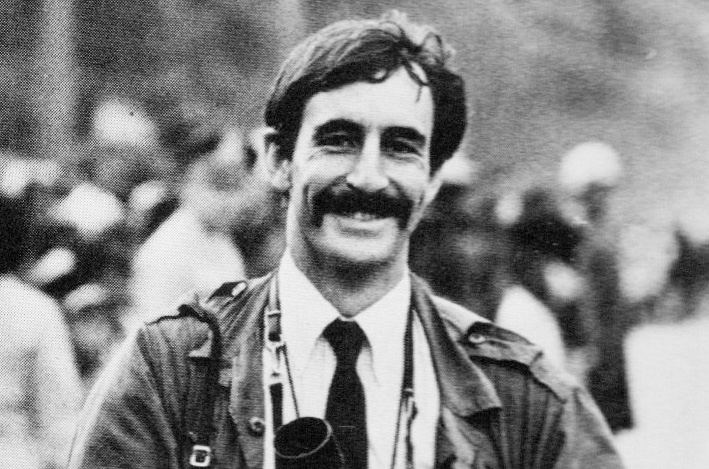
But even reporting didn’t hold Mares’ attention, so he tried his hand at photojournalism, documenting Richard Nixon’s 1968 presidential campaign, the trial of the Chicago Seven and the Rolling Stones.
On one assignment, he snapped a photo of one of the “attractive college graduates hired to decorate the lobby” at the opening of a Chicago bank. He rushed to print the photo and return to the bank to present it to the young woman, then offered her a ride home. That marked the beginning of “50 years of joyful companionship” with Hadsel, whom he called “the other bookend of my life,” along with his parents.
Mares’ greatest adventure came in 1971, when a chance encounter with a former professor, William Polk, led to a 1,200-mile odyssey through the deserts of Saudi Arabia by camel. Polk hoped to publish a modern translation of the pre-Islamic poem, “The Golden Ode,” and illustrate each of its 72 verses with a photo from the desert. He needed a photographer, and Mares was game.
In Riyadh, Saudi officials tried to talk them out of the expedition — suggesting they take trucks instead — and it soon became clear why: Their guides hadn’t ridden camels in years and did not know their way across the desert. After a harrowing journey, which included a serious brush with dehydration, they finally crossed the Jordanian border and reached Amman.
“Little did we realize that in less than three years, the empty, ominous Nafud would begin to be crisscrossed by some roads, more settlements, the hum of oil-seeking crews,” Mares wrote. “There would be fewer camels there than wild mustangs in the American West, and no traveler would be dependent upon finding obscure water wells for survival.”
‘Don’t be afraid to fail’
Mares and Hadsel moved to Vermont later that year and were married on a hilltop above the farm they purchased in St. Johnsbury. It was in the Northeast Kingdom that Mares became enamored with two hobbies that would captivate him for the rest of his life: beekeeping and brewing.
By then, Mares’ career as an author was taking off. In addition to the books he published with Polk about their Arabian adventure, he produced a collection of photos of Marine recruits at Parris Island. He and Hadsel traveled to West Virginia to photograph coal miners for a book that never materialized. He also worked at times for newspapers in New Hampshire and Michigan.
The pair finally settled down in Vermont’s Queen City, where Mares became a writer and then an editor for the Burlington Free Press. His boss at the time was Jim Welch, who would later serve as a senior editor at VTDigger and as interim executive director of the Vermont Journalism Trust.
“He was a perceptive reporter whose elegant writing took what was then the state’s dominant news outlet up a notch,” Welch said of Mares’ work at the Free Press. “He really brought a level of professionalism I don’t think they’d seen.” (The two became close friends, traveling together and yucking it up over beers for another half-century.)
Living in Burlington, Mares found a new muse, Vermont, and a new genre, humor. With Frank Bryan, a rabble-rousing political science professor at the University of Vermont, he cowrote “Real Vermonters Don’t Milk Goats,” which he later described as “essentially a one-joke book about the differences between the real article and the new arrivals.” It became a surprise best-seller, and he rode his newfound local fame to yet another career: politics.
Mares joined the Vermont House in 1985, representing a Burlington district once held by the incoming governor, Madeleine Kunin. Hooper, a fellow Democrat, had been elected to the House the same year, and the Free Press noted that one incoming member, Mares, had written a book mocking those who milked goats, while another, Hooper, actually milked them.
“So we had an immediate rivalry,” Hooper recalled.
Mares approached his work in the Statehouse much like an anthropologist, marveling at the manner in which legislation concerning hunting and fishing struck “some primordial chord in certain legislators and almost never failed(ed) to arouse even the drowsiest members to fiery parry and thrust.” At times, though, he struggled with indecision, voting to raise the drinking age from 18 to 21 one day, and then reversing course a day later.

Mares was particularly proud to have introduced a bill allowing breweries to sell their wares on their own premises, reversing a Prohibition-era restriction. In addition to his own homebrewing experiments, he had published a book years earlier on the generation of microbrewing entrepreneurs then finding success across the country. Mares’ bill became law, and he cut the ribbon when the Vermont Pub and Brewery opened in 1988, becoming Burlington’s first brewery in nearly a century.
After three terms in the House, Mares called it quits. He didn’t love legislating and thought he wasn’t very good at it. “I felt that I was probably too thin-skinned for part of this work,” he wrote. But he gathered enough material for yet another book of Vermont humor, “Out of Order: The Unofficial Statehouse Archives,” which he asked his goat-milking pal, Hooper, to illustrate.
By then, Mares and Hadsel had two young boys, Timothy and Nicholas, and he decided to follow in his mother’s footsteps — going back to school to become a teacher. He eventually landed at Champlain Valley Union High School, where he taught social studies for close to a decade and a half. He organized mock trials of historical events and invited friends from earlier lives — former CIA operatives, ambassadors, newspaper editors, Peace Corps volunteers — to speak to his students.
After retiring, he was invited to deliver a commencement address at the Hinesburg school. His message to the graduates? “Don’t be afraid to fail.”
‘Harmonized into a chord’
“Retirement” is probably not the word to describe the final chapter of Mares’ life.
“For me, the boundary between work and nonwork has been more porous than for many,” he wrote in his memoir.
Indeed, Mares immersed himself even more into beekeeping, brewing, fishing, singing, running marathons — and wrote books on each of these topics. He wrote and recorded roughly 100 commentaries for what was then known as Vermont Public Radio. He served on the boards of more than half a dozen nonprofits and contributed generously to each of them.
Mares even managed to cofound a blendery, specializing in sour Belgian beers, called the House of Fermentology, with Todd Haire, who had served as head brewer at Magic Hat and Switchback. It was eventually folded into Foam Brewers, of which Haire was a co-owner, and where Mares could often be spotted hoisting a pint.
“Bill had more interests and professions than anyone I’ve ever known,” said Welch, the former newspaper editor.
“There was nothing Bill Mares did not find interesting,” said Joe Hagan, a retired pediatrician and close friend of Mares’. “Bill did a lot of things and he did them well. They were always about service in some way.”
According to Hagan’s wife, Joyce, a retired clinical social worker, “He always had such an active mind and an active curiosity. He just took it all over the place.”
Mares described his professional and extracurricular wanderings a touch more poetically. “My life was not a single note, in vocation or avocation,” he wrote. “I was happy to play as many notes as I could, as long as they harmonized into a chord.”
After writing 19 other books, Mares turned to a final genre as the onset of Covid-19 kept him locked down: memoir. He was again bitten by “the book bug,” as he put it, and started compiling his personal history from the diaries he’d kept since that fateful trip to Europe some seven decades earlier.
The timing of the book’s completion was fortuitous. Advance copies arrived at his house a day or two after he called hospice, according to Hadsel.
“He said, ‘Man, this is the last piece of great good luck,’” she said. “It was a source of great pleasure to get that done and to see it.”
“Better to Be Lucky than Smart” is set to be released later this month.
According to Hagan, “He said, you know, the fact that I’m dying — it might really help the sales!”
At the conclusion of the book, Mares wrote that he had considered ending with St. Timothy: “I have fought the good fight; I have finished the race; I have kept the faith.” Instead, he quoted from a note that Keith Wallace, a fellow legislator and retired dairy farmer, had sent him decades earlier when Mares completed his first speech on the House floor.
“You have fulfilled the three requirements of good public speaking,” Wallace wrote. “Stand up and be recognized; speak up and be heard; sit down and be appreciated.”
