


A sewer pipe that crosses beneath the Winooski River broke on Wednesday morning and is dumping about 10% of Burlington’s wastewater flow into the flooded river, which will ultimately reach Lake Champlain, according to city officials.
Burlington Public Works Director Chapin Spencer said in an interview that crews have been unable to repair the broken pipe due to dangerously high water levels.
“The pipe itself — the sewer main — is underneath the Winooski River. Flows are exceptionally high,” Spencer said. “It is not safe to have a diver in the river at this time.” He said he could not predict when the repair may be made.
The break was discovered at about 6 a.m. Wednesday by water resources staff at the Burlington Department of Public Works, according to a department press release. Staff members noticed that wastewater flows coming into the North Plant had plummeted, which indicated that untreated wastewater was flowing into the river rather than into the treatment plant.
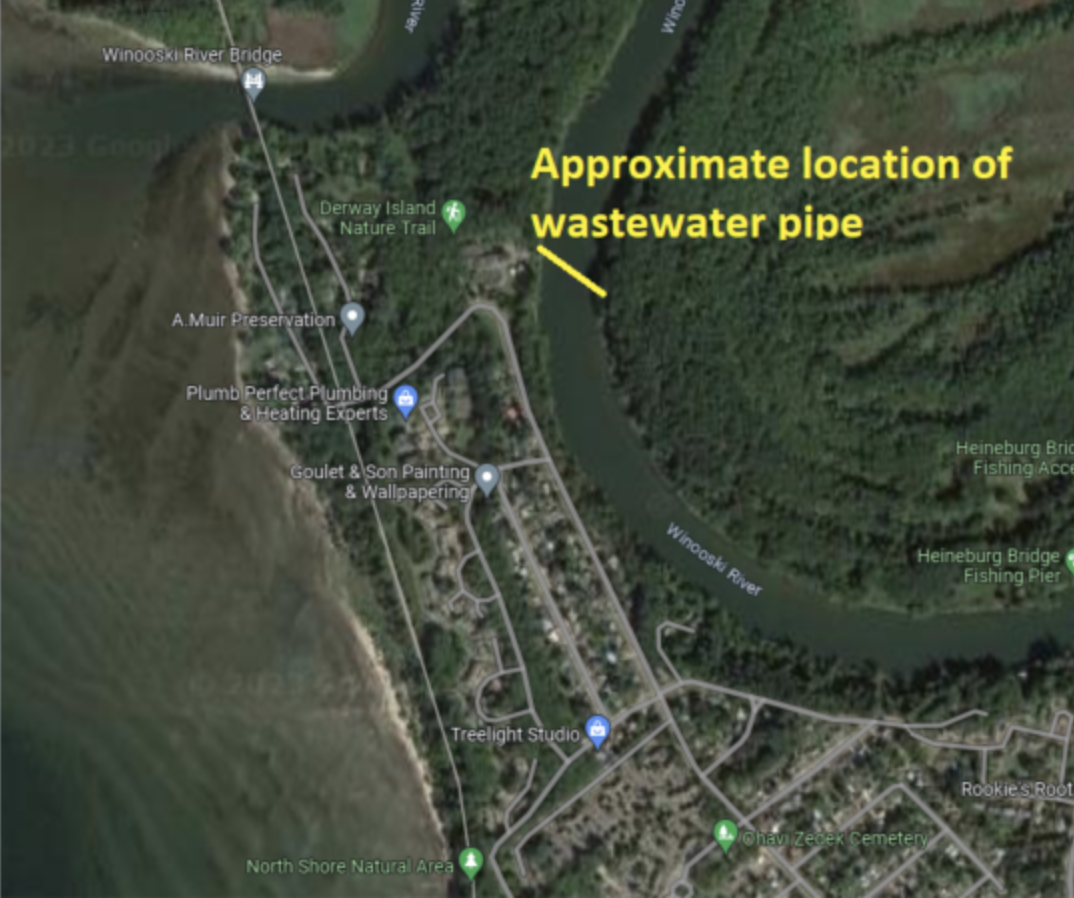
Public works officials said that by 8:45 a.m., crews had notified state officials about the problem and mobilized to block off the sewer crossing pipe to ensure that as much wastewater as possible could reach the treatment facility.
While officials say some of the leaking wastewater has been diverted back to the facility, they estimate that 10% of the city’s wastewater — or half of all wastewater produced in Burlington’s New North End — is still entering the river.
Public works officials said they are calculating how many gallons of wastewater have entered the river and declined to provide initial estimates.
“This break is very likely a result of the intense and powerful storm flows currently affecting the Winooski River,” the press release stated. “We are actively responding to limit the impacts to area waters, investigating what happened, and working to prevent it from re-occurring in the future.”
Spencer said that a similar sewage spill occurred in 2006, when one of the plant’s river crossings failed and was repaired with a “directional bore.” As a precaution since that incident, Spencer said the public works department conducts biannual inspections of pipes to guard against erosion.
“We had just had our most recent inspection last month, in June, and the report indicated that there were no major issues with the pipe,” Spencer said.
Burlington public works officials say a large portion of the untreated wastewater that is spilling will end up in Lake Champlain — although the concentration of wastewater will be dissipated by the volume of water and the flow of the river.
“No swimming” signs have been posted at beaches within a mile of the mouth of the Winooski River due to the sewage spill.
“We do anticipate that (the sewage spill) will have an effect on the lake,” said Tom DeBell, environmental health engineer at the Vermont Department of Health. “Whenever we hear about these sorts of releases, it really is a good idea to avoid being in the water.”
Wastewater and other pollutants in floodwater can have disastrous effects on local ecosystems, introducing toxic bacteria and supporting increased growth of cyanobacteria, according to officials at the Lake Champlain Basin Program.
