

Lawmakers have agreed to legislation that would set property tax rates for the next fiscal year.
If signed by the governor, the “yield bill” — annual financial legislation that dictates property taxes — would push tax rates slightly down.
The non-homestead tax rate, which generally applies to businesses and second-home owners, would dip from $1.466 per $100 of assessed value to $1.391 per $100 of assessed value.
Average homestead property tax rates, which are linked to local school spending, would drop from $1.386 per $100 of assessed value to $1.311 per $100 of assessed value. At that rate, a $300,000 house would generate a $3,933 property tax bill.
Most Vermont homestead taxpayers pay their property taxes based on their income. Under the yield bill, that rate would stay steady at 2.32%.
The decreases in tax rates are not expected to translate into lower taxes. Because of Vermont’s rising property values, upcoming average property tax bills are actually expected to increase by 4.06 percent from the current year, according to the Legislative Joint Fiscal Office.
Lawmakers reached a final agreement on the yield bill, H.492 on Thursday, and the legislation is currently awaiting a signature from Gov. Phil Scott. Jason Maulucci, a spokesperson for Scott, said the governor has “not expressed major concerns” with the bill.
Its tax rates hew closely to those projected in the Vermont Department of Taxes’ annual “December 1 Letter,” a document that sets out a financial outlook for the state’s education fund for the rest of the year.
The education fund, which pays for Vermont’s local school budgets and other education-related expenses, is filled mostly through property taxes, as well as taxes on sales, rooms and meals.
In December, Tax Commissioner Craig Bolio said he expected an “extraordinary” $63 million surplus for the fund for the fiscal year.
In fact, those projections were a lowball: After those initial estimates, state officials revised their projections up. The fund, it turned out, is boasting a whopping $103 million surplus for the fiscal year, due to better-than-expected revenue from meals, rooms, and sales taxes.
Lawmakers used most of that surplus to buy down tax rates for the upcoming year.
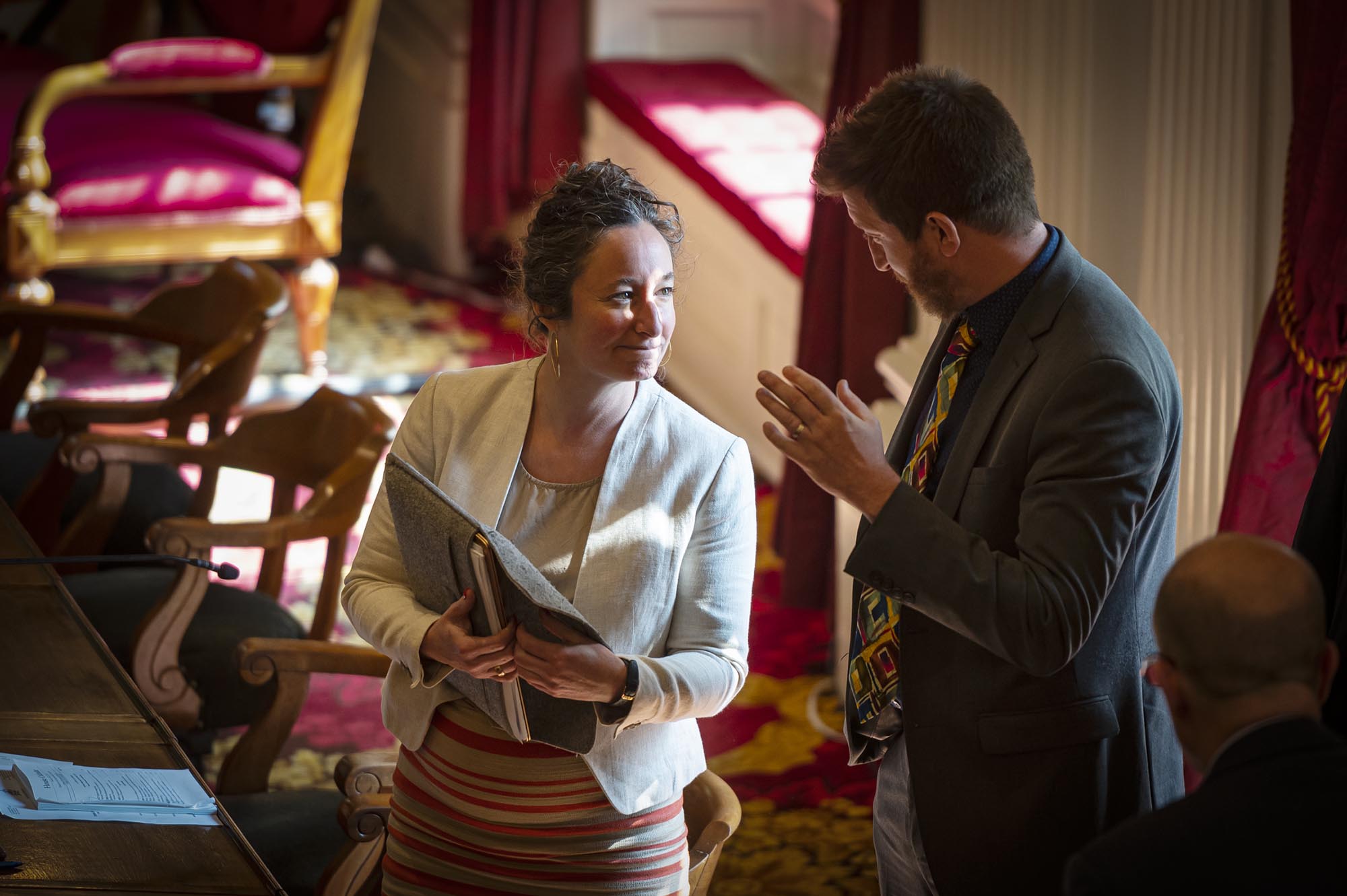
“We were really aware that schools are still experiencing the aftermath of the pandemic, and their federal money has been mostly spent at this point,” said Rep. Emilie Kornheiser, D-Brattleboro, the chair of the House Ways and Means Committee.
“We saw a fairly higher-than-normal rate of growth in school budgets statewide, for good reason,” she added. “Kids have a higher-than-average amount of needs right now. And so we were able to use, you know, some pretty unusual increases in revenues and sales tax and a few other consumption taxes in order to ensure that property taxes didn’t rise at the same level of spending.”
But legislators have also sliced some pieces off the surplus for other priorities.
The Legislature’s universal school meals bill also pulls $29 million from the fund to pay for free breakfast and lunch for Vermont students for the upcoming year.
The yield bill would place another $13 million in reserve for fiscal year 2025, when the state is scheduled to begin a dramatic overhaul of how it funds education. That would provide a cushion for “unanticipated happenings” around those reforms, as well as “the fact that the economy is doing a lot of unexpected things right now,” Kornheiser said.
Another approximately $12.1 million would go toward cost-of-living adjustments for retired Vermont teachers, as dictated by the state’s budget. Of that sum, $9.1 million would be held in reserve for the future, while $3 million would be sent out as a one-time payment.
Jake Feldman, a senior fiscal analyst with the Vermont Tax Department, said the bill was “pretty quiet” this year.
He pointed approvingly to the fact that the tax rates set forth in the bill were similar to those projected by the department in December.
“That’s really helpful for school districts to plan,” he said. “It’s a complicated system, and to try to have something that’s transparent and stable is a good thing.”
Clarification: This article has been updated to clarify the cost-of-living adjustments for Vermont teachers.
