


Vermont Law and Graduate School announced this week that it plans to make one of its scholarships more widely accessible to Indigenous students in Vermont.
“As a concrete first step in strengthening our relationship, we are pleased to announce that an annual scholarship supporting an Indigenous Vermont student’s pursuit of a legal degree will now be available immediately,” Rod Smolla, president of Vermont Law and Graduate School, said in a press release.
In the past, the law school’s First Nations Scholarship was available only to students who belong to federally recognized tribes. It will now apply to students from state-recognized tribes as well, expanding access to students from the Elnu Abenaki tribe, the Nulhegan band of the Coosuk Abenaki Nation, the Koasek Abenaki of the Koas and the Missisquoi St. Francis-Sokoki band, none of which have been federally recognized.
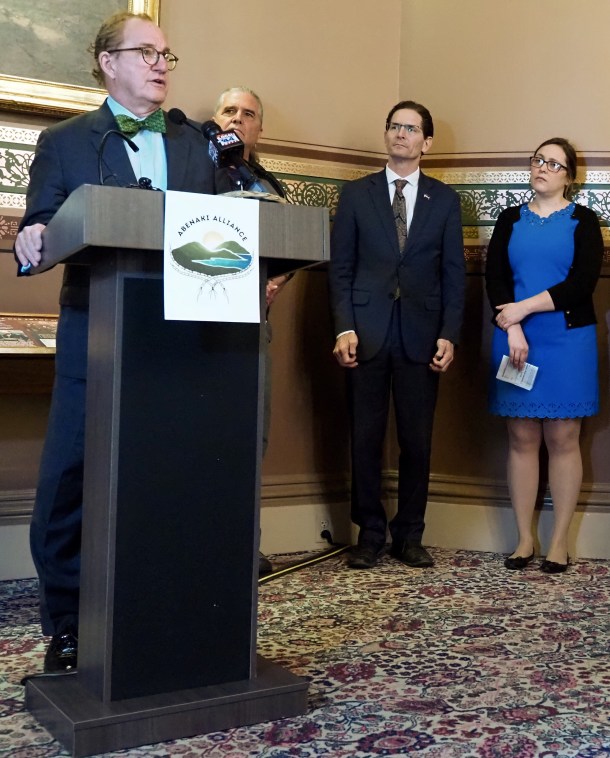
“One of the reasons we expanded the scope of (the scholarship) was to make sure we’re also including students in Vermont (and) including members of the Abenaki communities,” said Lisa Lance, vice president of communications at Vermont Law and Graduate School.
The scholarship covers full or partial tuition for one or more Indigenous students per year pursuing programs such as the law school’s Juris Doctor legal degrees or master’s degrees offered by the School for the Environment and Center for Justice Reform, according to the college’s website.
“Supporting students from state and federally recognized tribes is an important step towards achieving equity in education and beyond,” the college’s Native American Law Students Association wrote in a statement to VTDigger. “Providing financial resources is vital, and we hope the school will continue to foster and develop an environment where Indigenous students feel belonging and inclusion.”
Smolla announced the expanded scholarship at a Statehouse press conference on Tuesday, where members of Abenaki Alliance, a consortium of Indigenous advocates, were recognized in honor of what Gov. Phil Scott recently proclaimed “Abenaki Recognition and Heritage Week.”
According to the governor’s proclamation, the seven-day period from May 1 to 7 has been set aside to honor the culture and traditions of the Indigenous tribes who, for nearly 13,000 years, have stewarded the land that became known as Vermont after it was colonized by European settlers just over 400 years ago.
Smolla said he plans to meet with members of the Abenaki Alliance this summer to discuss how Vermont Law and Graduate School may be able to support Abenaki communities with legal needs.
Don Stevens, chief of the Nulhegan Band of the Coosuk Abenaki Nation, who has been part of discussions with Smolla as part of the Abenaki Alliance, said he thinks the scholarship provides a more accessible avenue for higher education that is desperately needed by many Abenaki students.
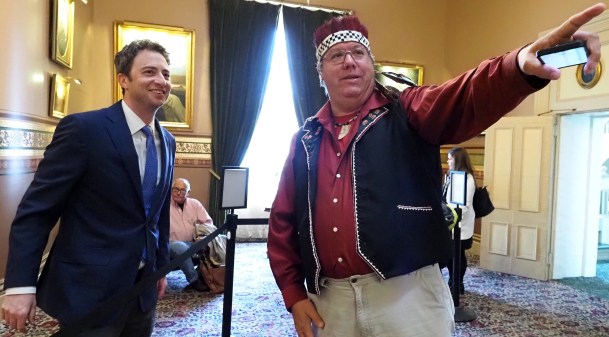
“Anything people can do to help uplift disadvantaged communities, and anytime you can uplift people out of poverty, that is a good thing,” Stevens said. “I really love to celebrate uplifting people, and there’s not enough of that.”
In 2020, the college enrollment rate for 18- to 24-year-olds of American Indian or Alaska Native descent in the U.S. was the lowest of all recorded ethnic groups, at 22%, according to the National Center for Education Statistics.
Nadia Hare, a student at Middlebury College who helps lead a student group called Voices of Indigenous Peoples and is affiliated with the Leech Lake Band of Ojibwe, said scholarships like the one at Vermont Law and Graduate School are important methods of expanding accessibility to higher education and fostering Indigenous community on college campuses.
“Having a scholarship for Indigenous students is a way of saying, ‘Hey, we want you guys at our school and you deserve to be here,’” Hare said. “As a Native student, I do think it’s super important to have that community on campus.”
Hare said she hopes institutions like Vermont Law and Graduate School take the time to build meaningful relationships with Abenaki and other Indigenous people as they work to create more access to their educational programs.
“I’ve definitely heard a lot of white people be like ‘we need to have a relationship with this marginalized community so that we look good,’ or something, so that it’s only in one way beneficial,” Hare said.
She said performative action or rushed relationship-building miss the point, which for Hare centers on forming intentional relationships, building solidarity and building a presence of Native students in a place.
“The idea of having Abenaki community members with a law degree is just very, very exciting,” said Jeff Benay, former chair of the Governor’s Advisory Commission on Native American Affairs and the current head of Indian education at Missisquoi Valley Union High School. “We know that at Missisquoi, for instance, when kids go on to college, a lot of them go into education and the first thing they’ll talk about is wanting to come back to the community.”
“I hope other colleges follow suit,” Stevens said. “I would love to see other colleges in the area that would be able to provide these opportunities for (students) to help reduce the cost of college or give a head start to someone who maybe, when they graduate, can also give back to the (Abenaki) community.”
