



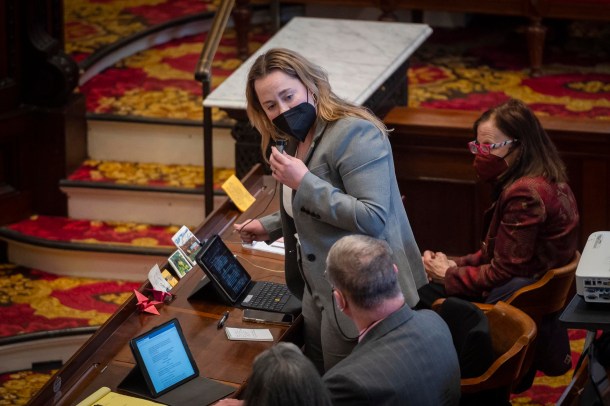
By a vote of 18 to 9, the Vermont Senate on Friday passed a bill that would double legislative pay — by 2027.
Lawmakers who supported S.39 made clear that this date was key. They were not raising their pay, several said on the floor, but the compensation of future Legislatures.
During a preliminary vote and floor discussion Thursday, Senate President Pro Tempore Phil Baruth, D/P-Chittenden Central, noted that any current lawmaker would need to serve another five years before seeing the full benefits of the legislation, should it become law.
“You would have to be reelected not once, but twice,” he said. “That was deliberate.”
A historic rate of turnover in the Legislature last year has brought renewed energy to a longstanding debate in Montpelier about legislative pay. And a new crop of lawmakers has argued forcefully that unless salaries go up, elected office will remain out of reach for everyday Vermonters.
“Serving in the Vermont Legislature is not supposed to be a career, but it’s also not supposed to be a job that only wealthy or retired folks can afford to do,” Sen. Becca White, D-Windsor, told her colleagues Thursday.
Rank-and-file lawmakers currently make $812 a week during the legislative session, which typically runs from January to May. That totals a little under $15,000 a year. They also get mileage, meals and lodging reimbursements for trekking to Montpelier during the session.
But there’s no health insurance and no retirement package. In the off-session, unless they’re being paid a stipend for work on a special task force or study committee, there’s no compensation at all.
If S.39 is adopted, weekly in-session pay would rise to at least $1,000 per week in 2025, $1,100 in 2026 and $1,210 in 2027. (The bill calls for adjustments for inflation.)
Starting in 2025, lawmakers would also be paid for one day of work each week the Legislature is not in session, to reflect the constituent service they perform year-round.
That extra pay would bring lawmakers to a total base salary of $29,766 annually by 2027, a little more than twice what they receive now. Prorated, that’s roughly equivalent to the average salary earned in Vermont, according to White.
“That feels like ‘reasonable compensation,’” she added, a reference to Vermont’s Constitution, which, she noted at the beginning of her floor speech, entitled public servants not to “offices of profit” but “reasonable compensation.”
But Sen. Thomas Chittenden, D-Chittenden Southeast argued Thursday he couldn’t support the bill as written. Although he liked the idea of getting paid what the “average Vermonter” got, he noted that most don’t get meals reimbursed on top of their salary.
He argued, too, that partial off-session pay should be axed.
“If we’re adjourned, we shouldn’t be paid,” he said.
Echoing Gov. Phil Scott, Sen. Russ Ingalls, R-Essex/Orleans, proposed an amendment that would have increased legislative pay to $1,500 a week but shortened the legislative session to 13 weeks. It failed.
Under S.39 lawmakers would also be eligible to receive the same health insurance coverage — with the same premium split — as state employees. Here again, White emphasized that lawmakers were seeking to be held harmless for their service, not unduly benefit.
“While over 95% of Vermonters have health insurance coverage of some form, many state legislators do not,” she said. “This is a barrier for many people’s ability to run for state office, especially if they would lose their health insurance coverage — which happens because they’re taking time away from their full-time job.”
The total increased cost to the General Fund in 2027, when S.39 would be fully in effect, would be $4.9 million, according to the Legislature’s Joint Fiscal Office. The bill now heads to the House.
— Lola Duffort
IN THE KNOW
Hundreds of students from across Vermont gathered at the Statehouse on Friday to demand that lawmakers take bold action on climate change. They called on the Legislature to pass laws such as the Affordable Heat Act.
“We are the powerful reminder of the next generation — of who exactly our leaders are failing. Who they must do better for,” said Miriam Serota-Winston, freshman at Montpelier High School. “We will be present constantly to remind our leaders of this.”
Eliza Doucet, a junior at Mt. Abraham Union High School, recalled spending summers at her aunt’s house on a lake in Maine, listening to the calls of loons.
“According to the Vermont government, within the next 25 years, these loons will be gone as the effects of climate change continue to worsen,” she said. “They are at risk of being another loss to the devastation we are facing. The devastation we failed to prevent.”
— Emma Cotton
ON THE MOVE
A bill that proposes banning paramilitary training in Vermont is poised to become law.
Gov. Phil Scott has indicated that he’s likely to sign S.3, which passed the House on Friday and the Senate in February.
“The Governor hasn’t reviewed the latest draft, but he is not opposed to the concept and barring any new additions that significantly changed the bill since the version the Senate originally approved, it is likely to become law,” Jason Maulucci, the governor’s press secretary, wrote in an email.
— Emma Cotton
A Senate bill that would establish a clean heat standard in Vermont, S.5, has cleared the House Environment and Energy Committee.
The bill, which lawmakers are calling the Affordable Heat Act, aims to cut emissions that come from heating Vermont’s buildings. It would ask the state’s Public Utility Commission to stand up a program that would incentivize switching to less-polluting heating sources, such as electric heat pumps, and weatherizing homes.
While the majority of environmental groups support the bill, some have expressed concerns that it could create dependence on biofuels, which can have negative environmental impacts. Others, including Gov. Phil Scott, are worried the bill could be expensive for Vermonters.
Members of the Environment and Energy Committee voted 8-3 in favor of the bill on Thursday, and it will now be considered by the House Appropriations Committee.
— Emma Cotton
The Senate on Friday passed H.53, a bill that would nix the state’s ability to suspend a person’s driving privileges solely because they have not paid the fine for a moving violation. That includes things like running a red light or making an illegal U-turn.
The bill would not impact drivers whose licenses are suspended for criminal violations, such as driving under the influence. Supporters say it would break a harmful loop whereby people lose access to transportation just because they don’t have the means to pay for a ticket.
Senators had previously agreed to a minor amendment pushing back the date that the bill takes effect by 30 days. As such, H.53 will now travel back to the House for review.
— Shaun Robinson
A VERY SPECIAL ANNOUNCEMENT
Sen. Kesha Ram Hinsdale, D/P-Chittenden Southeast, who has been hospitalized since late March to help prolong her pregnancy, has given birth.
“Mira Ram Hinsdale was born at 5:17 pm on April 13 at 7 pounds and 4 ounces. She shares an auspicious birthday with her great great great grandfather, Sir Ganga Ram, Father of Modern Lahore,” the lawmaker posted to Twitter on Friday.
From everyone at VTDigger: Congratulations!!!
— Lola Duffort
WHAT WE’RE READING
Ed Koren, New Yorker cartoonist and beloved Vermonter, dies at 87 (VTDigger)
Vermont students have been restrained or secluded at least 125 times this school year (VTDigger)
Legislature’s housing bill advances, and hopes for Act 250 reform wane further (VTDigger)
Vermont State University president Parwinder Grewal resigns as system pauses library changes (VTDigger)
On delivery with Vermont’s only pharmacist for aid in dying prescriptions (Vermont Public)
