

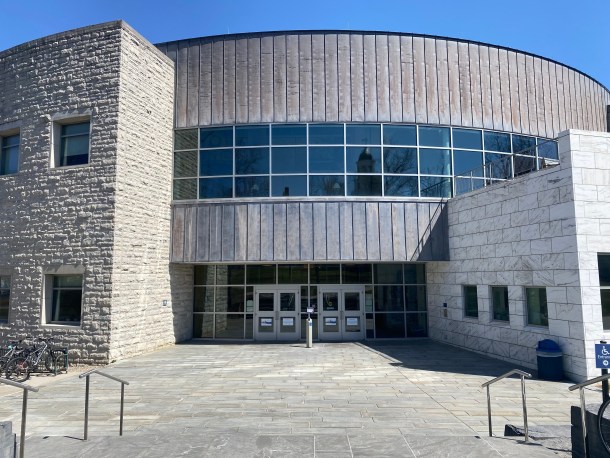
The emergency alert appeared across student cell phones and email inboxes at 11:53 p.m. on Sunday: Police had received a report of an active shooter at Middlebury College’s Davis Family Library.
After evacuating students and searching the area for 31 minutes, police determined the call was a fake report, or a case of swatting — a hoax designed to trigger a law enforcement response to a non-emergency.
According to a press release issued by the Middlebury Police Department, a 911 call was placed to Middlebury police through the Vermont State Police dispatch center in Williston at about 10:30 p.m. from an anonymous source. The caller “referenced an ongoing shooting, mass casualty, incident at the Middlebury College library,” presenting information that led “the call-taker to believe that the incident was indeed ongoing.”
The caller said “shots had already been fired and that they were hiding in the building,” Middlebury police Sgt. Vegar Boe said.
But there was no threat, Middlebury police determined, after evacuating students from the library and searching the building. At 12:24 a.m., the college’s emergency notification system told students that the shelter-in-place order had ended.
It took longer for on-campus anxiety to lift.
A national crisis
For the generation of students currently in school, the threat of gun violence is a commonplace part of education.
There have been more than 146 mass shootings in the United States so far this year, and more than 11,525 people have been killed by guns so far in 2023, according to the Gun Violence Archive, an independent, nonprofit research group. Among the dead are 71 children under the age of 11 and nearly 400 between the ages of 12 and 17. Those numbers, which are updated daily, include the four victims of Monday’s mass shooting in Kentucky.
As a recent graduate of Middlebury College and current resident of the town, I woke up after Sunday’s events to 63 missed messages from friends on campus talking about the reported threat. My first fear, as part of a generation that has witnessed as many as 377 school shootings in our lifetimes, was that I was reading last words.
Early Monday morning, college administrators sent an email to students, faculty and staff, following up on the night’s events.
“While investigators found no credible threats,” the email read, “any situation like this — founded or not — is unexpected and upsetting, especially to those who were present when police arrived.”
Arthur Martins, a Middlebury student from Brazil, said he was walking toward the library when he heard about the threat from a student group chat, about an hour before the college issued its emergency alert.
“I felt very unprepared because, you know, in Brazil, only now we’re getting into this similar trend of school shootings,” he said. “I felt disoriented. I felt that I didn’t know where to look for resources (and) didn’t have the language to understand what I could do to protect myself.”
After hearing about the reported threat, Martins said he immediately went home to his campus residence, where he and his housemates turned off all the lights and closed their window blinds, waiting for more information.
‘Some people were sobbing’
Meili Huang, another student at the college, was in the library when police reached the building. When officers came in and shouted, “put your hands up; put your hands where I can see them,” she thought it was a prank.
“Armed police came in with guns and everything, and then I was a little bit panicking,” Huang said, “but I think I remained mostly calm.”
Huang said police escorted her and other students to a printing room in the library to shelter in place while officers secured the building. “Some people were sobbing,” she said. “There were people who came in afterward who were panting and really scared, and that’s when I realized the situation was really kind of scary. That’s when they told us there (may be) an active shooter.”
Sailor Kabeary, a first-year student at Middlebury who was also in the library when police arrived, said she feels the event will have an effect on her ability to feel safe at the college.
“Last night when it felt like I was running for my life from the library on the same paths that I walk every day, this place was stripped of any feeling of home,” Kabeary said.
According to Demitria Kirby, associate vice president of safety at the college, “the Crisis Management Team is reviewing its protocols considering last night’s situation: weighing whether to use Rave alerts even for unsubstantiated reports of this nature, and more precisely defining what a ‘substantial emergency response presence on campus’ means.”
The Middlebury incident followed an uptick in swatting calls in Vermont in February, when police responded to 21 unfounded reports of school shootings in the state.
Several similar incidents were reported Sunday night on other campuses, including Boston University, Syracuse University and Wake Forest University.
According to the FBI National Press office, the FBI is collaborating with law enforcement agencies and “actively investigating these dangerous and criminal threats.”
“The FBI takes swatting very seriously,” the office wrote in a statement to VTDigger. “These threats put innocent people at risk and cause significant fear in the community. We have no information to indicate a specific and credible threat at this time, but we continue to collaborate with our law enforcement partners and are actively investigating these dangerous and criminal threats.”
