


BRATTLEBORO — Deep in the night this Groundhog Day, as historic subzero wind chills began to blow, a driver on the dark local road between Interstate 91 and Route 30 pulled over at a surreal sight: A snowmaking system blasting more blindingly than the surrounding Hollywood-wattage lights.
Why, the out-of-stater wondered, would anyone try to outgun Mother Nature?
The volunteers who manage Brattleboro’s Harris Hill knew. The momentary freeze at Vermont’s sole Olympic-size ski jump was about to be followed by a prolonged thaw just before the venue’s annual Presidents Day weekend tournament.
If organizers wanted snow, they’d have to stockpile it.
So goes the growing threat for winter landmarks like Harris Hill, which celebrated its 100th anniversary last year and is set to enter its second century with competition Saturday and Sunday.
At Killington, the state’s largest ski area, officials saw warm weather cancel seven of the World Cup ski circuit’s first eight races in Europe just before their own scheduled event last Thanksgiving weekend. Fearing the resort might join the list when temperatures spiked to 72 degrees on Nov. 12, they took advantage of a subsequent freeze to power 120 snow guns around the clock and pull off the contest.
“Every year seems to be a challenge,” Killington President Mike Solimano said at the time. “Weather is always the biggest in this business, but there’s always a lot of ups and downs.”
Harris Hill’s nonprofit board relates. A year ago, groomers who had smoothed over the frozen 90-meter slope saw a freak last-minute thaw and rain strip much of it away, forcing them to hastily return with snowmaking guns the night before the event’s Saturday morning start.
This week, the local forecast is similarly scary.
“It’s almost a repeat of last year,” said Todd Einig, chief of competition. “It’s definitely going to challenge us.”
Then again, Harris Hill — one of just six of its size in the country — has a history of overcoming adversity. Organizers hauled in snow from outlying areas in 1938 and from local streets in 1954, and went so far as to postpone the event a month in 2005.
A lack of snow has canceled competition only six times (in 1930, 1932, 1937, 1980, 1981 and 1998), with just one of those years coming after organizers added snowmaking capability in 1985.
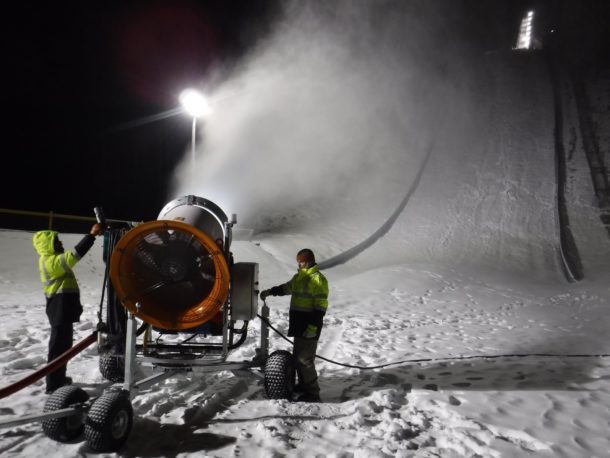
Jason Evans, a local contractor in charge of hill preparation, has worked in the past with six guns, an air compressor and a water pump. This winter, organizers purchased a new all-in-one system that churns out more snow and consumes less energy. That meant his crew — Peter Clark, Ian Clews, Henry Ireland and Glenn Rosinski — could work the equipment alone rather than in teams of two to three.
“It’s much more efficient,” Evans said.
But snowmaking requires freezing temperatures, ideally between 10 above zero and 10 below. This week’s highs in the 50s have turned the surrounding fields into mud. But the crew promises the next few days won’t melt their work of the last couple of weeks.
“We have a foot or two of snow on the landing hill and probably 3 feet on the outrun,” Evans said. “Man-made snow holds up much better to warm temperatures, and we have plenty of it. How can I not be confident?”
