


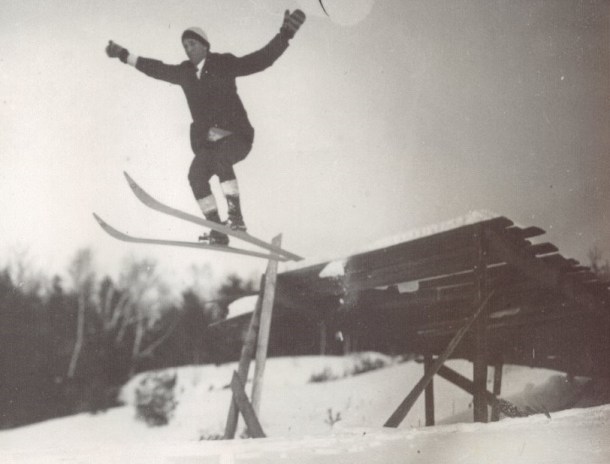
Fred Harris was a young contemporary of the Wright brothers — inventors of the airplane in the dizzyingly heady days of the early 1900s — when the Brattleboro college student first strapped wooden slats to his feet and catapulted off a snow-covered ramp.
“Broke my skis all to pieces,” Harris penned in his diary.
But two more timbers brought two more tries.
“Fell twice,” he wrote.
But again, persistence.
“Tried jump several times, and at last made it,” Harris proclaimed. “Hurrah! twice Oh! ye! Gods!”
If only Harris could foresee what it all would snowball into.
When the Vermonter built what’s now the Harris Hill Ski Jump in his hometown in 1922, he needed only a few planks for a launchpad and two more to lash to his boots to leap off a peak 30 stories high at speeds of up to 60 miles per hour.
“The jump provided heroics for all to see,” winter sports historian E. John B. Allen says. “It really did seem that a man could fly.”
But to attract a current-day crowd of world-class athletes and several thousand spectators, a nonprofit volunteer committee had to raise nearly $600,000 upon the start of the new millennium to rebuild the venue — now the only Olympic-size ski jump in New England and one of a mere six of its height in the nation.
That’s just the latest wrinkle in a century-long history of rising above seemingly insurmountable odds.
Harris Hill has drawn the nation’s top athletes for decades — except in years the Winter Games pulls them elsewhere. Competing against PyeongChang, South Korea, in 2018, the Brattleboro event promoted itself as the next best thing: The chance to see the up-and-comers aiming for Beijing, China, in 2022.
Four years later, all five Olympians on the current U.S. team can say they’ve competed at Harris Hill. So when the jump welcomes 45 young flyers from North America and Europe for fireworks Friday and competition Saturday and Sunday, spectators could be looking at the nation’s lineup for the 2026 games set for Milan and Cortina, Italy.
‘Those days when jumping was so new’
The oldest known skis — discovered in the snowdrifts of Russia — date back some 10,000 years. But neither “skiing” nor “ski jumping” were household words locally when Harris — a sportsman turned stockbroker who lived from 1887 to 1961 — introduced the sport to the Northeast.
A pioneering “extreme skier,” Harris is credited with making the earliest slalom descents of Mount Washington in New Hampshire and Whiteface in New York, as well as founding the Dartmouth College Outing Club — the first such organization of its kind in the country — “to stimulate interest in out-of-door winter sports,” he wrote in his school newspaper.
Harris lived for adventure. He often canoed the Connecticut River to commute between home and college, won the U.S. mixed-doubles tennis championship in 1912 and piloted his 87-year-old grandmother in a plane for her birthday in 1920.
That’s why locals weren’t surprised when Harris — who shaped and shellacked boards into his own skis — created the Brattleboro Outing Club in 1922, the same year he built his namesake jump for $2,200.
The hill may boast a history 100 years in the making, but it was brainstormed and built in a few short weeks. Harris had eyed an evergreen-laden slope on Cedar Street in December 1921. In a month, workers cut trees, blasted rocks, smoothed the result and constructed 350 steps up to a wood trestle for an inaugural jump that drew 2,500 people Feb. 4, 1922.
“I think I shall never see more interesting ski events than in those days when jumping was so new,” the late Associated Press correspondent Charles Edward Crane wrote in his book “Winter in Vermont.” “I remember vividly the figure of Beatty Balestier, troublesome brother-in-law of Rudyard Kipling, who always drove in to the ski meet in an old-fashioned pung filled with straw and buffalo robes — and apparently quite a bit of liquid warmth for the inner man.”
The press reported one injury, a 17-year-old New Hampshire high school student who strained a muscle. But rather than deter people, “the voyeuristic pleasure of watching danger and play at the same time helped bring the crowds in,” Allen notes.
The hill would host its first national championship in 1924, the first of nine up to the 1992 event that served as the U.S. qualifier to that year’s Winter Olympics.
But it also has faced turbulent times, be it a lack of snow that canceled the event during the Great Depression years of 1930, 1932 and 1937 or World War II fighting that stopped competition in 1943, 1944 and 1945.
Marking the return of peace and prosperity, the jump hosted the 1951 national championship. The event set athlete and attendance records with 168 sportsmen and 10,000 spectators — fittingly, on the day Harris Hill was officially named for its creator, who would win induction into the Ski Hall of Fame in 1957 and see the U.S. competition return to his hometown in 1961, just four months before his death at age 73.

‘The whole community came together’
Brattleboro resident Dana Sprague knows ski jumping both as a past athlete up on the launch and as the hill’s present historian and photographer down on the landing.
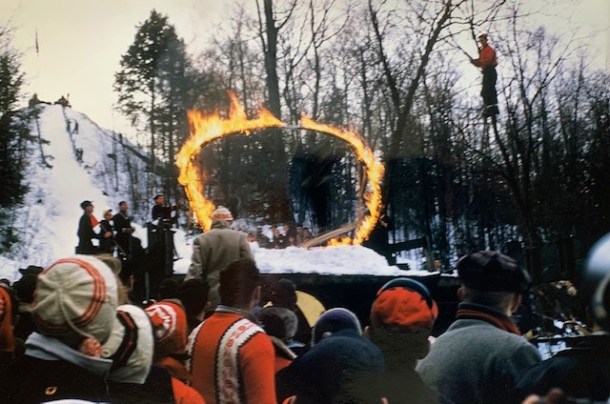
Sprague can tell you everything from how Harris’ sister, Evelyn, tested the hill in 1922 (the venue welcomed female athletes long before the Olympics first let them compete in 2014) to how a few brave souls went on to ski and sled off the ramp through a flaming hoop.
Back before helmets, liability insurance and high school hockey, local teenagers considered the sport as common as football, basketball or baseball. But the arrival of the state’s new interstate highway in the 1960s ushered in new individuals, new institutions and new ideas, while natural tree-lined hills like the one Harris cleared by hand eventually gave way to metal towers with slick plastic ramps.
In 2005, as the late Harris was inducted into the Vermont Ski and Snowboard Museum’s Hall of Fame, the U.S. Ski and Snowboard Association ruled the jump’s seemingly antique starting tower was unsafe and couldn’t be sanctioned for any more competitions.
A volunteer organizing committee, forced to cancel future events, set out to rebuild the hill. Supporters labored two years to raise more than $250,000, only to see The Associated Press ultimately report they couldn’t reach their $600,000 goal.
That’s when the seemingly bad news turned good. Within a month, the New York-based Manton Foundation, unsolicited yet swayed by the AP headline, surprised volunteers by agreeing to contribute the sum needed to complete the renovations.
Construction crews replaced the starting tower and added a steel launch ramp, peak-to-parking lot staircase, required safety features, and water and electrical fixtures for snowmaking in time for Harris Hill to reopen on Valentine’s Day 2009.
Spencer Knickerbocker, then a 16-year-old Brattleboro Union High School sophomore, was the first athlete to test the new 90-meter jump.
“I think it was important to have a local do it,” Knickerbocker told the press after, “because the whole community came together for the fundraising support.”
The jump, still managed and maintained by volunteers, traditionally opens only one weekend a year. As a real slope rather than a ramp atop scaffolding, it’s one of the few anywhere to allow attendees to climb all the way to the takeoff and catch athletes up close.
“We think it’s a great thing for people to get an appreciation of the speed and skill that’s required,” says Rex Bell, a longtime supporter and former coach of the U.S. Olympic ski jumping team.
Visitors also can see how snowmaking guns funnel and freeze gallon upon gallon of water before grooming machines smooth the result.
“Natural snow melts a lot quicker than manmade snow,” says Jason Evans, a local contractor in charge of hill preparation. “No matter how much snow falls, we still make it.”
‘His vision, his passion, his legacy’
Win the Harris Hill competition three times and you can take home its Winged Ski Trophy, just like Torger Tokle of Norway in 1942, his brother Arthur Tokle in 1951, U.S. Olympian Art Devlin of Lake Placid, New York, in 1957, Hugh Barber of Brattleboro in 1974, Vladimir Glyvka of Ukraine in 2000 and one more athlete, who dramatically snagged it just weeks before the Covid-19 pandemic closed the venue.
On Feb. 16, 2020, Chris Lamb of Marlboro College and Blaz Pavlic of Slovenia prepared to compete as two-time winners. Locals knew Lamb for setting the hill’s long-distance record of 102 meters — and Pavlic for breaking it with a 104-meter jump. But that didn’t stop Lamb from not only matching Pavlic in the first of 2020’s two rounds but also outscoring him in style points.
As a capacity crowd of New Englanders stirred with the possibility of one of their own taking the trophy, Barber — the only local to retire it after victories in 1972, 1973 and 1974 — recalled how he was in second place with one jump left in his final year.
The past champion knew the present-day challenger was down but not out.
As spectators clapped mittens and gloves (and, in a ski jumping tradition, clanged cowbells), the Slovenian shot off the launch ramp, soared more than 300 feet in the air and landed a jump a mere 5.5 meters farther (or about the length of a Volkswagen Beetle) than the American.
The resulting win was as head-spinning as it was historic.
It was also just another typical day at Harris Hill.
Founder Fred Harris’ daughter, Sandy, presented the trophy just as her late father and mother, Helen, had when recognizing the previous three-time winners.
“I want to do this because of how much this community has honored my father,” Sandy Harris said. “It means a lot to me to think Brattleboro has carried on his vision, his passion, his legacy.”
All of which continues to leap forward. The venue, celebrating its centennial with a program of public events this Presidents Day weekend, is reaching out to new generations through its website, live-streaming and a youth training program. Yet for all its technical advances, it’s still grounded just above a cornfield as one of the few natural jumps on the continent.
“Everyone who has contributed to preserve the tradition of ski jumping in Brattleboro can be proud,” volunteer Liz Richards said upon the hill’s recent restoration. “Proud that we did not let this amazing piece of local history become history.”

