

BURLINGTON — Before the bus was free, Bowie Bouchard would be more frugal getting around town.
If the 34-year-old needed to visit the University Mall, for instance, he’d shell out 75 cents for a bus ride to that South Burlington shopping center. On the return trip, though, he’d take his bike, since the way home had fewer uphill climbs.
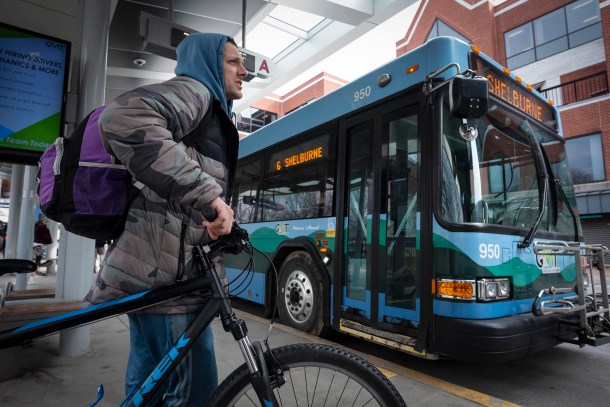
But with the advent of fare-free public transit — a pandemic-era subsidy extended by the state Legislature — Bouchard is more likely to take the bus whenever it’s more convenient, he told VTDigger as he strapped his bike to the front of an outbound 6 bus Thursday morning.
Bouchard is not alone among regular Green Mountain Transit riders. By forgoing the once-common rituals of coughing up change or purchasing a monthly bus pass, riders around Chittenden County and beyond are finding extra cash in their pocket.
“It’s helped me save $20 a month,” said Rebecca Aberl, 46, a New North End resident who rides the 7 bus to get groceries and attend medical appointments.
Yet other riders say the $1.7 million needed to sustain the program across the state for another year should be allocated toward making service more frequent.
Those calls have grown louder in areas served by Green Mountain Transit, after the bus system recently announced service cuts in three of its routes as a cost-saving tactic. Officials initially said the cuts would be temporary, but have since indicated they will become permanent.
Under the proposed changes, the 6 bus (which runs up and down Route 7, also known as Shelburne Road) and 7 bus (which ferries passengers back and forth along North Avenue in Burlington) would run every half-hour, instead of every 20 minutes during the week.
A commuter bus between Burlington and Montpelier would also run four fewer times a day, since ridership on the route has dropped 30% during the pandemic, officials said
But it’s the bus system’s weekend service on both Chittenden County routes that most troubles Bob Miller, a 70-year-old Burlington resident. Miller takes the bus to work on Saturdays and some Sundays, and the hour-and-a-quarter gap between buses on Sundays makes his commute less convenient.
While he appreciates fare-free, Miller said, he’d rather see public transit money fill service gaps such as the one he experiences on weekends.
Miller acknowledges that his situation is not universal. When he goes to work on Saturday mornings, he’s sometimes the only one on board, he said.
“I understand that that isn’t good economically,” Miller said. “But it’s good for me.”
Miller was one of several riders who spoke to a VTDigger reporter on board the 6 and 7 buses Thursday morning. Another was Frederick Royce, an 81-year-old resident at Heineberg Senior Housing in Burlington’s New North End.
Royce told VTDigger he wasn’t a fan of the service cuts, since the bus is his only way to get downtown.
“It may mean that I won’t be able to do as much,” he said.
Most, but not all, of the passengers who spoke to VTDigger relied on Green Mountain Transit buses as their primary mode of transportation.
The transit riders VTDigger spoke to who did own cars, such as Burlington resident Damion Kristoo, said they preferred fare-free service to more frequent availability. Kristoo got a lift on the bus Thursday to go pick up his truck from a repair shop.
Shelburne resident Malik Mines also owns a car but usually takes the bus to work. The 26-year-old likes fare-free service, he said, but not necessarily because it’s cheaper.
“It’s just more convenient to not dig for change or go buy a bus pass,” Mines told VTDigger.

Some local transportation analysts argue that fare-free buses should remain for people such as Mines.
For Green Mountain Transit to boost its ridership to past pre-pandemic levels, fare-free will be more effective in drawing new passengers than more frequent service, said state Rep. Curt McCormack, D-Burlington, who sits on the House transportation committee and does not own a car.
Yet the argument between fare-free and more frequent service obscures a more fundamental issue — how Green Mountain Transit will manage to provide service at a time when fuel prices are outpacing the system’s effort to cut costs.
The planned service reductions, for example, are expected to save the transit service $250,000, said Jon Moore, Green Mountain Transit’s executive director. But if the recent spike in oil prices endures, the company could be $400,000 over its fuel budget in the upcoming year, he said.
A study issued last year cites the transit system’s spotty funding as a source of its financial woes. The service receives most of its funds from towns that choose to chip in money, rather than from a state fund.
But while a state fund would help stabilize the utility’s finances, it would require towns that don’t benefit from Green Mountain Transit services to pay into it — a concept that doesn’t sit well with some state legislators.
Some riders who spoke to VTDigger on Thursday, meanwhile, said they wouldn’t mind if Green Mountain Transit reinstated fare collection.
One of them is Kimberly Clark, a 46-year-old Burlington resident who said she rides the 7 bus every day. Clark bought a monthly pass the day before Green Mountain Transit went fare-free, she said, and has been dying to redeem her purchase.
“I’d rather pay the money,” Clark told VTDigger. “I’ve been using a bus pass since 1999.”
While Green Mountain Transit officials say ridership is down across the system, Clark sometimes struggles to find a spot on the 7 bus during the morning and midafternoons, when Burlington High School students make an exodus from their new, downtown learning space.
Burlington High School student Bailey Kingsbury, 17, said Thursday morning she would like the bus system to prioritize fare-free service over more frequent buses.
Bill Worthen, 81, agreed with her. The Burlington resident has been riding the bus every day for years, and while he thinks the fares Green Mountain Transit used to offer were reasonable, he would appreciate the continuation of fare-free service.
“It’s unbelievable,” Worthen said. “How can you beat a free bus?”
