


The Deeper Dig is a biweekly podcast from the VTDigger newsroom, hosted and produced by Sam Gale Rosen. Listen below, and subscribe on Apple Podcasts, Google Play, Spotify or anywhere you listen to podcasts.
In late August, Burlington High School’s entire student body came together for the first time since the pandemic began.
But the school community is facing unusual challenges — and it’s more than just Covid-19.
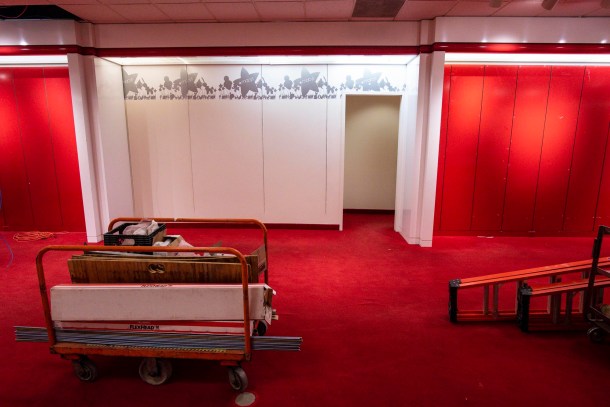
In March 2021, after discovering the campus on Institute Road was filled with toxic chemicals known as PCBs, the high school relocated to an abandoned Macy’s department store in downtown Burlington. They erected classrooms and hung up student artwork, but relics of the Macy’s remain.
While there have been plenty of jokes, memes and press coverage, students are facing real challenges attending school in a building that wasn’t intended to be a school.
“It was so much more work put in from students and teachers than just moving into a new school,” said Rahema Aubdi, a senior at Burlington High. “A lot of people fell through the cracks.”
On this week’s podcast, students, teachers and administrators describe the move to Macy’s — and the things they left behind. Below is a partial transcript, edited for length and clarity.
Grace Benninghoff: It’s early September, and the second week of school is underway at Burlington High. The entire student body is back on campus for the first time since the pandemic began.
McKenna Wheeler: You know, after you’re remote for so long, your idea and your mindset towards school just changes a little bit. So when you’re back in person, that mindset is still not where it used to be.
Kelemua Summa: The biggest challenge for me was definitely how optional online tele-learning seemed to be. Because all you have to do is kind of roll out of bed and click a button on your computer, and then you can turn your camera off and be like, “that’s class for me today,” and just stay muted for the entire time.
Rahema Aubdi: Being able to like talk to my teachers about things that, like, weren’t school related — because on Google Meet you never really had time and like actually being able to like connect and like show your personality not through a screen.
Grace Benninghoff: Since March 2020, students at BHS — and across the country — have been adjusting to new types of learning. Remote learning, hybrid learning, then back to learning in the classroom. Then remote learning again. Schools have been on what’s become something of a familiar roller coaster in which they adjust, reopen…
Dan Hagan: We had all of our safety protocols figured out. We figured out how they were going to flow around the building, how we were gonna make our classrooms work. We had removed desks, we had redone all of our instructional pieces so that we could do them in that hybrid model.
Grace Benninghoff: …and then close.
Lauren McBride: And we were then required to close the school down and go fully remote.
Grace Benninghoff: But for BHS, the problem wasn’t just the pandemic. And the solution was a bit unorthodox…
Kelemua Summa: There was definitely a period of time when we first got the space where we were just trying to guess what departments the classrooms used to be a part of, and we got pretty close to some of them. It’s been pretty fun, people are still trying to guess in some areas. The library has a bunch of back shelves in it, and we’ve kind of been like, “Was that supposed to be like the lingerie and women’s section? Or was it just like random house cleaning stuff?
Rebecca Cunningham: They left the Michael Kors sign where the old store used to be, and then added ‘cafe,’ and that’s our cafeteria.
Rory Stein: I’ve been in math class, and then I can hear the escalator running, and it’s just that quiet murmur. And I’m like, “Yeah, this feels like a department store.”
Grace Benninghoff: Coming back to school in 2021 means masks, hand sanitizer, and — for Burlington High School students — learning in what used to be a Macy’s Department Store. Here’s how they got there.
In March 2020, BHS — like most schools in the country — shut down because of the Covid-19 pandemic. Then, last September, they prepared to welcome students back.
Lauren McBride: We were engaged in a lot of Covid protocols, making sure that our school was safe, getting the plexiglass that we needed, ensuring that we had hand sanitizer, like preparing for a new normal school year.
Grace Benninghoff: That’s Lauren McBride, the principal of BHS.
Lauren McBride: On the first day of school for us, which was a Wednesday, and so Wednesday in the hybrid model was a fully remote day, our teachers were introducing themselves to their classes online and getting to know their students remotely.
Grace Benninghoff: Meanwhile, the school was preparing for some renovations. It was an old building with a leaky roof. And it hadn’t been updated in a long time. Since students would only be in the building a few days a week, it seemed like perfect timing. The school was doing some air quality testing to prepare. And then…
Lauren McBride: We received a call from the Department of Health letting us know that the levels of PCBs that were found in the high school were higher than the Vermont and the national average.
Grace Benninghoff: PCBs are chemicals that were used in some old building materials, especially back in the 1960s, when the school was built. And it turned out they’d been used in the window caulkings, that hard bubbly plastic-looking stuff that secures windows into the walls. Eventually, those chemicals made their way into the air.
Lauren McBride: We had to call a faculty meeting at 3:00 to let our faculty know and then reach out to our community to let them know that we would not be able to return in person. And all of that happened on the first day of school.
Grace Benninghoff: Here’s Dan Hagan, a history teacher at BHS.
Dan Hagan: The rumor mill started to circulate. Like, “What’s going on?” We don’t usually get these all hands on deck meetings. But that’s where we found out, around 4 p.m., that the next day would not be happening as we had expected, and we would be not going back into that building.
Grace Benninghoff: Those first few weeks, there was some hope that this would just be a temporary thing, that there might be an easy fix. In fact, Superintendent Tom Flanagan was optimistic.
Tom Flanagan: I even told the whole girls soccer team that it was looking good to get back in. That was my rookie mistake. Because I quickly learned after convening with the EPA and the Department of Health that they were really concerned, and so we ended up closing.
Grace Benninghoff: PCBs are carcinogens, and the administration soon discovered there’s no easy way to get rid of them, especially when they’re embedded in the walls of a building. If the high school were to convene in person again, the campus on Institute Road — where the school had been since the 1960s — wouldn’t be an option. Ever.
Dan Hagan: We got shut down, just like that.

Grace Benninghoff: As teachers and students muddled through another semester of remote learning — this time not because of the pandemic, but because of PCBs — school officials started searching for a new space to hold classes. It was a tall order. The building would have to comfortably fit the entire student body, plus teachers, faculty, and staff while allowing for social distancing. It would also need to have good ventilation.
Lauren McBride: There were a lot of different things happening behind the scenes of like, “Well, where are we going to go? Because we can’t be remote forever.”
Grace Benninghoff: Pretty soon rumors about where the new temporary high school would be started circulating.
Dan Hagan: One of my buddies came out of a meeting, and he was tipped off that one of the places they were looking at was Macy’s. There was other speculation that it might be the old Hannafords on Shelburne road, or that somehow [University of Vermont] was going to make us a building.
Grace Benninghoff: But according to Tom Flanagan, there was only one site they ever really considered, only one spot that met all their requirements.
Tom Flanagan: We looked around and what we found was that really this was the only site that had the square footage that we needed and had a blank footprint that would allow us to build and to be able to get in within months.
Grace Benninghoff: The site was an abandoned Macy’s department store in downtown Burlington. It’s walking distance from shops and restaurants, two stories tall, and — rumor has it — where Bernie Sanders bought new suits before his 2016 presidential bid.
McKenna Wheeler: Someone had told me about it and I thought it was a joke at first. I was like, “Oh, haha, that’s funny. The old Macy’s. What are we actually going to be doing?” And then eventually it got confirmed by the administrators at the school, and I was just really surprised, and kind of like, I guess, a little confused about how it was going to work. Because it was just an abandoned building.
Grace Benninghoff: That’s McKenna Wheeler. She’s a senior at BHS. Here’s Rory Stein, another senior.
Rory Stein: When it was announced that it was going to be in the old Macy’s, it immediately became a joke. It was like, from the get go, people were making memes, making jokes, and I remember thinking like, “Jokes aside, that’s not a bad idea.”
Grace Benninghoff: Dan Hagan, the history teacher, grew up in Burlington, so he knew the Macy’s well.
Dan Hagan: Having grown up here and having like spent some of my formative years in this mall, I originally thought like you know, is that the Macy’s where you go when your mom forces you to go buy new underwear, or when you wanna hang out at Papa Ginos or the arcade or something like that? This is the ’80s and early ’90s. So, I had all these other visions of it.
Grace Benninghoff: Even the principal had her doubts about if they could pull this off. She remembers visiting Macy’s with the architects after the decision to move in there had been made.
Lauren McBride: There was nothing here. It was all empty, it was however Macy’s had left this space, and I remember walking in and thinking “Yeah right, how is this ever going to work? And how is this going to work in three months?” Like, “There is no way that we are going to be able to pull off making this a school.”
Grace Benninghoff: It took a few months, but by March 2021, BHS was welcoming students back to what they called their ‘downtown campus.’ They erected classrooms with white walls, added a cafe in what used to be the Michael Kors section of the store and hung up student artwork. Teachers were able to salvage some supplies from their classrooms in the old building. Here’s John Mazuzan, the art teacher.
Mazuzan: Forty-plus years of teaching art to go through my very best stuff to bring down and throw the rest away. It gave me a great excuse to purge my room.
Grace Benninghoff: And teachers and students had fun with the new space. There were guessing games about which classroom served as which department…
Dan Hagan: I figured out that my classroom was cosmetics. We could tell by the marble floors and the nice ribbon of red carpeting going through it. It was the entrance from the mall where you walked through the cosmetics and you were sprayed with the sample perfume, those types of things.
Grace Benninghoff: Jokes on social media…
Rory Stein: I would like to say, as far as I know I’m the first person to put “Macy’s 2022” in their Instagram bio.
Grace Benninghoff: And general curiosity.
Rory Stein: “Oh, you go to BHS? Oh, you’re in Macy’s then, right?” And I’m like, “Yeah, we’re in Macy’s. It’s not that bad, I swear.”
Grace Benninghoff: The move also brought a new wave of school spirit, and after more than a year of remote learning, that was something students had really missed. Burlington High’s mascot has always been a seahorse, but when they moved into Macy’s a new, unofficial mascot was born.
Rory Stein: The mallrats were a big thing. I have a mallrats sweatshirt that one of the teachers made. But I think it’s actually really good because in the past couple years, especially with the pandemic, I’ve seen school spirit start to die down. And even in this kind of ironic sense to have school spirit — you know, going to a soccer game and chanting “go mallrats,” something like that — it’s really enjoyable.
Grace Benninghoff: But the move was a big adjustment — in more than one way. BHS had been remote for an entire year by the time they moved into the Macy’s building. Just like students all over the country, they had to adjust to being in a room full of people again, to attending class in person, navigating high school social dynamics masked and from a distance. But also, the buzz of the escalators, and backlit display cases, faux wood and converted dressing rooms, it was nothing like their old high school at all. Even masks and social distancing aside, it was unfamiliar.
McKenna Wheeler: I remember going back last year, like when we first came to this building. I walked in and it did not feel like a school to me. It just felt like someone had done like a DIY makeshift school, and that’s what we were in now.
Grace Benninghoff: Even the fire alarm sounded different.
Rahema Aubdi: The fire alarm is polite. It’s so weird, did you hear it that time?
McKenna Wheeler: Yeah, it’s just — it sounds like a phone ringing, like you’re calling someone, but just louder.
Grace Benninghoff: Did the old building have a louder fire alarm?
McKenna Wheeler: Yeah, that one was bad.
Rahema Aubdi: It was, like, scary.
Grace Benninghoff: The new building — like a department store — doesn’t have any windows.
Rory Stein: Coming in the first day was kind of a shocker. I’d seen a couple pictures, and some of my teachers had gone in to move before. I remember specifically my teacher Mr. Hagan said that it felt like a casino because there were no windows and a lot of artificial light, and I kind of experienced that too the first day. When you come into the building it’s very much like you lose sense of time.
Grace Benninghoff: Rebecca Cunningham is a senior at BHS, and she said the new space took some getting used to, but being back in person made it worth it.
Rebecca Cunningham: There are no windows. You know, it’s not BHS, it’s a new building. And I remember showing up on the first day, and there was music playing, and someone was in the seahorse costume outside the front door greeting everyone, and people were just so excited to be back and seeing each other again. And I thought that was really special.
Grace Benninghoff: Earlier this month, I spent a few days at Downtown BHS. I wandered through the clean, somewhat bare, white hallways and popped into classrooms.
I saw the Michael Kors cafe and the ribbons of red carpet stretching through the hallways. Sometimes when turning a corner, three different floor patterns would converge into a sort of tacky mosaic; white tile, fake wood and red carpet. There were old jewelry display cases with trophies and school memorabilia stuffed inside them.
There were no lockers. Instead, posters of Levi Jeans and Underarmour logos peppered the walls. The front office is where the dressing rooms once stood.
As quirky as it was, in a lot of ways it was exactly like any other high school. Kids were laughing in the hallways, and the tile floor made that particular squeaking sound under hundreds of pairs of sneakers. But red carpet and escalators aside, there are other ways it’s different too. For one, the walls don’t quite reach the ceiling, so there’s a lot of noise, something the school is working on addressing.
Dan Hagan: There’s four classrooms within a perimeter where the walls go to the ceiling, so we’re sealed off from noise around the escalator and the atrium, but we still compete kind of with each other.
Rebecca Cunningham: The other day I was in English class, and we were talking about Frankenstein and going over some literary analysis of the text and having kind of a deep discussion. And then the band room, which is not that far away, was practicing, and all of a sudden we heard them. It was just kind of this really weird contrast.
Kelemua Summa: There have been moments where people will be talking about maybe something a little bit more private, or just like not something you want your full class to hear, and then walk in the hallway and then walk in and realize, “Oh, everybody just heard what I said.” Which is a little bit embarrassing, but after a certain point you just get used to it and it’s a little bit funny.
Grace Benninghoff: That’s Kelemua Summa, a senior at BHS. She said as funny as the noise issue can be, it can also be seriously distracting.
Kelemua Summa: The noise levels can be really intense sometimes. I’m a migraine-prone person and so last year it was just, like, so terrible. So some of the school this year, if you walk around it, you’ll see that some of the classrooms have, like, half walls on part of them. And then on the other part they have full walls. And it’s because we need to have ventilation throughout the school, but also we need to have some level of noise control.
McKenna Wheeler: I’d be in classrooms sometimes and I couldn’t hear my teacher ‘cause it was just, it felt like there were people, just a crowd of people around me all talking in my ear at once.
Grace Benninghoff: McKenna Wheeler and Rahema Aubdi — both seniors — said that in a lot of ways they like being in a new space. It’s really clean, it’s close to downtown, there’s no leaky roof, it’s a more modern building. But in other ways it feels unfamiliar and not quite like home yet.
Rahema Aubdi: The other school was, like, so much more lived in. There were quotes on the wall and stuff, like being there didn’t really feel so alien as much as being here. There’s no windows. There’s art on the walls, but it’s not really the same type of art as at the old school or anything.
McKenna Wheeler: Also trying to figure out where my classrooms are — which is weird as a senior to have to try and figure out where stuff is in the school …
Rahema Aubdi: It is so embarrassing. I keep walking myself back to the escalators so I can be like, “OK, now try this hallway,” and all these freshmen and sophomores are seeing me, and I’m like, “I swear, I am a senior.”
Grace Benninghoff: After a tour one day, I sat down and chatted more with McKenna and Rahema about what moving to a new campus has been like for them. Both girls started high school in 2018. Their freshman and most of their sophomore years were pretty normal. No masks, no pandemic, no Macy’s.
They’ve both been back to the original campus since it shut down. The school still uses the athletic facilities there, and when they first closed students were allowed to go pick up their books and other materials. There’s some nostalgia in going back.
McKenna Wheeler: My first year and a half-ish of high school, which is like — the only normal part of high school that I got was all there. All the memories of, to me, which was like a real high school experience, was there. So then going back and thinking about what we missed out on because of Covid and because of the building, and seeing that, it’s kind of nostalgic. It’s a little bit sad.
Rahema Aubdi: I stopped by to grab a book, I think, and it was so weird. Walking in, I was like, I can’t believe I used to come in here every day and walk and all that stuff. And then it was suddenly like, you can’t go past this point. And now people go to the old school, I guess, just to hang out or whatever, like there was this guy who had like a photoshoot there.
McKenna Wheeler: I was there over the summer for basketball, and after one of the practices I kind of just wanted to go see what the school looked like a little bit. So I went into the cafeteria, which is pretty close to the gym, and I remember it just looked — well, it looked abandoned. And it looked kind of run down. I remember seeing welcome back signs that were falling off the walls.
Grace Benninghoff: Being back in a high school and spending the day talking mostly to high school students made me think a lot about my own high school experience. And when I was reflecting, I didn’t really remember anything about what was on the walls of my classroom, or how clean the building was, but I remembered the senior alcoves. It was this part of the senior hallway across from the lockers where everyone would congregate. A lot of times we’d eat lunch there. It was a reliable place to find friends right after school. We’d meet in the alcoves and then walk to Starbucks or go hang out in someone’s basement. They were really just outdated nooks with grey carpeted benches and chalk signatures decorating the brick walls around them. But there was nothing like this at Burlington High School anymore. No alcove or even large patch of grass for students to stand around and just … do nothing.
McKenna Wheeler: It definitely feels harder to socialize because there’s less common space, at the old BHS I remember every day when I came to school, we would all, like me and my friends, we’d all go this area in the lobby that had these chairs.
Rahema Aubdi: Oh, yeah.
McKenna Wheeler: We’d all hang out there before school started. And now when I come to school — well, if I made it on time — I’ll just go straight to my class. There isn’t really a common space for kids to hang out, there isn’t a lunch room, and for lunch we just go with our block three class.
Grace Benninghoff: The thing is, teachers and administrators have really tried to make things great for these kids. They’ve lost a lot of sleep, and worked long hours trying to figure out a way for students to be together physically. But talking to kids, it’s clear it’s just not the same as going to school in a building intended to be a school.
This Macy’s wasn’t designed to foster social interaction between students. It wasn’t designed to provide quiet learning environments, so a lot of kids are struggling. Not only have they been through the ups and downs of pandemic schooling, they’ve been relegated to this sort of weird building that wasn’t really made with them in mind. And no matter how hard adults around them have tried to make it great, there are serious flaws. Some of the news coverage has lost sight of that, Rahema said.
Rahema Aubdi: What really I didn’t think about the entire transition back into Macy’s was just how many students were falling through the cracks. And even now, you kind of hear stuff, and people are like, “Yeah, I just didn’t get put into that class,” or like, “Yeah, it just didn’t really get figured out.”
I don’t think the articles thought about how hard it was for everyone here. Like, it was so much more work put in from students and teachers than just moving into a new school, and it was all just handy dandy or whatever. A lot of people fell through the cracks, and none of those articles really talked about that. They were just kind of like, “Oh so funny, kids in a mall,” instead of like, kids who are trying to graduate, and kids who are missing some credits or like had all of these [accommodations] at the old school and not here.
Grace Benninghoff: Burlington High School will remain in the Macy’s building until at least fall 2025, which is the deadline for the school district to have built a new high school. Last week, the school board announced that it had whittled down a list of possible locations for that school to a few finalists: two sites on Institute Road — where the old high school still stands — and the downtown Gateway Block — a stretch of land along Main Street in Burlington.
In the meantime, the administration is making adjustments to improve the Macy’s campus. They’ve raised some of the walls, hung up more art. Students told me it’s feeling more and more like home all the time.
McKenna Wheeler: The full community being here and kind of leaving our mark, like the art on the walls and stuff like that has helped it become more of just like a school kind of vibe.
Rahema Aubdi: Yeah, now we can decorate the walls and put up stuff, like club meetings, because we actually have clubs…
Grace Benninghoff: If there’s anything the administration has taken away from the move, it’s a willingness to embrace change. When they moved into Macy’s, they also pushed back the school start time. They created a meditation and prayer room at school, which they never had in the old building.
Lauren McBride: I think I’ve been able to see systems and structures in a way that is truly rare. Because you know again, there were systems and structures that were in play at the original BHS, but then we had to throw those away when we went totally remote. And then there were systems and structures at play when we were in hybrid, but then those kind of got tossed away when we moved into this space. So I think in some ways it’s provided me an opportunity to really be able to, like, step back and look at what things we used to have that maybe worked — but it’s provided the flexibility to change things that maybe were working but, were they really the best for kids?
Grace Benninghoff: In 2025, BHS students will again adjust to a new school building, teachers will move their classroom decorations again, and art will be taken down and rehung on new, clean white walls. By then, two full graduating classes will have attended high school exclusively in the Macy’s building. In total, five classes of seahorses will graduate — unofficially — as mallrats.
Correction: An earlier version of the transcript misspelled Dan Hagan’s surname.
