



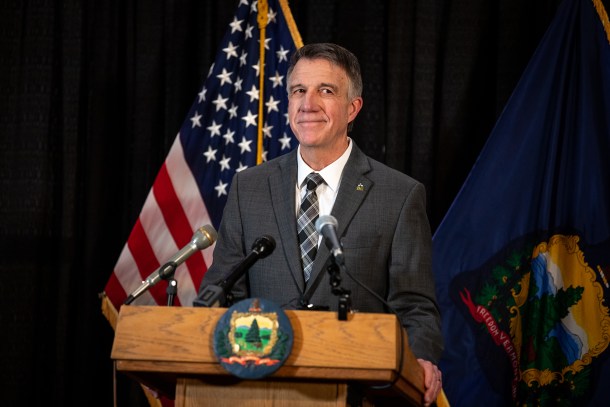

Gov. Dad at his weekly news conference on Tuesday gave state legislators a bit of a talking-to about their transparency practices.
Reporters’ questions on the issue were prompted by VTDigger’s recent coverage (shameless plug) revealing that state legislators for two years have utilized Zoom’s private chat function while in official, electronic public meetings. While legislators have patted themselves on the back for Covid-era steps forward in livestreaming public meetings, lawmakers’ private chats have not been archived. Now, they’re lost in the sands of time.
Gov. Phil Scott said he gives lawmakers the benefit of the doubt when it comes to their instant messaging habits, calling politics-by-Zoom “new territory.” However, he took the opportunity to jab the legislative branch for its prevailing lack of a code of ethics — a subject of intense debate this legislative session via S.171. Vermont remains one of only a handful of states without a statewide ethics code for lawmakers and government workers.
“I think they have many opportunities to be more transparent in a lot of what they do, as we have done in the executive branch,” Scott said. “For instance, we have a code of ethics, and we have to respond to all of your FOIA requests and so forth. The Legislature does not.”
“I think in this day and age,” Scott continued, “I think everything should be able to be FOIAed.”
He’s not mad. He’s just disappointed.
— Sarah Mearhoff
IN THE KNOW
Members of the Senate Committee of the Judiciary appeared to agree Wednesday on the merits of a bill that would prevent making civil arrests at a courthouse.
But they put off voting on the proposed law because they weren’t sure who could face penalties for violating it.
What’s worrisome, Sen. Joe Benning, R-Caledonia, said, was what could happen if U.S. Immigration and Customs Enforcement agents make such an arrest and that person taken into custody is housed in a state correctional facility.
“I just don’t want to vote for something if there’s any threat to Vermont employees who are somehow wrapped up in this chain and called as assistants for doing whatever ICE’s bidding was,” Benning said.
Committee members decided to put off a vote on the bill, S.140, until Friday as they search for clarity.
— Alan Keays
Approximately 5% of Vermont adults have a previous felony conviction, a Brennan Center for Justice attorney told lawmakers Wednesday. This percentage is significantly higher than our neighbors to the east and west: In New Hampshire and New York, that figure is about 2% to 3%.
Lawmakers have returned to the issue of sealing criminal records. And while the bill under consideration, H.534, would only impact a subset of felony records (generally property crimes, such as credit card fraud or counterfeiting money), it would cover all misdemeanor records except for specific exemptions.
The current draft has mostly scrapped the word “expungement” — which has proven controversial before — except for municipal violations.
Wednesday’s testimony in support of the measure brought together an unexpected pair of allies: The Brennan Center, a think tank affiliated with New York University School of Law, and … JPMorgan Chase. The financial titan “banned the box” in 2019, striking any questions about criminal history from its job applications.
Witnesses from both organizations pitched sealing records as not just a question of justice, but also an economic measure to boost Vermont’s workforce. They suggested the committee could go further than its current proposal, in which an individual must specifically ask the court to seal their records — referred to as a “petition-based” process.
The “gold standard” for sealing records is an automatic process as it doesn’t burden individuals with an additional legal procedure, Ames Grawert, Brennan Center senior counsel, told the committee.
Nan Gibson, executive director of JPMorgan Chase’s policy center, cited a 2020 study which found that in Michigan’s petition-based system, only 6.5% of people eligible for expungement had successfully received it.
— Riley Robinson
The House Judiciary Committee is considering a bill that would make it easier for Vermonters to win discrimination cases in the realms of employment, housing, education and public accommodations.
The committee walked through revisions to the bill, H.534, Wednesday afternoon. Most of the text of the bill homes in on employment law and includes sexual harassment alongside other forms of discrimination.
Current employment law requires that the person making a complaint show the discriminatory behavior was either severe or pervasive — meaning one event was particularly egregious or the behavior was repeated over time. This bill would end that requirement, so one instance could count as harassment.
The bill states that whether an employee first filed an internal complaint shouldn’t matter when they decide to make a legal case. It would no longer matter in court whether an employee laughed off an act of discrimination or spoke up about it in the moment. The employee also would no longer be required to compare their treatment against a colleague’s to prove something was discriminatory.
If passed, the bill would also change how courts consider the effects of discrimination. It wouldn’t matter if someone kept succeeding at a job after they were harassed. An employee would no longer have to show the behavior impacted their performance, just that it impacted their work.
— Riley Robinson
Vermont’s two largest credit unions are planning to become one.
New England Federal Credit Union and Vermont State Employees Credit Union announced Wednesday that they plan to merge. The move, which requires regulatory and member approval, could be finalized by early 2023, according to the organizations.
— Ethan Weinstein
ON THE MOVE
The House passed one of the bills to amend Burlington’s city charter, H.448, on Wednesday, so it will now proceed to the Senate.
The body also passed H.456, which seeks to create goals and reporting requirements for the Vermont State Colleges.
— Riley Robinson
WHAT’S FOR LUNCH
We’re feeling major Hump Day vibes today here at Final Reading. Asked for Thursday’s menu, Chef Bryant Palmer sighed and rubbed his eyes. “What am I doing tomorrow?” he asked, sounding tired or resigned or filled simply with existential dread. (I may be projecting.)
But then he rallied, as must we all: The special tomorrow will be herbed polenta with wild mushroom ragu.
That sounds pretty delicious. And hey — at least it’s almost crossover.
— Lola Duffort
WHAT’S ON DECK
THURSDAY, FEB. 24
9 a.m. — Senate Economic Development, Housing and General Affairs has scheduled a possible vote on its omnibus housing bill, S. 226.
10:15 a.m. — Senate Judiciary discusses qualified immunity for police officers.
1 p.m. — House Education gets schooled on “Education Financing 101.”
WHAT WE’RE READING
Most small communities limiting big spending this town meeting season (VTDigger)
Bronze medalist Megan Nick on going from gymnastics to Olympic aerial skiing, and her Vt. roots (VPR)
