


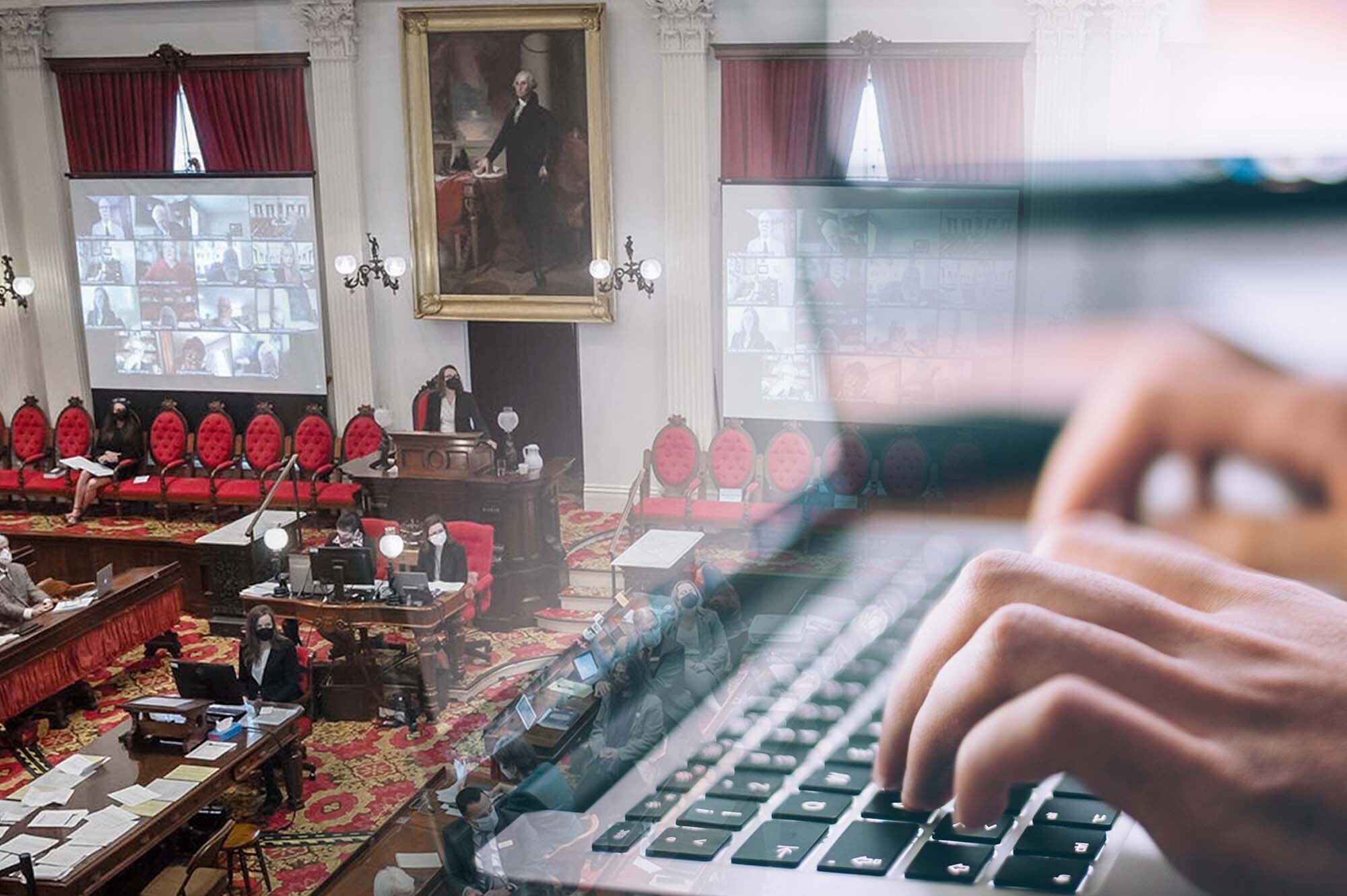
Over the past two years, the Vermont Legislature has regularly debated how to continue its work during a pandemic while preserving public accessibility. In some ways, according to advocates for government transparency, remote lawmaking has made the process more visible to the public — because committee and floor debates are now available via YouTube.
“Every committee meeting is now open to the public in real time, or afterwards,” said Paul Burns, executive director of the Vermont Public Interest Research Group. “That was not true before.”
But the shift to remote legislating also has made it easier for lawmakers to communicate among themselves during public meetings — out of the public eye.
While committee meetings are now conducted using Zoom and broadcast over YouTube, legislators have used Zoom’s private chat function to communicate among themselves. Members of the public cannot view the chats and those chats have not been archived. Potentially two years of communications have now disappeared into the ether.
In one such chat shared with VTDigger by a member of the House, lawmakers privately debated whether a vote they had just taken on the floor had been conducted properly. The chat, which took place during the first week of the legislative session in January, was available only to members of the House and their staff. A dozen members piped up during the exchange, which related to a ceremonial vote of the House.
“We aren’t allowed to unmute and can’t vote,” wrote Rep. Mari Cordes, D/P-Lincoln.
“Ummmm no vote was taken!” responded Rep. Barbara Murphy, I-Fairfax.
“We were blocked from voting!” wrote Rep. Anne Donahue, R-Northfield, adding later, “No(t) sure this was a legal vote… We should be able to get this right by now. No fake processes.”
The Zoom chat function has since been deactivated during floor proceedings, according to House Speaker Jill Krowinski, D-Burlington. She said this was because many representatives have returned to the Statehouse.
Both Krowinski and Senate President Pro Tempore Becca Balint, D-Windham, said that by “custom and practice” the Zoom chat function is only to be used for “logistical and technical communications,” and not for any substantive discussion.
“We’ve been very clear with our chairs and staff that that is the purpose and it is not there for anything else,” Krowinski said.
After VTDigger asked legislative leadership earlier this month about how the chat function is used, committees changed their Zoom settings to restrict chat messages.
“In an effort to improve implementation of the policy limiting chat to logistical communications, all committees in both chambers have adjusted Zoom settings to only allow direct chats between participants and host (the committee assistant) or co-hosts,” Carolyn Wesley, Balint’s chief of staff, wrote in an email to VTDigger.
Mike Ferrant, director of the Office of Legislative Operations, confirmed that the chats are still not archived.
When the Legislature first set up the streaming system in 2020, leaders wanted streams of their Zoom meetings to be available on YouTube in real time, Krowinski said, and “it was just in that process that we said (Zoom chats aren’t) going to be kept or recorded.”
They also considered potential storage capacity issues, she said.
In the Senate, the Zoom chat function has never been enabled during floor proceedings, nor was that ever a consideration, according to Balint. Unlike the House, the Senate has never allowed use of electronic devices in the chamber while in session.
Senate committees use the chat function to alert a committee chair or assistant about a technical glitch in the livestream and do not discuss policy in the chat, Balint said.
However, there is no way to independently verify how the Legislature’s chat function has been used, since it is not archived.
“If we can figure out another way to do that in real time, so that we’re not getting messages that our meetings are not being aired, then I am open to another solution,” Balint said.
Legislative custom and practice is conveyed to members through memos and trainings, Krowinski said.
“As we’re all working through this transition with coming back into the building, I think people have been trying their best to get it right, and be able to do our work,” Krowinski said.
It’s fairly routine for lawmakers to communicate privately through text or email, said Lia Ernst, legal director of the ACLU of Vermont. However, emails or texts discussing public business can later be retrieved through a public records request. Ernst compared deleting Zoom chats to discussing legislative business on Snapchat.
“Insofar as they are relevant to the public’s business, they ought to be publicly available,” Ernst said.
Public records law, as well as written guidance from the Vermont Secretary of State’s Office, affirms that any time a quorum, or majority, of a public body communicates online, it constitutes a meeting — whether that’s in an email chain, a group text or on social media. Even collaborative editing on a single Google Doc could fall under the definition of a meeting.
“In general, if a quorum of a public body gathers to discuss the body’s business, a ‘meeting’ is being held,” Vermont Secretary of State Jim Condos wrote in guidance published in 2019.
Communications that are strictly logistical, such as for scheduling, are the exception under Vermont law, so long as they are “available for inspection” as a public record, according to guidance from the Vermont League of Cities and Towns.
Condos, who has long advocated for open government practices, said his agency has no investigative or enforcement powers and that he was “not privy” to the Legislature’s directives.
“The members of the Legislature are well aware that deliberations and decision-making should be made where the public can see, not in a private, invisible chat room,” Condos said in a written statement. “I could see the ‘Chat Function’ being used for non-substantive items like ‘I’m going to the bathroom,’ or ‘I need to walk my dog[’] or ‘have a nice weekend’.”
According to Burns, the VPIRG leader, the Legislature’s failure to archive Zoom chats was likely a mere oversight when it shifted online. He noted that Vermont governance has a unique culture that generally strives for broad public transparency, beyond what other states have put in place.
“I don’t know if it’s being misused,” Burns said of the Zoom chat function. “But the problem is that nobody knows.”
