

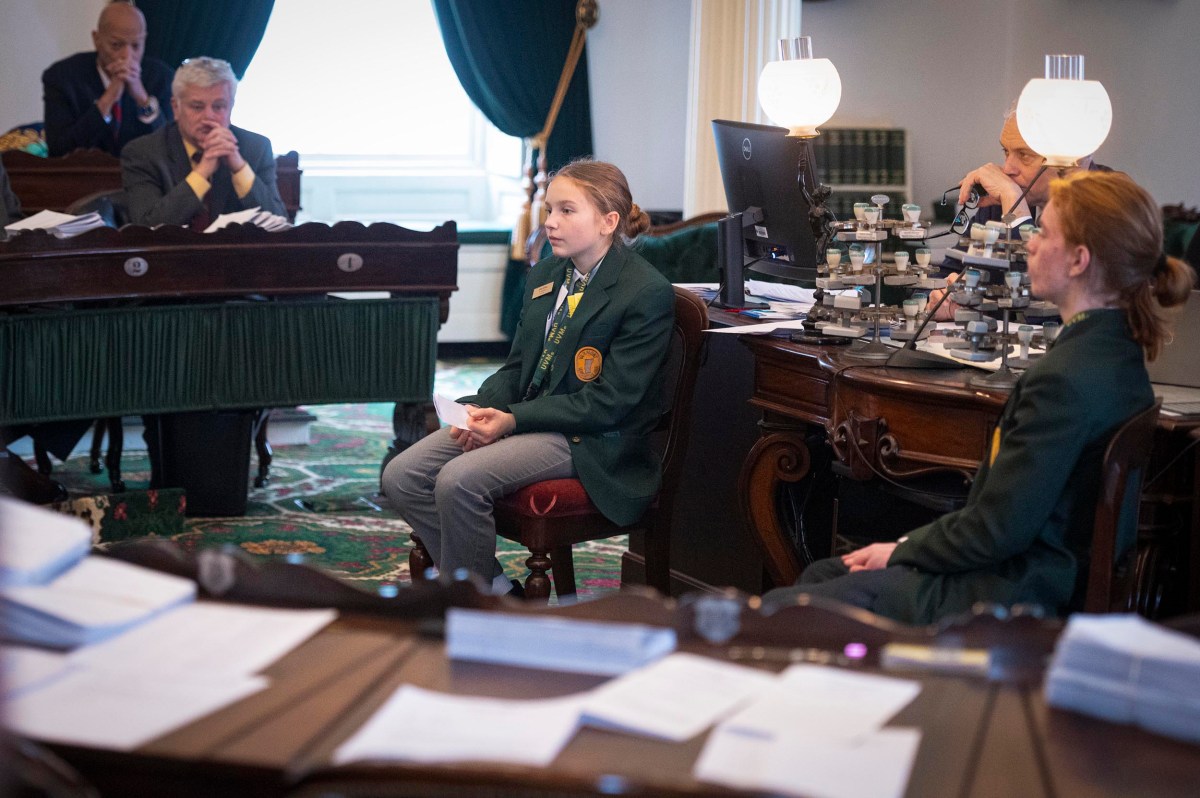
There are a host of historic fixtures adorning the Vermont Senate chamber, far from the least of which are the black leather chairs stationed behind each senator’s desk. But for the legislative pages tasked with attending to lawmakers’ needs during floor sessions, the seating has long been less luxurious: small, wooden stools with no backs and scant cushioning.
“If there had been any padding — like, ever — it was gone by the time I got on it,” said Braeden Schuren Burns, a Montpelier High School ninth-grader who worked as a page last year.
Schuren Burns was leaving the Senate one day when he wondered aloud whether the stools, which are historic in their own right, could get an upgrade. Senate President Pro Tempore Phil Baruth, D/P-Chittenden Central, overheard him, Schuren Burns said. Much to the student’s surprise, the pro tem struck up a conversation and then decided to take on the cause.
Baruth had Schuren Burns testify about his seating experience before the Senate Rules Committee, after which the panel voted, unanimously, to have the stools replaced.
The result? “You will notice they are sitting in chairs,” Baruth said on the first day of the 2026 session earlier this month, referring to the two pages seated in the chamber that day.
The chairs, which have thick, red cushions and tall backs, were previously situated around a table in the lieutenant governor’s office, according to State Curator David Schutz. They’re not exactly of the same style as the rest of the 1859 chamber, he said, but do a good enough job fitting in. The color of the cushions, for instance, matches red details in the room’s carpet.
Baruth said that while the chairs will be in place during the session, Statehouse staff may swap the old stools back in once the Legislature adjourns for the year. Lest tourists get the wrong idea: The Senate has long made middle-schoolers suffer in the name of historic preservation.
In fact, Schuren Burns isn’t the first to raise the issue in the roughly 100 years that teens have served as pages. Senate Secretary John Bloomer’s office directed VTDigger to a 1969 joint House and Senate resolution proposing, per legislative records, to “study the need for cushions for the pages’ stools.”
“Whereas they are less well padded against discomfort than their elders, and whereas, their discomfort leaves them sorely aggrieved,” it reads, the Sergeant-at-Arms ought to work with leadership to find “a method of alleviating the plight” of the building’s youngest staffers.
It only gets better from there. The House and Senate ended up sending the resolution to a conference committee, which settled on new language stating “that a proper package deal of broken resolves, green schist, talc, and stuffed shirts, encased in Morgan horse hide, be applied to the hardwood stools,” as well as “that the stools be painted a Pavilion brick color.”
“And be it further resolved,” the measure continues, “that the cost of these refinements be footed from the general fund surplus expected from the sales tax or the lieutenant governor’s slush fund, whichever is the greater.”
That Senate in 1969 deadlocked on a vote to approve the conference committee’s report, which, to be sure, seems like it was more of a civics education effort for the pages than anything real. Regardless, procedures played out; and in a tie-breaking vote, the LG shot the plan down.
No doubt he was protecting his secret stash — at the expense, of course, of pages’ comfort for decades to come.
— Shaun Robinson
In the know
“All roads lead to the Northeast Kingdom,” at least according to U.S. Sen. Peter Welch, D-Vt., who stood before a packed Cedar Creek room this afternoon to rally support during the region’s Statehouse takeover day. On either side of the lunchtime rally, local advocates, elected officials and NEK residents testified on a range of issues that hit close to home.
Welch was joined by State Treasurer Mike Pieciak; Rep. Michael Marcotte, R-Coventry; Rep. Leanne Harple, D-Glover; and fellow Glover resident Lt. Gov. John Rodgers in summing up the matters most pressing to NEK residents: how to attract and keep young people in the area, how to build affordable houses that allow people to own a patch of land and how to support farmers who rely on marketplace health insurance and have recently lost the enhanced subsidies that helped keep plans affordable.
But the biggest applause of the day went to Harple, in her plea to keep small schools small: “A small school isn’t a failed school. A rural school isn’t a business mistake,” she said. “We can’t legislate away geography. We can’t consolidate rural life, and we can’t remap Vermont into being something it’s not.”
— Olivia Gieger
Vermont Education Secretary Zoie Saunders on Thursday presented lawmakers a proposal to “modernize and enhance” the state’s career and technical education system by establishing a single regional governance entity to oversee its delivery.
Saunders addressed lawmakers during a joint meeting of the House Education Committee and the House Commerce and Economic Development Committee, as well as the Senate Committee on Economic Development, Housing, and General Affairs.
Currently, career and technical education centers in Vermont serve around 5,000 students, but most centers have long wait lists.
There are 17 career and technical education centers, with four varying governance models overseeing them, according to Ruth Durkee, state director of career and technical education.
Saunders said this “makes the overall system more complex.” Students’ access to career and technical education centers, meanwhile, is often limited by their proximity to a center.
The testimony offered some insight into Saunders’ thinking for the future state of public education as lawmakers and officials this session work toward the reform envisioned by Act 73.
The regional agency overseeing career and technical education would “be that bridge until we, as a state, get to the future where we have regional comprehensive high schools, where all students are enrolled in a high school, co-located with the CTE center and all of that programming is seamlessly delivered,” she said.
In these regional high schools, students would be offered “blended pathways” to both career and technical education opportunities as well as traditional learning.
“The idea here is to make sure that it’s not a separate option, that CTE is infused in how we develop and design our education programming across the state,” she told lawmakers.
— Corey McDonald
On the move
“Public trust is key, right?” said Jeffrey Amestoy, former chief justice of the Vermont Supreme Court.
Amestoy, also a former Vermont attorney general, authored the majority opinion in the 1999 state Supreme Court ruling that found the state had no legal basis to discriminate against same sex couples. That lawsuit later led lawmakers to legalize civil unions for same sex couples.
He’s no stranger to controversy and political backlash — and Thursday he encouraged senators in the Judiciary Committee to remain apolitical and look at the qualifications of Christina Nolan and Michael Drescher, the governor’s two recent nominees for the state Supreme Court, when considering them for confirmation. Both nominees previously served as the top federal prosecutor in Vermont under President Trump.
Baruth asked Amestoy: “Is there a difference in attitude that justices need to bring?”
Judges always need to be sensitive to the times they’re living in, Amestoy said. But he emphasized that a candidate’s integrity and qualifications may say more about their ability to uphold Vermont values than their political background.
Sen. Welch called both candidates “really solid attorneys” during a press scrum in the card room Thursday.
He condemns prosecution on behalf of Trump that is politically motivated, he said. “But I have not heard anything suggesting that either of them were involved in anything related to a political motivation,” Welch said.
— Charlotte Oliver
From Davos, with love
Did you have ‘Vermont mentioned at Davos’ on your 2026 bingo card? Me neither.
JPMorgan Chase CEO Jamie Dimon, arguably the world’s most influential banker, used his bully pulpit at the World Economic Forum Wednesday to criticize President Trump’s idea to cap credit card interest rates at 10%. And he threw in a cheeky nod to the Green Mountain State.
Dimon warned Trump’s idea would cut off many Americans from accessing credit, Reuters reported.
Per Reuters: “I think we should test it,” Dimon said. “The government can do it, they should force all the banks to do it in two states — Vermont and Massachusetts — and see what happens.”
— Ethan Weinstein
Overheard
“That’s alright; it’s better without shoes,” said Rep. Theresa Wood, D-Waterbury, who carried her pumps into the House Human Services Committee meeting just in time for its 1 p.m. convening.
— Olivia Gieger
