

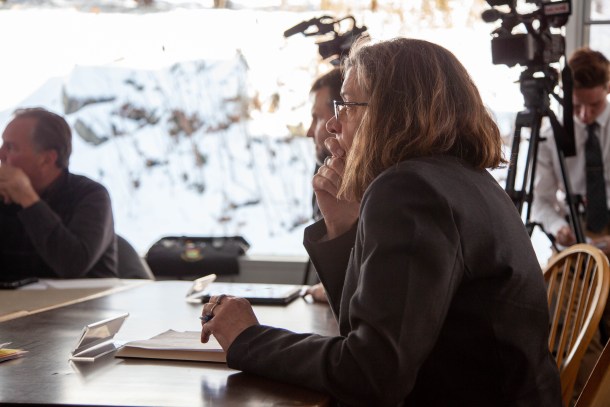
In just five months, the Vermont Climate Council must complete its plan for how the state can drastically reduce its carbon emissions.
With time dwindling, the 23-member council is working around the clock, and reports it is on schedule to adopt the plan by Dec. 1 — setting up what lawmakers say will be the road map for Vermont’s drive to cut greenhouse gas pollution and combat climate change.
The climate council was formed by the Global Warming Solutions Act, enacted in 2020. Gov. Phil Scott vetoed it, but the Legislature voted to override the veto.
The law requires Vermont to reduce greenhouse gas pollution to 26% below 2005 levels by 2025. Emissions must be 40% below 1990 levels by 2030, and 80% below by 2050.
In recent years, Vermont’s carbon emissions have been increasing.
Secretary of Administration Susanne Young, chair of the council, said the December plan will focus on strategies for meeting the 2025 goals, then expand into how best to meet the 2030 and 2050 targets.
“The world is changing and we’re going to have to keep up with it and not just stop the work that we’ve done on Dec. 1,” Young said.
Now, climate council subcommittees are working on draft strategies, which will be presented to the full group July 26. Those five panels are the Agriculture and Ecosystems subcommittee, the Cross-Sector Mitigation subcommittee, the Just Transitions subcommittee, Rural Resilience and Adaptation subcommittee, and the Science and Data subcommittee.
Young said the just transitions panel, which aims to ensure the climate action plan is equitable for all Vermonters, is close to finalizing a public engagement plan that is “integral for the rest of the council.”
“This is really kind of a key part of the Global Warming Solutions Act,” Young said. “It’s looking at how are we going to do this in a way that is just, affordable and does not have an adverse impact on the most disadvantaged — the rural communities, the marginalized communities and low-income Vermonters.”
The council plans to finish an initial draft of the climate action plan by early October. A public comment period would run through October, giving the council all of November to make adjustments and then adopt the plan by Dec. 1.
Some of the parts will still require legislative approval, and others will have to go through a rulemaking process.
On the legislative front
Sen. Chris Bray, D-Addison, who chairs the Senate Committee on Natural Resources and Energy, said he wants to make sure homeowners have access to weatherization efforts, modifying buildings to reduce energy consumption and optimize energy efficiency.
The Legislature has made weatherization a top priority in recent years, and Bray said that will continue in 2022.
“There’s no conceivable version of the climate action plan that doesn’t say ‘we need to do better on weatherization,’” he said. “And there’s no conceivable version of that plan that doesn’t say ‘we need to reduce fossil fuel use.’”
Bray said his goals include making sure homes are more energy efficient and then ensuring there are “cleaner ways” of getting energy to Vermont’s homes.
He also expects a major push on the transportation front to reduce emissions from vehicles.
“We are not reacting swiftly enough and I’m very committed to helping Vermonters pick up the pace on things that we already know how to do,” Bray said.
Rep. Laura Sibilia, I-Dover, said she expects the climate action plan to be a “gut check on where we’re at and what’s needed” as Vermont looks to reduce greenhouse gas emissions.
Sibilia, vice chair of the House Committee on Energy and Technology, said she hopes the Legislature will adopt legislation next year that supports and builds on the climate council’s work.
She added that it’s important to make good use of the $50 million in federal money that the state earmarked for climate initiatives in the fiscal year that began Thursday.
The $7.32 billion budget commits $20 million of the federal money to weatherization efforts, and another $20 million to the Clean Energy Development Fund, dedicated to expanding renewable energy in the state.
Lawmakers and the governor have said they also want to spend an additional $200 million on “climate mitigation efforts” and about $100 million more on clean water projects in the coming years, using American Rescue Plan Act money.
“We have to make sure that we’re moving on it,” Sibilia said. “We have an opportunity to employ dollars in a really effective way.”
Showing the way
Bray’s counterpart in the Vermont House of Representatives, Rep. Tim Briglin, D-Thetford, said the climate council’s work should help the Legislature “prioritize where to direct that funding.”
“I would view the ARPA funds and some of the direction and guidance we get from the climate council and the climate action plan as the accelerant, if you will, to help Vermont transition to a less greenhouse gas emission economy,” said Briglin, who chairs the House Committee on Energy and Technology.
Briglin plans to have his committee hold a hearing with the climate council in late July or early August for a status update on its work.
Young said that, while the state is in an enviable position, it is far too early for the climate council to begin deciding how the money could be spent.
“We really won’t know what we’re financing until the climate action council has produced its strategies and produced a plan,” Young said.
