

Jon Margolis is a VTDigger political columnist.
Like every other state, Vermont has its myths. One of them – encapsulated in the slogan, “Vermont is what America was” – is that life here is more personal, less remote than elsewhere.
The rest of the country may be digitized, automated, detached. Vermonters value the local. They communicate neighbor-to-neighbor, face-to-face. In politics, they have to be persuaded, preferably in person, because their votes can’t be bought via high-tech, programmed, electronic marketing.
Tuesday’s primary proved that this myth is true.
Except when it isn’t.
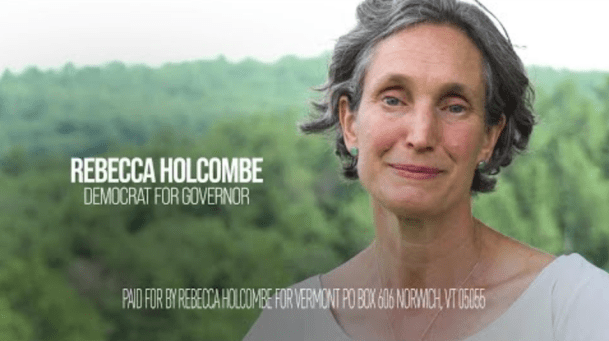
Former Secretary of Education Rebecca Holcombe raised and spent much more money than her primary opponent, Lt. Gov. David Zuckerman, spending a great deal of it on television commercials in her campaign to become the Democratic candidate for governor.
She didn’t exactly “blanket the airways.” But anyone who watched even a modest amount of TV for the last month couldn’t have missed seeing one of her ads, probably a few times.
Zuckerman, who raised less than two-thirds of the money Holcombe did, bought some TV time, too. But he was more a blip than a presence on the screen, leading some Democrats to expect at least a close race, if not a Holcombe victory. Zuckerman himself, the day before the primary, said awaiting the results Tuesday “might make for a long night.”
Not so long. At 9:18 Tuesday night, the Associated Press called Zuckerman the winner of the primary and the candidate who will face incumbent Republican Phil Scott on Nov. 3.
And it wasn’t close. By the time (almost) all the votes were counted, Zuckerman had a 10 percentage-point edge.
In this race, Zuckerman’s 20 years of personal contact with voters outdid Holcombe’s two months of professionally adept messaging.
But if Holcombe’s commercials did not work, Molly Gray’s did. Gray was less well-known than Holcombe. Neither had ever before run for or held elective office. But Holcombe had spent four years as secretary of education. Gray is an assistant attorney general.
How many Vermonters (or Americans) can name a single assistant attorney general?
But Gray defeated Senate President Pro Tem Tim Ashe for the nomination for lieutenant governor. She did it by raising a lot of money and introducing herself to voters with television commercials. It isn’t that the TV ads were all she had going for her. She has an impressive resume. She had the support of such respected and influential Democrats as former Gov. Madeleine Kunin. The fact that she could raise all that money is itself a testimony to her ability to convince people that she could be a good candidate and an effective public official.

But, had it not been for her TV blitz she would not have beaten Ashe, who had been the Senate leader for four years, a Burlington City Council member before that, and at one point a candidate for mayor of Burlington. He had at least a modest (and largely positive) public profile. She had none. So she created one for herself and won by a hefty margin, 44%-to-33%.
The verdict on the power of money and of television advertising was also mixed when it came to the races for Chittenden County’s six state Senate seats.
The biggest winner was just about the lowest spender – Sen. Ginny Lyons, first elected to the Senate 20 years ago. Her constituents know her and they must like her.
TV ads? She had lawn signs. Who needs high-tech communication skills? This is Vermont.
The three other incumbents – Philip Baruth, Michael Sirotkin and Chris Pearson – also won renomination despite neither raising nor spending much money.
But the winners of the two open seats – Kesha Ram and Thomas Chittenden – were the candidates who raised and spent the most money. So even in Vermont, money can make a difference.
But not necessarily money spent on television. One candidate, Adam Roof, became one of the few state Senate candidates ever to buy TV time. They were pretty good ads, too. He finished 11th.
Perhaps one reason Holcombe’s TV ads didn’t work is that they violated another aspect of Vermont’s myth about itself – that however effective it may be elsewhere, “going negative” does not work here.
Holcombe went negative. One of her ads said that while Zuckerman “was a nice man … he’s questioned the science behind vaccines.”
He did, once. So the ad was not inaccurate. But it may have backfired. Zuckerman is not an “anti-vaxxer” nor is he anti-science. He makes his living as a vegetable farmer, and as he noted, if he ignored science, he’d have gone broke years ago.
Voters seem to have known that Holcombe’s attack was a bum rap. That’s because they know Zuckerman.
“I have been in people’s living rooms and church basements and library meeting rooms and cafes for 20 years,” he said. “I’ve been to the county fairs for years and years.”
He used to arm wrestle with them, he said, always losing. “I got crushed,” he said. “I’m a vegetable farmer. Those dairy farmers whipped my arm right down.”
Bad arm wrestling. Good politics. He connected with voters.
Why couldn’t Ashe?

Partly because he hasn’t been at it as long. At 43, he’s only five years younger than Zuckerman, but he didn’t run for office until 2004, a decade later than Zuckerman started.
But it’s also a matter of personality. Zuckerman is a schmoozer. Ashe is not. He’s by no means unpleasant, but sometimes a bit aloof. More of an intellectual than most politicians (a master’s degree from Harvard, after all), he has a puckish sense of humor that not everybody gets right away.
Ashe has been an extraordinarily successful Senate leader, and more than half his Democratic caucus endorsed his candidacy. But he’s “only” a legislative leader. Political junkies keep learning (well, they keep being taught) that most voters pay little attention to their state legislatures, whose leaders therefore do not get famous.
Another way in which Vermont – regardless of its myths – is just like everyplace else.

