


Editor’s note: This article was updated at 7:57 p.m. on July 23 with a response from Seven Days publisher Paula Routly.
BURLINGTON — On a sweltering hot afternoon in early July, Sen. Tim Ashe arrived punctually in Burlington’s Battery Park, overlooking the marina and Lake Champlain, with the Adirondacks visible in the distance through the humid haze.
Just two weeks removed from the adjournment of a prolonged legislative session dealing with the Covid-19 crisis, the outgoing leader of the Senate looked refreshed and cheerful, sporting a T-shirt and suit pants.

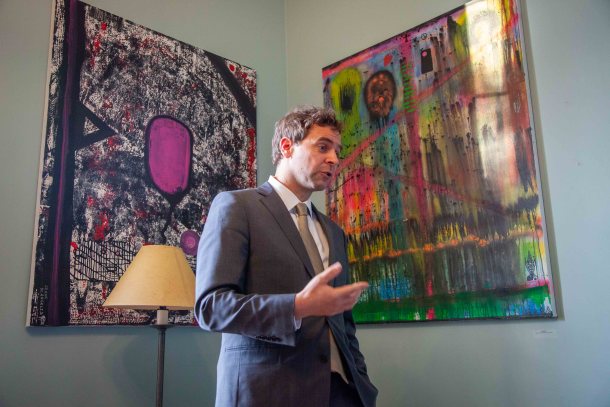
The athletic 43-year-old arrived for the interview with an opened umbrella to shield himself from the sun, in one hand, and a blazer and dress shirt (to be donned for a portrait to accompany this piece) in the other. Ashe said he had gone on a 6-mile run earlier in the day.
Now with the Statehouse’s initial coronavirus response wrapped up, Ashe has at least temporarily shifted his focus from marshaling legislative action to his bid for lieutenant governor — in a four-way race for the Democratic nomination that could very well be the most competitive statewide primary this year.
Since January, when he first announced he would be making a run for the second highest office in the state, Ashe has been stuck in Montpelier, along with fellow candidate Sen. Debbie Ingram, D-Chittenden. The other two contenders, Molly Gray and Brenda Siegel, an assistant attorney general and arts administrator, respectively, have been campaigning hard for months.
Ashe says his inability to campaign since March has been a major setback in his campaign for lieutenant governor. But it doesn’t weigh heavily on him. He is proud of his work leading the Senate’s response to the coronavirus crisis.
“The experience of the three and a half months working with the governor, working with the speaker, has been the most difficult but most rewarding service of my adult life without any close cousin,” he said.
With lawmakers on recess until Aug. 25, which will mark Ashe’s last turn as the pro tem, the upcoming primary will determine whether he moves to a new office in the Statehouse or leaves the Golden Dome entirely.
The race for lieutenant governor will test whether the Senate leader’s popularity in Chittenden County can translate into statewide political success.
Ashe is almost entirely running on his record of more than a decade in the Legislature, where he has proven to be more of a political pragmatist than progressive torchbearer, despite his political roots with Sen. Bernie Sanders, I-Vt., and Burlington’s Progressive Party.
Now, in his first statewide bid, Ashe is aiming to turn that experience and connections he has developed with senators, and the leading candidates for governor, to his advantage.
“I really do look forward to playing that in between-role, between the governor and the Legislature,” Ashe said of the lieutenant governorship, adding that he has strong working relationships with Gov. Phil Scott, Lt. Gov. David Zuckerman and former Education Secretary Rebecca Holcombe, the top contenders for the state’s top office.
“Obviously, I have a lot of legislative history,” Ashe said. “I wouldn’t be there in the managerial role that I’ve been in, but rather as someone who can be looked to for support and guidance.”
As lieutenant governor, Ashe said he would build on his work as the Senate pro tem and continue pressing for proposals to close the inequality gap between the “two Vermonts.” This will include a focus on climate change measures, including a potential weatherization bond for commercial and residential properties, new public transportation strategies and pushing for subsidies to make electric and fuel efficient vehicles more affordable.
Ashe said he would also work to rectify one of the biggest disappointments from his time as Senate leader: failing to see a 24-hour waiting period for handgun purchases get enacted. The House and the Senate passed the measure in 2019, but it was vetoed by Scott and the House could not muster the numbers for an override vote.
“As lieutenant governor, I will make sure I’ll go to every single House district where someone voted against it, and I will do whatever organizing I have to do to get that done,” he said.
Ashe’s political rise
Ashe got into politics just after he graduated from the University of Vermont and landed a job in Sanders’ congressional office. Before that, Ashe says, he had been thinking about becoming a teacher, following in his mother’s footsteps.
He stuck with Sanders for about four years — overlapping with now current Vermont state Sen. Chris Pearson, P/D-Chittenden, for a few months early on in that time. But it wasn’t until after he left Sanders — telling the Vermont independent he needed to forge his own political path — and received his master’s degree in public policy from Harvard University’s John F. Kennedy School of Government in 2004, that Ashe’s political ascent began.
That same year, Ashe won a seat on the Burlington City Council as a Progressive, where he would remain until 2007. Ashe then ran for the Vermont Senate in 2008, claiming 28,103 votes — enough for the sixth Chittenden County Senate seat, which sent the then-32-year-old to the Statehouse.
“I was the 30th on the totem pole when I first arrived,” Ashe remembers. “I was absolutely free and liberated to speak for just myself and to think strategically based on what I believed was the right thing to do.”
Ashe, who was the top vote-getter in Chittenden County in the 2018 Senate election, also recalled that during his first two years in the chamber, he had only one conversation about a bill with then Pro Tem Peter Shumlin — a lack of communication that Ashe would look to rectify when he led the Senate 10 years later.
The old guard of the upper chamber was at first wary of Ashe. “When Tim was first elected he was seen as this Progressive-Democrat,” said Sen. Dick Sears, D-Bennington, who has worked with Ashe on both the judiciary and appropriations committees.
“There was a question about how will he approach issues — is there going to be a high degree of ideology at work,” said Sen. Jane Kitchel, D-Caledonia, of the initial skepticism toward the new senator.
Ashe almost exited the Statehouse in 2011, when he decided to run for mayor of Burlington, seeking both the Progressive and the Democratic nominations. The race ended in a dead heat between Ashe and Miro Weinberger for the Democratic nomination. The state senator ultimately lost in a runoff, 655-533, and decided to bow out and support Weinberger — who is still the mayor — rather than continue as a Progressive.
After his mayoral defeat, Ashe successfully retained his Senate seat in the 2012 election. Back in Montpelier, he became the chair of the Senate Finance Committee, which handles tax policy and telecommunications issues.
During that time, he developed a reputation as a shrewd political operator with a tenacious work ethic. Ashe calls himself a “bookworm;” Sears calls him a “nerd” for poring over legislative reports that no one else bothers reading.
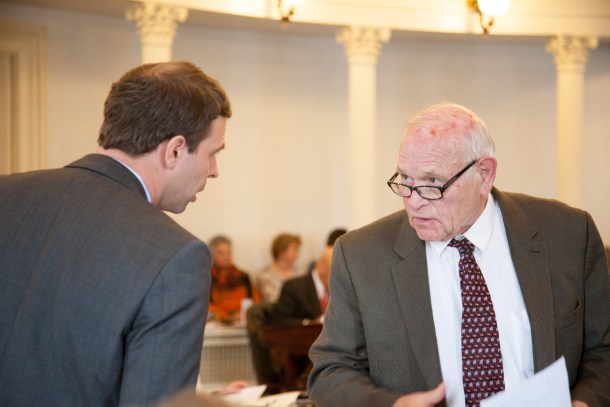
Asked about her initial concerns, Kitchel — who is Ashe’s campaign treasurer — laughed and said the notion that he was merely an extension of the Burlington Progressives was proved false 10 years ago.
“He’s not driven by ideology,” she said. “He will look at things on the merits.”
“He’s way more practical than I would have thought,” said Sen. Richard Westman, R-Lamoille, about his perception of Ashe when he first arrived in the Senate.
Ashe describes himself as someone who has an “activist’s heart but the governance mind.” He added, “I’ve always been more interested in accomplishing things than feeling righteous and that is what it is. I don’t care what the definition of that is, about the labels.”
During Ashe’s time in the Senate, he has fostered connections with senior senators in the Democratic caucus, including Kitchel, Sears, Sen. Dick Mazza, D-Grand Isle, and Sen. Bobby Starr, D-Essex/Orleans. As one of three members of the Committee on Committees, Ashe has also had a hand in keeping all of these senators — some of the most conservative Democrats in the chamber — in their position as committee chairs.
“I think he cultivated relationships with a lot of the right people in order to put himself in a position of power, which is what politics is about,” said Sen. Anthony Pollina, P/D-Washington, who is also the chair of the Vermont Progressive Party.
At the beginning of the 2017 session, at the age of 40, the Democratic caucus elected Ashe to the pro tem position. He said his supporters included “the most conservative members” and “the most liberal members” of the caucus.
“I hope what that means is that I actually care what people think. I respect people who have opinions that aren’t exactly like mine,” he said.
Pollina said Ashe’s move to the middle has also appeared in his policy agenda.
The Progressive elder statesman pointed out that Ashe has been surprisingly closed to the idea of taxing the wealthy. “He’s been very moderate and has been more in sync with Jane Kitchel and Dick Mazza and those folks than with the more progressive members of the Senate,” he said.
Pollina, who used to host a radio program on WDEV and first met Ashe when he interned on the show in the early 2000s, added that the Senate leader has chosen “more of a middle path” politically.
“His hesitancy to raise revenue and look at tax reform in a more serious way is a problem for a lot of Progressives,” he said.

Ashe concedes that his first instinct is not to raise taxes but to meet the needs of the state with existing resources — and then look to additional revenues as a last resort. But he also points to his time heading the finance committee, when he and the Senate did raise nearly $50 million in new revenue from wealthy Vermonters and also brought in about $30 million taxes and fees from out-of-state financial firms.
“In recent years we have done a good job of making an already progressive tax code even more progressive,” Ashe said during a July 14 Vermont Progressive Party candidate forum.
End of session blow up
Ashe enjoyed success early on as Senate leader working with the lower chamber to move gun control legislation and approve a partial marijuana legalization bill — both of which the governor signed.
But the 2019 legislative session did not go as smoothly for Ashe — ending in disaster for the Democratic leadership. Lawmakers packed up and left Montpelier following failed negotiations between Ashe and House Speaker Mitzi Johnson, D-South Hero, on the Democrats’ two economic priorities — increasing the minimum wage and passing a paid family leave proposal.
Compounding frustration was that in the previous year the House and Senate had passed a $15 minimum wage and a paid leave proposal, only to have them vetoed by Scott.
“Some people forget that it’s not because we haven’t been able to get it done,” Ashe said. “Instead it was we did it the year before and the governor vetoed both and so it was an added stress trying to figure out ‘OK we can’t do what we did last time because we know where that went.’”
The end came when Johnson sent a letter to Ashe on the final day of session, demanding that he pick from a list of proposals before noon. When Ashe did not respond in time, finally heading up to her office in the mid-afternoon, it was too late.
Johnson adjourned the House shortly after Ashe left her office, and the Senate had no choice but to do the same after a few days of futile waiting. “That was not fun for me or for anybody, there’s no doubt about it,” Ashe said of those end-of-session events.

After adjourning, Ashe said he unplugged, hiked the Long Trail and had limited contact with the Senate Democratic caucus. But he did make a point of being in touch with Johnson to discuss the upcoming year.
He also redecorated the pro tem’s quarters, placing an assortment of modern art on the walls, including a large Jackson Pollock-esque painted heart, and bringing in new furniture to make the room more accommodating to visiting senators.
Looking back on how that session ended, Ashe said he hadn’t realized how anxious members of the Legislature were to go home, and added that he failed to properly communicate with Johnson about how they could arrive at a deal.
“I should have seen that that was coming, that the time had probably already come and gone and it was long due for me to go in and just work directly with Mitzi,” he said. “That was a moment that neither of us want to look back on much, and I think I committed myself at that point to really redoubling my efforts to be more communicative under those stressful moments.”
Through her chief of staff, Johnson declined to comment, saying that as a rule she is not weighing in on any of the statewide primary candidates.
But in December 2019, Johnson and Ashe held a press conference in which the speaker of the House said the disagreement between the two leaders was overblown in the press and not a symptom of a problematic working relationship.

“We tend, because it’s easy and we’re human, to look at disagreements in this building make them really personal but it’s really about the system of the people that we’re representing and trying to take care of,” Johnson said at the time.
Just weeks later, Ashe and Johnson returned to the Statehouse sounding like a united front and the House and Senate quickly agreed on a minimum wage increase to $12.55 by 2022 — much lower than the previous year’s Senate proposal which would have seen pay go up to $15 an hour by 2024 — as well as a $29 million paid leave policy funded through a mandatory payroll tax.
To little surprise, Scott once again vetoed both measures but the Legislature was able to mount an override for the minimum wage increase. However, Johnson fell one vote short in the House of the support needed to enact paid leave.
Results oriented business
During a Zoom committee hearing on June 26, Rep. Warren Kitzmiller, D-Montpelier, stated out loud an opinion held by at least a handful of House members.
“I like Tim Ashe — I like him, I like his politics, generally,” Kitzmiller began, speaking to a joint House committee hearing hammering out the details of police reforms.
Sensing trouble, Rep. Sarah Copeland Hanzas, D-Bradford, who chairs the House Committee on Government Operations, cut in.
“He’s probably watching right now so be sure to say some really nice things,” she said.
“I don’t care if Tim hears this, I like the guy,” Kitzmiller responded. “But there is one thing I don’t like about Tim. He loves to play the game. Politics to Tim is a game.”
Ashe speculated the perception expressed by Kitzmiller is the product of how often he has been involved in last-minute negotiations over the years, between his time as a committee chair and as pro tem.
“I was always in the end game, as they call it, and that’s the nature of the position,” he said. Generally, Ashe says he is more focused on policy results than what others think of him.
Under Ashe’s guidance, the Senate has passed abortion rights protections, sweeping gun control measures, marijuana legalization (but not tax and regulation), criminal justice reforms, climate change initiatives, as well as legislation to raise the minimum wage and paid family leave policies.
Ashe says he and Johnson have passed “some of the most progressive legislation in America” over the past three years.
Adam Necrason, a top liberal lobbyist in the Statehouse, said Ashe’s “agenda was unrelentingly focused on working people and so I was often thinking, how does this relate to people working for under $20 an hour because that’s who’s top of mind for Tim Ashe.”
“He’s obviously left-leaning,” said Senate Majority Leader Becca Balint, D-Windham, “but he’s also pragmatic and he will figure out what is a winner for policy, and for how it will play outside the building.”
As Senate leader, Ashe chose to move policies through compromise and by building consensus. “I believe that when you’re legislating — at the end of the day you don’t do a cutthroat winner takes all, where anybody who didn’t exactly agree with things, they lose out,” Ashe said of his leadership style.
Ashe has also tried to make sure the bills that he has helped to pass will stand the test of time, and endure the “pendulum swings” of political power that are bound to take place. And, he has made sure that he knows where his 30 members stand before a bill hits the floor.
“Tim does not like chaos,” said Balint. “He likes to run a tight ship.”
“He pretty much knew where people stood because he’d had those conversations beforehand,” she added. “But if you turned over on the floor, without letting him know — just like anyone — he would take it personally.”
Sen. Joe Benning, R-Caledonia, who leads the chamber’s handful of Republicans, said he has an excellent working relationship with Ashe. Despite their ideological differences, Benning believes Ashe has been an effective leader.

“He’s definitely a pragmatist followed immediately by a Progressive,” Benning said. “He’s very quick to use the government to solve people’s problems, and I’m more inclined to believe that the more government we have the more problems people have.”
Although few in Montpelier’s halls of power will speak poorly of Ashe on the record, Kitzmiller isn’t his only critic.
Some think his stony-faced march down the halls of the Statehouse — in which he doesn’t make eye contact or idle chat with passersby — is off-putting. To the press he can also appear prickly and secretive about the state of play.
Ashe admitted that he is often reluctant to share the Senate’s plans with the media because he does not want to make a promise he cannot keep.
“That comes across to some as ‘he won’t tell us what the plan is.’ The truth is because I’m not foolish, I know there is no answer to what we’re going to do because we have to deal with not only committees internal to the Senate, then we have to work with the House. Then we have to deal with the governor,” Ashe said.
“It’s not like things are pre-written. And I’m not going to be one of these people who comes out just because I want to act like I have all the answers and say something for the headline,” he said.

During Ashe’s tenure as Senate leader, he has been an outspoken critic of the influence wielded by lobbyists, and has received the reputation for famously avoiding talking to lobbyists. Much of the Statehouse lobbying corps, in return, is not a fan of the pro tem.
One of the inside jokes among some lobbyists is calling Seven Days the “Ashe News Network,” a reference to Ashe being the longtime domestic partner of Seven Days publisher and co-editor Paula Routly.
Routly, in an emailed statement, said that Seven Days’ news editors “took great pains” when Ashe’s political career began to develop a “robust conflict of interest policy.”
Routly has removed herself from involvement in the publication’s Statehouse stories, as she did for city politics when Ashe ran for mayor in 2011. Seven Days also runs a disclosure at the bottom of every story that mentions Ashe, noting that he is Routly’s partner.
“The suggestion that Tim has any influence at Seven Days is deeply insulting to me and our news team,” Routly said. “It’s also incredibly sexist.”
Ashe also vehemently denied that his relationship with the Seven Days publisher, who he has been with since 2002, has helped him politically, and said there has been a strict “firewall” between the two for his 16 years in public office.
“It is nothing more than a disgusting smear against Paula, frankly,” he said. “Any lobbyists or anyone else who would challenge Paula’s integrity has no integrity — him or herself.” He added, “There should be no anonymous ‘lobbyists say.’ Total cowards.”
Westman, the Republican senator, said he can see why advocates and lobbyists could come away with the impression that Ashe is closed off, opposes their ideas and has an aversion to working collaboratively.
“He has his own compass,” Westman said. “Some of the people who are more single-minded in focus, particularly lobbyists and people that don’t have experience in running systems and making a place work — I can see where they would say, ‘Well, he didn’t listen to me.’”
For Ashe’s part, he has little sympathy for lobbyists who feel that he has been less than attentive to them or their interests during his time as Senate leader.
“It is true that I don’t ask lobbyists to come into the office so they can tell me what’s going to happen,” he said. “I’ve made it clear that lobbyists can take a backseat in the room behind normal people and that I’m not going to advantage people who get paid to sit in the Statehouse over people who are not paid.”
“I will not worry about lobbyists feeling like they were neglected,” Ashe added.

Still an outsider
After 12 years in the Vermont Senate, including the last four as pro tem, one might expect Ashe to be running as the political insider. But because of his political positioning (as a Progressive from Burlington) and the rapid rise of Molly Gray, the Democratic establishment’s pick for the position, he isn’t.
Since Gray — an assistant attorney general with a background in international human rights law — announced her campaign back in January, she has racked up a number of high profile endorsements and brought in a total of $191,000.
Having previously worked for Rep. Peter Welch, D-Vt., in his Washington D.C., office, Gray has a number of current and former staffers from the Vermont congressional delegation financially supporting her bid. The list includes Tim Rieser, Ed Pagano, Luke Albee, Maggie Gendron and Theresa Alberghini DiPalma, all of whom have ties to the office of Sen. Patrick Leahy, D-Vt.
Gray has also received endorsements from former Govs. Madeleine Kunin and Peter Shumlin, along with former Lt. Gov. Doug Racine, Matt Dunne — who ran for governor in 2016 — and former legislator and health commissioner Harry Chen, among others.
Ashe is trailing Gray in fundraising by a wide margin, having brought in $50,000 during the second quarter from 213 contributors, and roughly $80,000 since the beginning of the year.
Ashe’s donors include Sanders’ former state director Phil Fiermonte; Burlington entrepreneur Alan Newman; real estate developer Eric Farrell; Sens. Mazza and Andrew Perchlick, D/P-Washington; as well as Peter Griffin, who has served as a legislative counsel and is running for a Vermont House seat in 2020.
Ashe has also compiled a small team, led by campaign director Llu Mulvaney-Stanak — who headed up Ashe’s mayoral bid a decade ago. Penny Cluse Café cofounder Holly Cluse is running the campaign finances and Carter Neubieser, a Burlington Progressive who interned for the Sanders 2020 presidential bid, is in charge of field organizing.
“I don’t have much to say about the other candidates,” Ashe said in early July, adding that he knows he will be out-funded and outspent during the campaign. He says he is unconcerned about what he cannot control.
And despite his remarkable rise in the Senate, Ashe said that he is under no illusion that his name will necessarily be recognized on ballots outside Montpelier and Chittenden County.
He’s been working to address that before the primary by holding “honk and waves” throughout the state, taking part in online candidate forums, as well as Zoom meetings with constituents. As of publication, he has held events in nearly all of the state’s 14 counties.
“I’m going to do the best I can between now and Aug. 11, and I’m going to be hopeful that I will prevail. And we will see on Aug. 12 whether that has worked,” he said.
