


Jon Margolis is a VTDigger political columnist.
Bernie Sanders changed America.
Not all by himself. Not as much as he wanted. Not to everyone’s liking.
But change it he did. After five years, his quest for the presidency ended Wednesday, and because he will never be president, that quest has to be judged a failure.
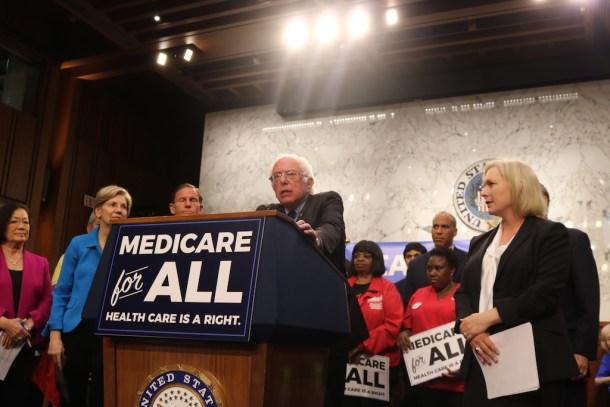
But most failures don’t accomplish this much. When he announced his candidacy in May of 2015, most of what he proposed wasn’t politically respectable. A $15-an-hour minimum wage? Free tuition for public colleges and universities? Health care for everyone, as though it were a “human right”?
It was all far-fetched, unrealistic, not worth discussing. Maybe even dangerous, as was complaining about “the three wealthiest people in America owning more wealth than the bottom half of our people.”
That day, when Sanders announced his candidacy at Burlington’s lakefront, what he was saying was not on the political radar screen. Even liberal Democrats hesitated to suggest anything resembling the extensive (and expensive) expansion of public service and government spending he envisioned. They feared being pilloried as “out of the mainstream” on the Sunday morning chat shows, or dismissed as “fiscally irresponsible” by respected columnists.
Now almost everything Sanders has been talking about is part of the political conversation. It isn’t that all of it has been embraced by a majority of the voters. But it’s all on that radar screen.
Nor is it just liberal Democrats. Most moderates and many conservatives favor raising the minimum wage and believe college should be more affordable. Though polls indicate that most people are not ready to scrap the private health insurance system, there is something close to a consensus that this would be a better country if everyone had affordable access to basic health care. That point of view is no longer radical. It’s mainstream. So is unease about the ever-expanding inequality of income and wealth.
Bernie Sanders dragged it into the mainstream, to the surprise (and often the consternation) of the self-appointed guardians of that mainstream, who were shocked at how much support he got when he ran in 2016.
Some of that support reflected voter antipathy to Hillary Clinton. But not all of it. Both the extent and the fervor of the Sanders vote proved that his candidacy had tapped into a profound unease and dissatisfaction in the body politic. He knew it was there, even if most of the reputable politicians and opinion leaders did not.
He had an advantage. Because Sanders never bought into the prevailing “neo-liberal” (meaning conservative) mindset of the last 40 years, he didn’t have to struggle to acknowledge how it had failed.
Its promise was that low tariffs, low taxes, low wages, low prices (but high profits), weak regulations and weak labor unions would enhance opportunity, prosperity and security for everyone.
They did not. Those policies did enable some to become very rich. But they also created an economy in which millions earn less than their parents did, with far bleaker retirement prospects and very little job security, living in fading communities, struggling to keep their children (and often enough themselves) free of the scourge of addicting and dangerous drugs.
It would be simplistic to conclude that this social and economic dysfunction is due to nothing but the “neo-liberal” policies introduced by Ronald Reagan and the Republicans and later accepted (if never embraced) by some Democrats.
But it would be naïve to dismiss the connection. The claim of the neo-liberals was that their policies would create so much economic growth that even those near the bottom of the income spectrum would prosper. But the economy didn’t grow fast; inequality did.
None of this surprised Sanders, who never accepted the “neo-liberal” project. Here, Sanders’ intellectual weakness was a political strength. Sanders is inflexible. He sometimes seems not to have questioned a single opinion he’s had since the early fall of 1963. But what some consider obstinacy came across to others as dependability, authenticity.
Sanders is not big on nuance. But a substantial chunk of the electorate doesn’t give a fig about nuance. Not the working-class middle-aged guy earning less than his father did. Not the recent college graduate saddled with debt and stuck in a low-paying job. Not the middle-income family impoverished by the medical bills for a chronically sick child. They were ready for a Bernie Sanders to come along.
Had he not come along, somebody else would have. The Democratic Party – indeed the whole country – was moving to the left on bread-and-butter economic issues as the failure of neo-liberalism became harder to ignore or deny.
That somebody else might have been a better candidate – younger, less grouchy, not a self-proclaimed socialist. That somebody else might have won the nomination and the election.
But nobody else came along. Bernie Sanders did. Because of him, it is now respectable, acceptable, even politically astute to assail inequality, to praise trade unions, to insist that no middle-income family be impoverished by the medical bills for a chronically sick child.
Maybe even to insist that health care be a human right.
His boast as he suspended his campaign Wednesday – “Together we have transformed American consciousness as to what kind of nation we can become” – may have been self-serving. It was not entirely incorrect.
All in all, not a bad five years work.

