

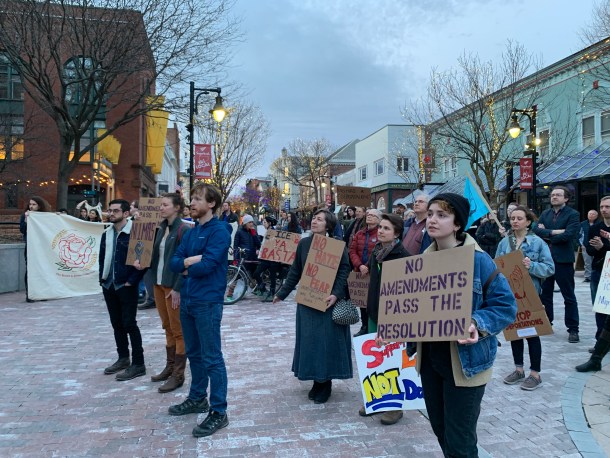
BURLINGTON — The Burlington City Council passed a fair and impartial policing resolution in an 11-1 vote Monday night. Outgoing President Kurt Wright, R-Ward 4, cast the only dissenting vote.
The resolution closes loopholes in the city’s current policy and prohibits local police from working with immigration enforcement agencies.
The loopholes make it easier for local law enforcement to collaborate with agencies like Immigration and Customs Enforcement by allowing local police to report the immigration status of individuals reporting crimes and allowing police to ask about a person’s immigration status if it is suspected they recently crossed the border.
The current policy, established in 2017, also allows police to collaborate with immigration agents in the name of “public safety” and allows immigration officials access to individuals in police custody.
More than 100 protesters rallied outside the council meeting in support of the resolution. The group also held a rally in February, during which protesters expressed frustration the item was not on that night’s agenda.
During the meeting, over 40 people gave public comment urging the council to pass the measure. Advocates for the resolution urged councilors to vote yes out of a moral imperative to protect immigrants in the Burlington community.
“This is about protecting basic human dignity and ensuring the safety and security of folks in our community,” said Councilor Jack Hanson, P-East District. “This is about fighting back against Trump’s policies and ensuring that we support and protect everyone who is living, working and passing through our community.”
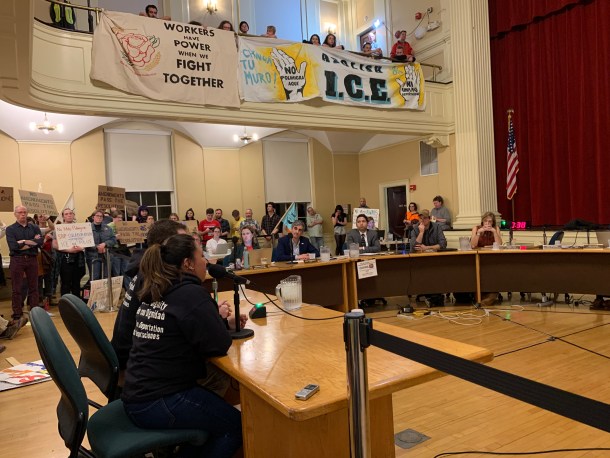
Burlington is the fourth municipality in the state to pass the resolution, which marks another success for the No Más Polimigra campaign led by Migrant Justice, a migrant workers advocacy group. Polimigra is a combination of the Spanish words for police and immigration agents. Winooski passed the resolution in 2016. Norwich and Hartford both passed the resolution last week.
Those opposed to the resolution, including Interim Police Chief Jennifer Morrison and Deputy Chief Jon Murad, spoke about the need to keep city laws in compliance with federal regulations. Morrison said that failing to do so would risk the loss of federal funds and put the department in a difficult position when it came to disciplining officers.
“In my estimation it will never be a good idea to take action at the local level that places the police chief, the mayor and other city officials in direct violation of federal law,” Morrison said. “If we have a policy on the books that is not supported by law, how does one go about disciplining officers for a policy violation if there is no legal backbone behind it?”
She also questioned the necessity of the resolution, calling it “a solution in search of a problem.” She noted that in some areas Burlington’s police policy is more robust than Vermont’s minimum requirement. She requested the City Council send the resolution to the Police Commission for further review.
“The precedent of the City Council taking a policy written by a special interest group and adopting it unilaterally without vetting is unconscionable,” she said. “If this is the way the council is going to determine policy for the police department, I fully expect to see policies proposed by other special interest groups.”
Councilor Chip Mason, D-Ward 5, introduced an amendment to send the resolution to the commission, which failed, 9-3.
Councilor Sharon Bushor, I-Ward 1, said she took the warnings from the police department seriously, but felt compelled to vote in favor of the policy after being “horrified” by national immigration policies including family separation.
“I feel the times just mandate that I do something more radical than I normally do,” she said.
Several councilors pushed back on the idea that effects on federal funding should be part of the discussion at all, including Perri Freeman, P-Central District, who introduced the resolution.
“I know that people come to this issue differently but I cannot imagine a monetary value that can be enough to convince me not to support this policy,” she said. “How do you itemize the value of someone’s life? The value of someone’s dignity, of their sense of belonging? Of being safe here?”
Councilor Max Tracy, P-Ward 2, spoke about the need to use the city’s laws to fight for a more just system overall, even if that means challenging federal statutes that cast the resolutions constitutionality into doubt.
“When we believe in something we should fight for it and we should put our legal muscle behind fighting for these rights,” he said. “We should put our values forward regardless of a potential court challenge we should fight for what we believe in.”
