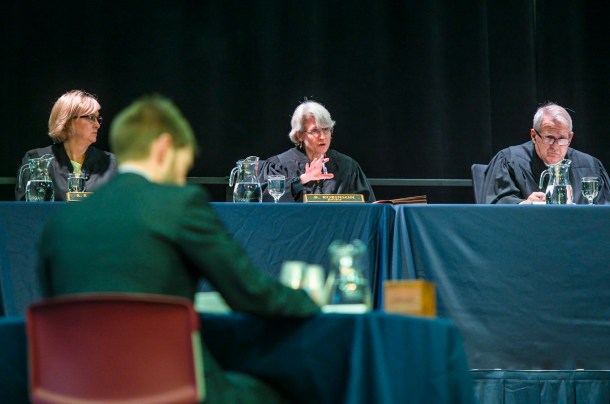
MIDDLEBURY — It is now up to the Vermont Supreme Court to decide if Act 46, the state’s sweeping school district consolidation law, passes constitutional muster.
A crowd of well over 100 packed a Middlebury College auditorium on Wednesday afternoon to hear oral arguments in the historic case. In attendance were college students, state officials, school board members from across the state, and even former Gov. Jim Douglas.
The state’s Supreme Court is the last stop for those school districts that have resisted coming together under the sweeping school governance reform. A legislative effort to forestall mergers fell apart in the last weeks of the 2019 legislative session, and a Superior Court judge dismissed three separate lawsuits filed by school districts seeking an out from state-imposed mergers.
Districts created through forced mergers under the State Board of Education’s final order under the law that began operating on July 1. The plaintiffs went to the Supreme Court for an emergency stay in mid-June in a last-ditch attempt to delay merging until the justices had weighed the merits of the case, but the court said no in a one-page ruling issued June 25.
Attorneys for both the state and the well-over two dozen plaintiff school districts mostly reiterated arguments made in the lower court during the fast-paced, hour-long hearing during which justices frequently interrupted with questions.
In his opening remarks, plaintiff’s attorney David Kelley of Craftsbury Common emphasized a key argument: that the State Board, in reordering districts under the law, had skipped the step of showing that such consolidations were “necessary” in the first place.
“The plain, unambiguous language of Act 46 require forced mergers to be necessary,” Kelley told the court’s five justices at the start of the 60-minute hearing.
Kelley also read quotes by lawmakers, including now-Lt. Gov. David Zuckerman, that he said illustrated a legislative intent that did not contemplate well-run districts being forced to merge.
“The understanding was, if it’s not necessary to merge you, if you are indeed an affordable school with great outcomes, then this bill seeks to leave you alone,” he said.
In response, Assistant Attorney General David Boyd noted that those legislators’ comments had been made regarding a piece of legislation that was, at the time, “materially different” from what would ultimately get signed into law.
And Boyd would also argue – as he had successfully done before a Superior Court judge – that the plaintiffs were selectively reading the law, and misapplying its use of the word “necessary” in order to “invert the structure of the statute.”
The law used the word “necessary” both when making reference to so-called “preferred” structures – merged districts – as well as alternatives, which might not involve a merger.
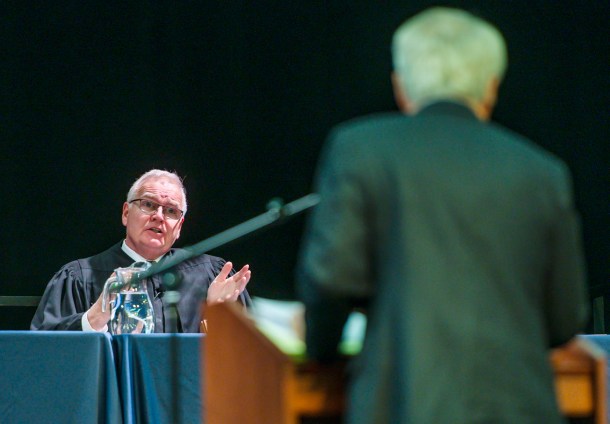
“The word ‘necessary’ couldn’t favor either structure type,” Boyd said.
But Associate Justice William Cohen, who was appointed to the court just last month, wondered if the word hadn’t been included in order to protect those towns that had rejected mergers at the ballot box.
“Doesn’t the word ‘necessary’ create a method so that towns that voted against it have some check on making sure that it’s going to be required by independent review? Isn’t that what necessary means here? I don’t see how you could read it any other way,” he said.
Boyd responded that towns that had rejected mergers during the voluntary phase of the law did have such a check – the procedure by which they could pitch an alternative proposal to the secretary of education, and then the State Board of Education, which made the final call under the law.
“So other than a lawsuit, what’s the check on the State Board’s decision to order a forced merger?” Associate Justice Harold Eaton Jr. asked.
“It’s the same as any other check in a democratic context. It’s your legislature,” Boyd responded. “Your legislators.”