

BURLINGTON — President Donald Trump’s reelection team triumphantly announced that it had raised $125 million in the third quarter of 2019 last month.
But the campaign continues to ignore a $8,400 bill from the city of Burlington for security costs associated with a visit during his last campaign, and Burlington officials have determined there isn’t anything they can do about it.
The city’s inability to recover the costs from the campaign was thoroughly covered in the media at the time, but is receiving renewed attention this year as Trump’s 2020 campaign kicks into gear.
Burlington Mayor Miro Weinberger decided not to pursue legal action against Trump after the city’s lawyers determined it would be “difficult to hold Donald Trump legally liable” for the costs incurred by the city.
Weinberger said he had “zero” hope that the campaign might pay the invoice this cycle.
“The Trump campaign was terrible to work with then,” he said. “I have no reason to think they’re going to be any better now.”
Trump’s unpaid bill isn’t the first time the city’s bills have been ignored by a presidential candidate — President Barack Obama’s 2012 campaign also did not pay bills sent by the city to cover the costs of security and traffic control.
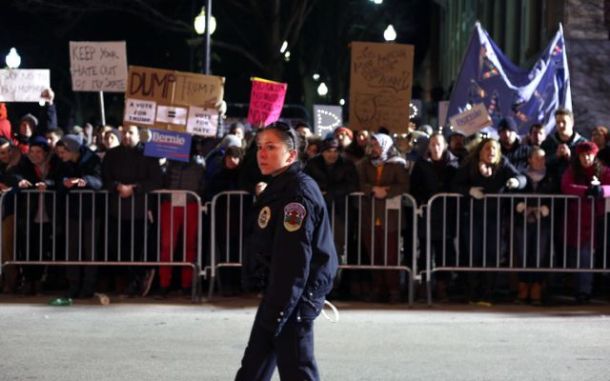
Trump appeared in Burlington on Jan. 7, 2016, weeks before his close second in the Iowa caucus. His visit to Burlington brought more than 1,000 supporters to Flynn Theater and hundreds of protesters to City Hall Park.
Burlington sent the Trump campaign a bill for $7,204 to pay overtime for 33 officers and $1,260 for four firefighter/EMTs, but never heard back from the Trump campaign.
The Center for Public Integrity this summer listed Burlington as one of ten municipalities with unpaid bills.
Vermont Sen. Bernie Sanders did pay the city for the costs associated with his 2016 presidential campaign kickoff in May 2015 on Burlington’s waterfront, which was attended by around 5,000 people.
Sanders’ campaign rented out the city’s Waterfront Park for the kickoff event, and that rental contract included paying for additional fire and police coverage as part of the venue’s cost. The Sanders campaign paid the city $858 for the fire and police coverage.
Since the Sanders campaign leased a public space, it had to work with the city to do so and pay applicable charges.
When candidates visit who require additional security on the streets and public rights of way but hold events in private venues, the city has no legal recourse to force the campaigns to pay for it, Weinberger said.
“There is very little we can do to recover costs if the campaign doesn’t want to be a good citizen and engage with the city,” Weinberger said.
The city needs to support candidates’ free speech rights that are “central to democracy,” Weinberger said, while still ensuring public safety.
“I think the people of Burlington would expect the city to support democracy even if it is a candidate most residents aren’t a supporter of,” Weinberger said. Trump won 11.7% of the vote in Burlington in the 2016 General Election.
The Trump campaign did not communicate with the city or police department before the visit, disrupted businesses and ignored the city’s invoice, Weinberger said.
“I have no reason to think they are actively considering (paying) it now, it would be a sea change if they were a better partner to municipalities in the upcoming campaign,” he said.
Weinberger said Police Chief Brandon del Pozo did an outstanding job in managing the crowds and ensuring the violence that occurred in and around other Trump rallies did not occur in Burlington.
Obama visited Burlington on March 30, 2012 and first lady Michelle Obama visited on June 30, 2011. The city charged the Obama campaign $2,816 for Barack Obama’s visit and $2,064 for Michelle Obama’s.
Weinberger said while neither the Obama nor Trump campaigns paid the city’s invoices, there was a “significant difference” between their communication levels with, and courtesy to, the city.
“There’s a long history of campaigns not paying costs like that, and it’s not just the Trump campaign and Obama campaign,” he said. “Trump’s campaign didn’t lift a finger, and that really rubbed me the wrong way then and really frustrates me now.”
Trump’s payment to municipalities also re-surfaced earlier this month when Trump confronted Minneapolis mayor Jacob Frey. Minneapolis charged the Trump campaign $530,000 for security fees and threatened to block the use of a downtown arena if the campaign didn’t pay.
The Trump campaign argued that the Secret Service was solely responsible for security and Trump’s lawyers contended that the city’s efforts were “a pretextual political effort with serious First Amendment ramifications.”
An unanticipated $8,000 cost is not a financial crisis for the city of Burlington, Weinberger said, and the overtime pay came out of the police budget.
Weinberger, a Democrat, said he was troubled to see the Trump campaign raise the $125 million last quarter, but not because of the city’s unpaid invoices. He’s more concerned about a possible Trump reelection, which said is a threat to the country’s future and a threat to democracy.
“When I see the Trump campaign raised $125 million, my first concern is not the city’s $8,000 invoice,” he said. “This one feels to me like the most important election of our lifetimes, and it’s going to be a tremendous battle.”

