

This article was updated on Sept. 9 with a comment from Samantha Steady’s lawyer.
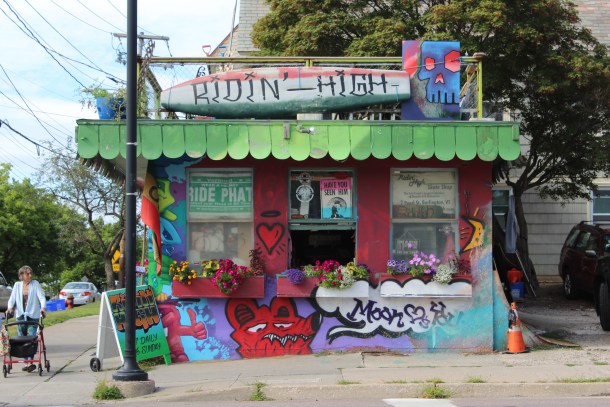
Burlington Police and federal agents had their eyes on Ridin’ High skate shop, and its owners, John Van Hazinga and Samantha Steady, long before their recent indictment on federal drug charges.
Court documents detail a year-long investigation, involving multiple undercover operations, into allegations that the pair were dealing marijuana and THC-infused edibles from the colorful shop, located prominently on the corners of Pearl and Battery streets, a short walk from the Burlington Police Department headquarters on the other side of the park.
The investigation culminated Aug. 6, when police executed search warrants at the Burlington store, Van Hazinga’s Underhill home and a camp in Keene, New York. The searches turned up approximately 78 marijuana plants, over 5 kilograms of marijuana and $67,000 in cash.
Both Van Hazinga and Steady are facing multiple charges of marijuana distribution, manufacturing and possession with intent to distribute. They both pleaded not guilty to the charges in federal court last month.
After Van Hazinga, who is also known as “Big John,” was arrested in August, a federal judge ordered that he be kept behind bars until his trial, as requested by U.S. Attorney Christina Nolan. Steady was released with conditions.
The affidavit, by Drug Enforcement Administration agent Dwayne Mellis, lists five separate times when an undercover officer purchased marijuana “over-the-counter” and an email correspondence with Steady regarding a “bulk order” of THC-infused brownies, cookies and other baked goods.
The joint DEA and Burlington Police Department investigation began with a report from an unnamed individual in early July 2018 that marijuana was being sold to minors out of Ridin’ High, and that it “was common knowledge” that marijuana was sold there, court papers say.
BPD officers entered Ridin’ High on Aug. 1, 2018, seeking surveillance footage for an unrelated incident when the officers noticed patrons exchanging $20 for folded paper packages, allegedly with small amounts of marijuana inside, according to the affidavit.
“We don’t sell, we accept donations,” an employee told the officers, the affidavit states. The same employee was heard speaking with customers about “wifi,” a specific strain of marijuana.
One month earlier, the state of Vermont legalized possession of small amounts of marijuana for adults 21 or older. Though sale of pot continues to be illegal, the law allows for adults to give small amounts.
However, state officials have been clear that any exchange of pot for money is considered illegal, as Attorney General TJ Donovan made explicit in a guidance issued last year after entrepreneurs probed the gray areas of the new state law. Selling an item like a lighter or a bracelet, for instance, along with a “gift” of marijuana is not legal, according to the guidance.
Court records show that Ridin’ High used the concept of “donations” repeatedly, including when an undercover agent, wired with audio and video devices and armed with $60, returned to the story on Aug. 8, 2018, looking to buy some pot.
When he arrived, he recognized Van Hazinga, who was standing behind the counter, smoking from a glass pipe, according to the agent’s statement.
“For your donation, I gave you 5.5 grams,” Van Hazinga said to the agent after exchanging $50 for the drug, the affidavit states. Van Hazinga asked the agent to place the money into a glass jar with a handwritten “donations” label affixed to it. Van Hazinga then moved the money out of sight behind the counter.
A few weeks later, the same officer returned to Ridin’ High, this time with $40, according to the affidavit. The undercover agent asked an employee at the counter if “wifi” was still available, referring to the same strain he had purchased the previous time.

After asking the detective if he was over 21, the employee pointed towards the back door of the store, directing the agent outside and up a staircase, where a man was controlling when other apparent customers could go onto the roof of the building, like a bouncer, according to the affidavit.
Van Hazinga, sitting behind a table, told the detective that he was out of “wifi,” but offered a variety of other strains, including “doctor, lemon kush, train wreck, chronic thunder, [and] purple diesel,” the affidavit states. He sold the detective a different strain of marijuana, and the two then had a brief conversation about purchasing THC-infused baked goods.
“They’re made by my lady,” Van Hazinga stated, according to court papers. Police later confirmed the “lady” in question to be Steady.
Anytime a purchase was attempted after 5 p.m., Van Hazinga was on the roof of the building, the court documents allege. With $45 in hand, in mid-September 2018, around 6 p.m., the detective climbed the staircase to the roof where he observed “6 or 7” individuals and Van Hazinga.
While waiting in line, the agent overhead a conversation between a customer and Van Hazinga about his living situation.
“I live with Samantha in Underhill,” the agent overheard, according to the affidavit. Surveillance done earlier in the day found Van Hazinga’s red Subaru at a property in Underhill. Months later, aerial surveillance Van Hazinga’s property in Underhill showed large numbers of cannabis plants growing in buckets and clearly visible from the air.

According to the affidavit, Van Hazinga explained to the agent the prices and potencies for the different treats on display. Each product had a label with a price on it.
The agent made a purchase for a $15 brownie and $30 worth of marijuana. While leaving the rooftop, the agent witnessed others purchasing the brownies and marijuana, while a woman and a young child were sitting nearby.
According to the affidavit, it was several months before the agent returned for another purchase. On May 22, the detective went to Ridin’ High with $60. This time an employee directed the officer to the basement of the store through a “plank” on the wall covering a staircase, where others were exiting. Another $50 purchase for 5.5 grams was made, again putting the cash into a jar with a hand-written “donations” label. There was another label which read “$20 minimum. Must be 21 to donate.”
One month later, on June 27, the detective made another purchase for two separate strains of marijuana, both for $20, the court papers state. The detective had also inquired with the employee about speaking to Steady to purchase some edibles. “She’s the chef,” the employee told the detective, police say, but also said she had left for the day. Instead, the employee provided a phone number and email address, which Steady used to take “bulk orders” of edible products.
Using the fake name “Eddie,” the detective wrote an email looking buy a larger number of THC-infused edibles, according to the affidvait. A few weeks later Steady responded offering a deal if the purchase was greater than “30-40” products.
Later in the summer, after authorities executed their search warrants, all of the currency used during the undercover purchases was recovered by matching the serial numbers on the bills.
A voicemail left with Van Hazinga’s lawyer, Paul Volk, was not returned by the time of publication. Efforts to reach attorneys representing Steady on Friday were not answered.
On Monday, Andrew Subin, a lawyer from Vermont Cannabis Solutions and Hoban Law Group which represents Steady, said in an email that the firm had no comment on “the facts alleged in the investigation and indictment.”
He did say, however, “Illegal opioids and heroin mixed with fentanyl are killing people every day. Cannabis has never killed anyone, and is rapidly and widely becoming accepted as a normal part of our culture. In light of these facts, we believe the federal government and the U.S. attorney’s office should make better use of their vast law-enforcement resources than to prosecute cannabis cases.”
If convicted, Van Hazinga and Steady could face up to 20 years in prison.
Van Hazinga has multiple prior marijuana convictions. In 2007 he was arrested for a drug crime by the Grand Isle Sheriff’s Department which led to the seizure and forfeiture of $100,000. In 2014, he was convicted of a felony for growing 25 marijuana plants, and again in 2016 with a felony conviction of possession of “one pound or more of marijuana.” In January 2018, court records show he sold marijuana at Ridin’ High in front of his parole officer.
In her motion to detain Van Hazinga pending his trial, U.S. Attorney Christina Nolan referenced his past record.
“The defendant should be detained, as there are no conditions that can be set to address the danger to the community that would exist should he be released,” she wrote in the motion. “Despite large cash seizures, felony convictions, court supervision, and imprisonment, defendant Van Hazinga has repeatedly returned to the easy money of marijuana trafficking.”

