


A new study finds that older forests may be better positioned to handle the impacts of climate change than newer growth forests.
Researchers from the University of Vermont analyzed data from 18,507 forest plots across the eastern U.S. and Canada to see how changing temperature and precipitation would impact key forest functions.
They found that as forests age, their capacity to store carbon, produce timber, and provide habitat for a range of species increases, said Dominik Thom, a UVM postdoctoral researcher who was the lead author of a study published in Global Change Biology last Wednesday. And the older forests are, the less vulnerable those functions are to climate change, he said.
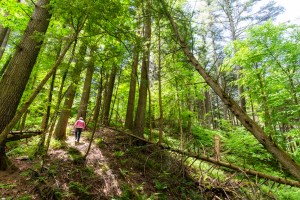
Older forests don’t just have older trees — they’re also more complex than younger forests. They have trees of different ages and sizes, canopy gaps that allow light to filter through for a wider array of species and dead trees strewn across the forest floor.
“Anything that has integrity, that has all its parts and processes intact, it’s going to be more stable, more resilient,” said Mike Snyder, commissioner of the Department of Forest, Parks and Recreation. “And that’s true for forests and climate change.”
The researchers recommend managing forests so that a portion mimics older conditions as a tool to make the overall landscape more resilient to climate change.
Climate change is already happening in Vermont. Since 1960, average annual temperatures have gone up by 1.3 degrees Fahrenheit and average annual precipitation has gone up by 5.9 inches, according to the 2014 Vermont Climate Assessment.
Snyder said that while forests are dynamic — and trees genetically diverse — climate change “outpaces their natural abilities” to react to change.
Bill Keeton, one of the study authors and director of UVM’s carbon dynamics lab, said that the “general scientific consensus is that climate change will create stress for forests.” Climate change increases the spread of invasive species, changes forest productivity and affects species distribution, Keeton said.
Vermont’s forests have made a comeback in the past century. Reduced by logging, sheep grazing and other agricultural practices in the late 1800s to 30% of the state’s land area, forests overtook dormant fields in the late 20th century.
Less than 1% of forests in the eastern United States and Canada are older than 200 years, Thom said.
Researchers, including at Keeton’s lab in Vermont, have been spearheading efforts to push forests toward older growth conditions. Those management techniques include allowing dead trees to stand, clearing room for larger trees, and pulling down trees to create tip-up mounds — the mass of decaying roots and soil left at the base of a fallen tree.
“Basically, what we’re trying to do is find the forestry techniques that promote the development of that structural complexity,” said Keeton. “And we’ve shown that it can be done.”
He stressed that in the new study, researchers were not saying older forests are inherently better.
“They don’t provide all (ecosystem) services, but…the mix of services and biodiversity that they do provide will be more resistant to climate change than younger forests,” he said.
Snyder said the state has “a whole new approach” to forest management — both on state lands and in advice to private landowners — because of climate change. Also, the state’s accepted forestry management practices were revised last year to reduce water quality impacts of, say, erosion from skid trails.
“One of the more obvious effects of climate change on our forests right now is the strange, whacky hydraulics and the…increased frequency of high intensity storms,” said Snyder.
This session, the Legislature passed an agricultural development bill, S.160, that included the creation of a working group to look at how to enroll more state and privately owned forests in so-called “carbon markets.”
Both voluntary and mandated markets — such as California’s cap and trade program — exist that can pay forest landowners for pollution offset credits. Many of the techniques that produce “old forest characteristics” align with measures that increase carbon storage, said Keeton.

