



BURLINGTON — Many more households, primarily in Winooski and Williston, will be affected by higher noise levels as the F-35 fighter jets arrive at Burlington International Airport, according to a noise map released by the Burlington International Airport Tuesday.
The total number of dwelling units exposed to average noise levels of more than 65 decibels will rise from 819 in 2015 to an estimated 2,640 in 2023, with the total population affected rising from 1,900 in 2015 to 6,125 in 2023. Half of the city of Winooski is in the noise zone.
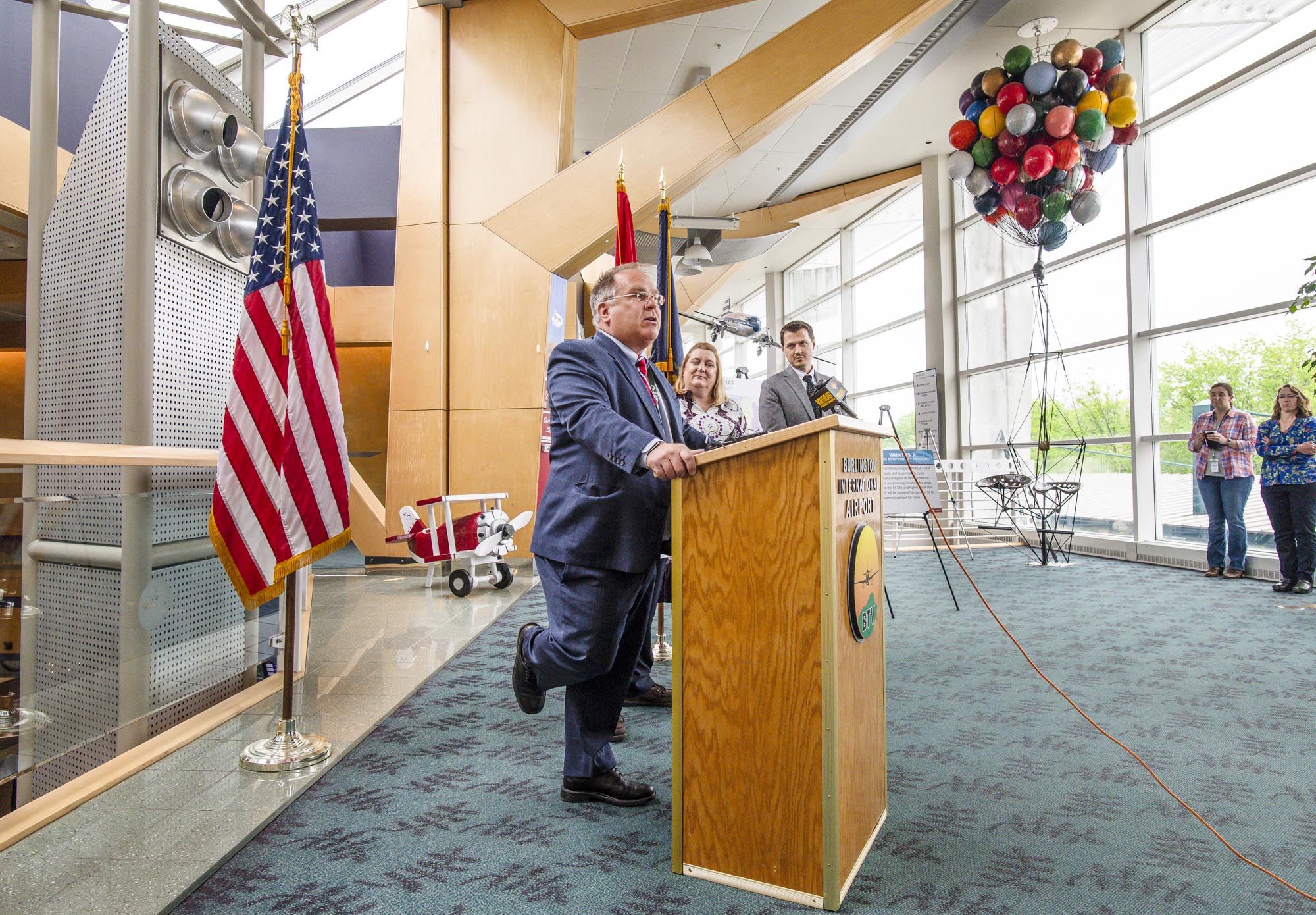
Airport officials held a press conference and public meeting Wednesday to answer questions about the maps.
The federal government considers areas with an average noise of more than 65 decibels “unsuitable for residential use.” The F-35s will be four times as loud as the F-16s, which ended their tenure in the state in April.
The first two F-35s which will be based at the airport are set to arrive in September, with two more jets arriving each month until the airport reaches its full commitment of 18 jets by the end of summer 2020.

Four F-35s made an unexpected landing at the airport Wednesday morning around 7:45 a.m. The jets took off from Hill Air Force Base in Utah and were set to fly overseas but were diverted to the airport due to weather and refueling schedules.
The changes on the map are due to departure noise, said Brandon Robinette, a consultant for HMMH who worked on the map. He said the operating characteristics of the F-35 led to changes to the contour lines.
“It’s a newer aircraft with an engine more powerful than the F-16, so based on its performance characteristics, it’s noisier in general,” he said.
While the arrival of the F-35s had a major role in the expansion of those areas affected by noise, Diane Carter, a consultant for the Jones Payne Group, which worked on the map, said other factors were at play as well.
“The F-35 certainly weighs into it, but there’s a change in commercial aircraft here in Burlington, and … there’s an increase in operations overall,” she said.
Nic Longo, the deputy director of aviation, said the airport is seeing more 150-seat commercial aircraft, instead of smaller 50-seat regional jets.
Longo said the FAA requires noise maps every five years or when there is a change in the airport’s operations.
“This was kind of a dual purpose, because we are hitting just about five years on our noise exposure map as well as new operations,” he said.
Noise Mitigation Efforts
The creation of the map allows the airport to receive federal noise mitigation grants, which the airport is going to use to fund programs for residents affected by the noise.
Longo said residents within the zone where the average 24-hour weighted noise level is 65 or higher could be eligible for the federal funding.
The funding will be used for airport programs to replace windows and doors for sound insulation, to help homeowners sell their homes if offers are below fair market value, and for a program in which the airport purchases property, insulates it and then sells it.
Gene Richards, airport director of aviation, said the process of instituting those programs would be lengthy.
“We anticipate that going on for years and years,” he said. “This, for those who qualify, will be a great benefit, and it may not happen tomorrow, but over time it could come your way with the funding available.”
In the past municipalities purchased and demolished homes near the airport affected by noise, but that is no longer being done, Richards said.
“We really believe that with Chittenden County’s need for housing, we preserve it in every way we can, and we hope the community agrees with us,” Richards said.
During the 30-day public comment period, Longo said, the airport is looking forward to reviewing land-use designations with municipalities and to hearing what noise mitigation measures the public is interested in.
Richards said the public comment period will be helpful for the airport to determine how the federal funds are used.
“We want to go into this process listening to the public, and not necessarily to the politicians, and see what people want to do with their homes, and how we can assist them,” he said.
Public Meeting
A public meeting hosted by the airport Wednesday night was an unstructured opportunity for residents to view and discuss the noise maps.
Airport officials and consultants stood by noise maps broken down into each of the surrounding communities. The Vermont National Guard also had staff to answer questions from residents.

Many opponents of the F-35 basing attended.
Cindy Cook of Burlington said she was concerned with the noise, especially since the noise of the jets on takeoff and landing would be louder than the average noise reflected on the maps.
“The deafening sound of the F-16 times four, I can’t even imagine what that’s going to be like,” she said.
Amanda Hannaford of Burlington said many people in her neighborhood spend time outside during summer, and the noise mitigation efforts would do nothing for outside noise.
“There’s a lot of upset people here,” she said.
Hannaford said she was concerned that the noise would render homes unsuitable for residential use, which would have negative effects on the county’s housing market.
“Chittenden County has a real affordability issue and a housing crunch,” she said. “That’s a huge deal for everybody in the whole county, not just people whose houses are negatively impacted and whose health is negatively impacted.”
Winooski Mayor Kristine Lott, who attended the meeting, heard the F-35s landing Wednesday morning from her home in Winooski.
“Obviously the noise impact is expanded dramatically to Winooski,” she said. “If you look at it, it’s almost half the city that it’s covering.”
Lott said she had come to hear from residents about their reactions to the map and their preferences in the noise mitigation programs. She said her priority was preserving housing, and she thought the insulation program and program featuring the airport purchasing and insulating homes would help accomplish that goal.
“That way, we’re keeping good housing in Winooski,” she said.
Some supporters of the F-35 basing also attended the meeting.
Charles Finnegan said even though his Colchester home is in the flight path, he supported the Guard and the F-35 basing.
“It’s a much bigger discussion than simply some noise at the airport,” he said. “As far as I’m concerned, they’re a pivotal point in the geography of the county, in regards to the borders and so on. I’m really proud that we’re part of it.”
Listen to VTDigger’s 2018 special audio report, where residents describe airport noise effects in the Chamberlin neighborhood:
