

[N]egotiations between the House and the Senate on another key education issue broke down on Tuesday, though the two sides were set to return to the table on Wednesday.
Lawmakers were visibly exasperated Tuesday as they hashed out compromise legislation to mandate testing for lead in school and child care center water systems.
“I am a little bit at a loss of how we proceed,” Sen. Phil Baruth, D/P-Chittenden, told House conferees as he was preparing to leave.
The sticking points remain the same as they have been all session: the threshold at which schools and child care providers would be expected to remediate, and the rates at which the state would reimburse associated costs.
Going into the legislative session, lead testing appeared to be a consensus priority. The governor called for testing to be completed within a year in his inaugural address. And lawmakers, assuming that some sort of mandated testing plan would be passed during the session, set aside $2.5 million from this year’s budget adjustment to help pay for the effort.
The Senate quickly advanced legislation, projected to cost $2.5 million, setting the action level at 3 parts per billion. A House-passed version of the bill set the action level at 5 parts per billion, reimbursed schools and child care centers more generously, and was projected to cost $3.2 million.
Early talks between both sides were congenial to start. On Monday, Senate conferees presented House lawmakers with their opening offer: a $2.8 million package that increased reimbursement rates for schools and set the action level at 3.5 parts per billion.
“We’ve tried our best to come not just to the middle but slightly over the line,” Baruth said at the time.
On Tuesday, House lawmakers replied with their counteroffer: a $2.8 million package that set the action level at 5 parts per billion. The deal included the reimbursement rates originally included in the House-passed version of the bill, but also a $500 deductible, per building, that districts would have to contribute toward remediation, to lower the state’s costs.
But Senate lawmakers bristled at the plan, complaining that House lawmakers weren’t willing to compromise. Their proposal didn’t make any adjustments to the House’s original position on the threshold for remediation, Baruth said, and the idea of deductibles hadn’t been envisioned in either the Senate or the House’s versions of the bill.
“You’re not moving much at all in our direction,” he said.

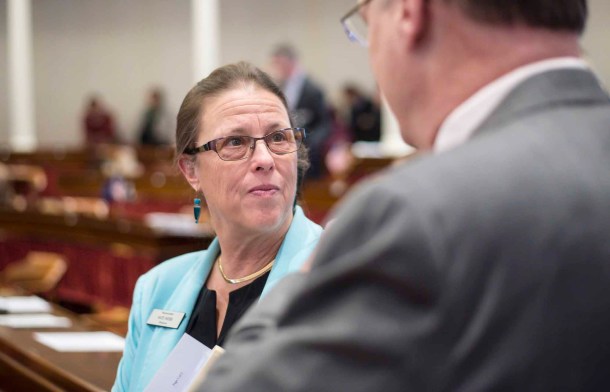
But Rep. Kate Webb, D-Shelburne, argued that at 5 parts per billion, Vermont would still have one of the strictest standards in the country. And with the inclusion of the deductibles, the House’s reimbursement rates were projected to cost within $20,000 of the Senate’s last offer.
“We have met the money, except for $21,000. I’ll personally cover the $21,000 if we can get this done today,” she joked.
Lead testing is not the only place in which discussions between the two chambers have turned into standoffs this session. The House and the Senate are currently at odds over the question of delaying school district mergers under Act 46. Resentments over that process bubbled to the surface on Tuesday.
“I think it’s an assumption that you make, which is that your committee has achieved the right view of the world. And the Senate has not. And that frankly killed our other committee. I’m hoping it won’t infect this one,” Baruth told Webb near the end of Tuesday’s talks.
Both Webb and Baruth say another meeting has been scheduled for Wednesday.
