


[T]he waiting game continues for developers of eight solar projects planned for the congested northern tier of the state’s electrical grid.
The Public Utility Commission issued orders this week for six proposed 500 kW net-metered solar installations — two in Brighton, two in Jay, one in Lemington and one in Eden — going against a utility’s request for consolidation. The Caledonian Record first reported on these denials.
But the fate of those and two other solar projects planned for Bloomfield and Franklin remain on hold until grid constraint issues are addressed.
The solar projects were all proposed in a portion of the state’s grid known as the Sheffield-Highgate Electrical Interface, or SHEI, in electrical utility parlance.
The SHEI area is already home to multiple large wind farms, in-state dams and methane digesters. Hydro-Quebec also sends 225 MW of power surging onto the system at the Highgate Converter.
Challenges in the SHEI area stem from a difference between how much electricity is produced in that area compared to how much is consumed. While the generating capacity in that area and Hydro-Quebec imports add up to 450 MW, there’s only 35 MW of demand in that rural part of the state, according to a report from the Department of Public Service.
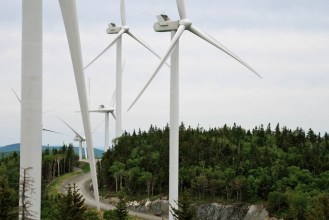
Because wind power can be throttled back, grid manager ISO-NE will sometimes send signals to the region’s larger wind projects — Kingdom Community Wind and the Sheffield Wind Farm — to produce less electricity. This curtailment translates into costs for utilities that either own projects or have long-term contracts to purchase power from these generators.
The solar project developers all had to seek approval from the state’s Public Utility Commission before they could begin construction.
Vermont Electric Cooperative, the utility that serves most of the northern tier of the state, filed motions for the PUC to hold hearings on the projects. VEC said in PUC filings that additional generation in this region would add to the curtailment issue utilities face in that region.
Green Mountain Power, which owns Kingdom Community Wind, and Washington Electric Co-op, which owns landfill gas to energy facilities at the Coventry landfill, filed similar motions in some of the cases.
Review of the solar projects was put on hold pending a ruling from the PUC on a similar-sized project proposed in Derby. Commissioners denied that application earlier this year. That decision is currently being appealed to the Supreme Court, according to David Carpenter, attorney for the developer.
This March, VEC filed a joint motion in eight net-metered solar cases planned for the SHEI area to consolidate the cases. The utility also wanted the PUC to first rule on how the projects comply with the state’s energy plan and what their impact would be to the grid.
Developers opposed those motions, saying that the projects were different enough to warrant separate hearings. The Department of Public Service said in filings that it was fine with ruling on grid impact first but was not in support of consolidating the cases.
PUC hearing officers, in a suite of rulings Monday and Thursday, said the commission could not consolidate the cases without all parties agreeing to that. They added that consolidation was not appropriate given differences between each project. They also denied the utility’s request to bifurcate hearings.
Nils Behn, CEO of Aegis Solar, which proposed the 500 kW net-metered solar project on a gravel pit in Eden, said he was pleased with the recent PUC decision.
The Eden project had been in an area VEC had initially deemed OK for interconnection, he said. Behn feels utilities should have done a better job of notifying developers that they would be opposing projects in this part of the state.
Vickie Brown, general counsel for Vermont Electric Cooperative said that utilities began feeling the economic impacts of curtailment with a rule change made by regional grid manager ISO New England in 2016. The utility incurred $653,000 in SHEI-related costs from the end of 2016 through 2017, according to testimony filed by Craig Kieney, manager of power supply for VEC.
“When we became aware of the economic consequences of these curtailments, we really did want to get the word out to developers to let them know (that) it’s probable we’re going to be intervening in these cases,” said Brown. “We didn’t want people to be surprised.”
She added that it’s possible some developers who had proposed projects in the SHEI area around the time VEC started developing policies to deal with curtailment could have felt caught off-guard.
In their ruling denying the Derby solar project, the PUC said the proposal presented the commissioners with a “fundamental question” of whether to allow existing renewable energy generation to be displaced with new “higher-cost” renewable energy.
“Such a trade-off, whereby a new, more expensive generator displaces already existing — and less expensive — renewable energy, would harm Vermont utilities and customers,” wrote the commissioners.
Vermont’s grid was built to send centralized power out to homes and businesses, according to a report on grid constraint issues from the Department of Public Service.
But in the past decade, Vermont’s in-state generation has gone from a few dozen large generators to thousands of smaller “behind the meter” generators that effectively reduce load, says the report.
There is no “silver bullet” solution to grid constraint issues, according to the department.
“Instead, an increased emphasis on distribution-level planning and grid modernization will be necessary to open up constrained areas,” wrote the report authors.
They add that constraints are not currently impacting the ability of the state to meet its greenhouse gas emissions and renewable goals.
One of the Department of Public Service’s proposed solutions was to have developers group together to fund additional infrastructure needed for grid upgrades.
Behn said he didn’t see that as feasible because the upgrades would cost millions of dollars. He thinks the utilities should have done more grid upgrades before building large wind projects in that region.
“This really goes to the issue of the utilities not properly planning for the modern grid,” he said.
He added that Aegis had proposed curtailing the solar array or pairing it with battery storage, but that utilities had not been keen to take him up on that.
Brown said she was not familiar enough with conversations between VEC engineers and Behn to comment on those proposals. She added that the utility has been having preliminary discussions with other developers around battery storage and that she didn’t think VEC would have been unwilling to hear a proposal from Aegis.
Electricity utilities and VELCO, Vermont’s grid manager, have been working on addressing SHEI issues. VEC has done the “easy solutions,” like shifting load and equipment upgrades. Now utilities are looking at the expensive solution of transmission upgrades, she said.
“Rebuilding transmission to take generation out of where it’s located is not really the goal of the state in encouraging distributed generation, which is supposed to be nearby load, not far away from load,” she added.

