

[V]oters in three small southern Vermont towns have set the stage for a game of brinkmanship with the state by postponing the work of merging their school districts under Act 46.
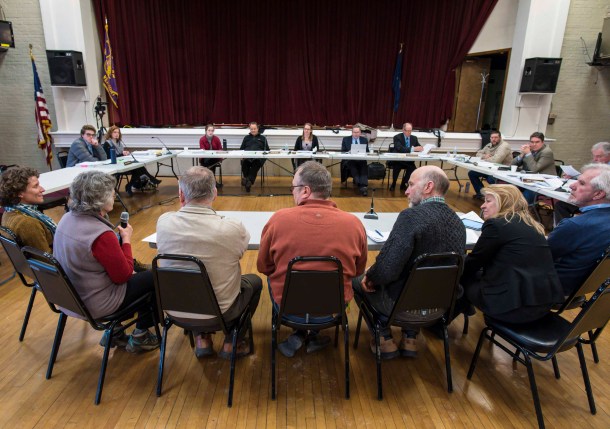
About a hundred voters from Westminster, Athens and Grafton gathered in the Bellows Falls Union High School auditorium on Wednesday night for what was supposed to be first meeting of the Windham Northeast Union Elementary School District, a new three-town district created by the State Board of Education’s plan under the sweeping consolidation law.
But before getting to the third item on the agenda, voters unanimously voted to recess the meeting until the Vermont attorney general had weighed in on whether the merger would violate the U.S. Constitution. The motion was suggested by Athens resident Harold Noyes, who argued the merger — by dissolving the contract between Athens and Grafton to run their combined school — would violate the “contract clause” of the U.S. Constitution.
The motion was amended at the suggestion of Grafton school board chair Jack Bryar, who said the meeting should be recessed until the attorney general had weighed in on the matter. Bryar said AG’s silence on the matter had been “deafening,” and that such a motion would force the state’s hand to offer a response.
He also suggested that tying the meeting’s continuation on a “ruling” from the attorney general would put any consequences of delay on the state – not local actors.
“It’s also a really different issue if we fail to meet in a timely manner because we’re waiting for the attorney general’s office to respond to us, and he fails to do so, that’s not our fault,” he said.
He added later: “If this process is delayed, that’s not our problem. That’s the attorney general’s office problem.”
The attorney general’s office did not respond to requests for comment Thursday.
Merging into unified school districts is a complicated, multi-step process. The Agency of Education has warned that earlier delays by recalcitrant school districts have left little time to seat unified boards and get voter-approved budgets in place by July 1, when the new fiscal year starts.
As it stands, existing law does not appear to contemplate what might happen in a newly-unified district if a budget isn’t approved by the electorate by July 1. In typical situations, districts that fail to pass budgets can borrow up to 87% of their prior year’s budget. But districts created by state fiat this year do not have a prior year’s budget, because they did not exist.
The agency has asked the Legislature to close that loophole to create a default budget in situations where unified budgets are not created in time. But while lawmakers are actively working on language, and expected to pass some sort of legislation, the matter is still unsettled.
The Legislature is also considering whether to grant school districts facing forced mergers a one-year delay. The House and the Senate have both passed different plans allowing for such a reprieve, and are currently crafting a compromise bill in conference committee.
Dozens of school districts — including Athens, Grafton, and Westminster — are challenging Act 46 in court. But while other school districts at first postponed organizational meetings of their new unified district, they have since reluctantly reconvened to continue preparing for mergers after a judge issued a preliminary ruling in the state’s favor.
Those working on the legal effort are preparing to take the case to the Vermont Supreme Court if a lower court judge ultimately rules against them. But they’ve also since advised school districts to follow a dual-track process, getting ready for the possibility of unification or independence come July 1.
“We have been advising people that nobody has a crystal ball, and that… we have a law and there’s a duty to comply with it,” said Craftsbury Commons attorney David Kelley.
Separately, Grafton has also decided to sell their school to the town to retain local control in the event of a merger. The move came, according to the Brattleboro Reformer, against the advice of both superintendent Chris Pratt and attorneys for the Windham Northeast Supervisory Union, who said such a transfer could be illegal.
In a memo to districts, the agency has warned that it would “take every action legally available to bring the district into compliance to ensure students are provided access to substantially equal educational opportunities.”
But on Wednesday, Secretary of Education Dan French, who attended the meeting, declined to elaborate on what that might look like.
“My perspective is that fundamentally we have a responsibility at the agency to ensure our students are educated. And we’re going to have to review that relative to these decisions. That obligation doesn’t go away,” he said.
French also said he was “patiently waiting” to see what the attorney general would do with the three towns’ request. And absent legislative action on the questions of both default budgets and whether districts could delay implementation, French admitted he was unsure what might happen next.
“There’s a lot of unknowns here,” he said.
