

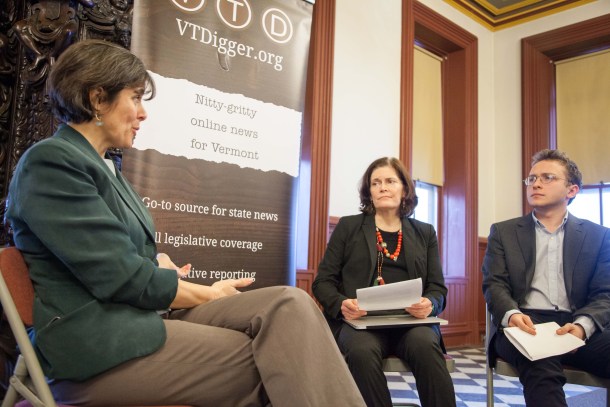
[F]or the past three weeks, VTDigger has held Morning Forums on Tuesdays at the Vermont History Museum in Montpelier with newsmakers from the Statehouse. We have conducted live interviews with key lawmakers, including House Speaker Mitzi Johnson, Senate President Pro Tem Tim Ashe, Senate Majority Leader Becca Balint and Rep. Jim Harrison.
The Morning Forum this Tuesday will be with members of the Taxation and Regulation of Marijuana Commission — Tom Little, Jake Perkinson and Gwynn Zakov. Register for the event here. Submit your questions here.
On Feb. 12, we wrap up our series with Gov. Phil Scott, Susanne Young, the secretary of the Agency of Administration and Adam Greshin, the commissioner of the Vermont Department of Finance and Management. Editor Anne Galloway and staff will ask questions posed by readers about the governor’s budget proposal.
We start at 8 a.m. with free Myer’s bagels and coffee and end at 9 a.m. sharp. The events are livestreamed on VTDigger’s Facebook page and filmed by ORCA. Each video clip is between 35 and 45 minutes.
The first Morning Forum was with House Speaker Mitzi Johnson who talked about her relationship with Gov. Phil Scott and Senate President Pro Tem Tim Ashe. The three leaders were at odds last legislative session and that discord hit a low note in the special veto session. Johnson struck a deal with Scott when she wasn’t able to get Ashe, a fellow Democrat, to negotiate and brought a proposal to the House floor in a last-ditch attempt to reach a compromise over education spending. That risky move broke the logjam and the next day the Legislature and Scott reached an agreement. This biennium, Johnson’s power as speaker has been solidified. The Republicans lost 10 seats in the House, and Johnson now has a supermajority of Dems, Progressives and Independents.
In this interview with VTDigger editor Anne Galloway and reporter Xander Landen, the Speaker also expounded on key issues, including support for a mandatory paid leave program that she says will benefit young families, a broadband initiative that features better mapping and support for local communities to fill gaps, and retail sales of marijuana (she agrees with the governor that the state must implement roadside saliva testing of drug impaired drivers before launching a tax and regulate system).

Morning Forum with Tim Ashe
On Jan. 22, Galloway interviewed Senate President Pro Tem Tim Ashe who talked about his aggressive timeframe for tax and regulation of marijuana (he opposes roadside saliva testing) and how the minimum wage bill would benefit the state’s economy and tens of thousands of low-income working Vermonters. Ashe also talked about a bill he has introduced that would lengthen the governor’s tenure in office from two years to four years, arguing that it has become increasingly difficult for the state’s chief executive to make long-term policy changes with the burden of running for office every two years. Former governors weighed in — for and against — in this story by reporter Anne Wallace Allen.

Morning Forum with Becca Balint and Jim Harrison
Last week, Galloway talked with Senate Majority leader Becca Balint and Rep. Jim Harrison, R-Chittenden, about the economic implications of a $15 an hour minimum wage. Both the House and the Senate voted for a minimum wage hike that would have gradually increased base hourly pay to $15 an hour over six years. Now that Gov. Phil Scott can no longer sustain a veto in either body of the Legislature this biennium, the passage (and enactment) of a similar bill is much more likely.
The federal minimum wage has stalled for nearly a decade (it is currently set at $7.25 an hour) and 20 states have increased the base rate on their own. The Vermont rate is now $10.78 an hour. In 2014, the Legislature set a step change in motion, increase the rate to $10 an hour by 2017 and $10.50 in 2018. After that, rate increases are tied to the consumer price index.
Balint, an avid proponent of further increases, said if the federal minimum wage had kept pace with inflation over the past 40 years, the buying power of the base rate would be the equivalent of $20 per hour.
The economic impacts are complicated and few jurisdictions have imposed a rate at the $15 level. Seattle, which increased its base rate to $15 per hour for employers with 500 or fewer workers in January, has a carveout for employers who provide medical insurance to workers.
Harrison, the former director of the Vermont Grocers and Retailers Association, said an increase could result in small inflationary increases for goods and services, potential job losses and possible bankruptcy for general store owners who struggle to get by. On the other hand, state income tax receipts would go up and fewer people could be dependent on state benefits, like foodstamps and Reach Up.

