

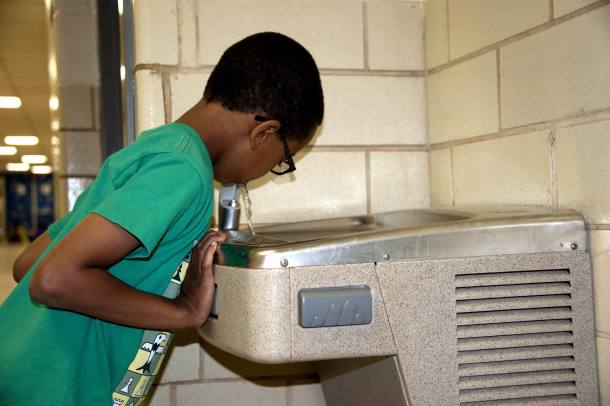
Gov. Phil Scott announced Thursday that he will join the push to have all Vermont schools test their drinking water for lead in the current year. The state originally said it would take three and a half years to complete the testing.
Senate leader Tim Ashe, D/P-Chittenden, discussed similar plans with his Democratic colleagues earlier in the week.
“Here’s an area we agree on, so let’s act quickly to protect our kids,” Scott said during his inaugural address on Thursday. “In order to do that, my budget will invest in lead testing at schools statewide. And, if you’ll work with me in budget adjustment, we’ll have every school tested within a year.”
The state agencies of Human Services, Natural Resources and Education will work with schools this year to test all taps used for drinking water or cooking, according to an information sheet from the Vermont Agency of Natural Resources.
Julie Moore, secretary of the agency, said in an interview Friday that the administration has drafted bill language to require the testing.
“And my understanding is that there’s interest among legislators in making this mandatory,” she added.
Last fall, the state recommended all schools in the state test drinking water for lead after the completion of a school lead testing pilot program at 16 schools. At least three taps in every school in the pilot, or 17 percent of taps tested, had lead levels higher than the American Academy of Pediatrics recommended maximum of 1 parts per billion.

The state released a plan in December to test for lead in drinking water at every school by June 2022, but some advocates and lawmakers said it is important to complete the testing sooner.
Moore said that the 3.5-year timeframe in the initial plan was based on the processing capacity of Vermont Department of Health labs.
“At the behest of the governor, they saw what they could do to accelerate that to the extent possible and, frankly … we may need to go to private labs to be able to get that done in a year,” she said.
The testing program is estimated to cost between $1.1 million and $1.5 million, Moore said, but that amount may be higher if some of the testing has to be outsourced to private labs. The state has applied for a $200,000 grant from the federal Environmental Protection Agency to cover part of the testing, she added. The rest will be funded with one-time money from the general fund.
Sen. Brian Campion, D-Bennington, and Ashe were among the critics of the state’s original multi-year proposal for testing.
“We are relieved to see that they are seeing the light on this,” Campion said of the governor’s proposal. “It is unacceptable to have kids go through elementary school with exposure to lead in the drinking water.”
The Senate will introduce a lead testing bill as early as next week, Campion said. One of the provisions of the bill will be to lower the level of lead in drinking water that would require fixing — in schools from 15 parts per billion, the EPA and state action level, to the American Academy of Pediatrics recommended 1 ppb.

“The Trump administration perhaps will be the worst administration as it relates to the environment,” said Campion. “So I do not think it makes sense for (the Scott) administration to follow their lead of 15 ppb.”
Moore said the governor’s proposal does not at this point include plans to lower the level at which schools must remediate lead, in part because doing so without also requiring public water suppliers to lower their lead levels could create challenges for schools.
“And so it doesn’t make a lot of sense then to take a fixture-by-fixture approach when actually the most significant source of lead is in the raw water that’s being supplied,” she said.
She added that the state will work with schools to lower lead levels as much as possible below the 15 ppb threshold.
Jeff Francis, executive director of the Vermont Superintendents Association, said that while he did not yet know the details of the plan, he supported efforts to make schools safer — and state funding of the necessary fixes.
“Our interests have been and will continue to be a program that is going to work well in terms of its application, and not leave schools with unfunded obligations to either test or remediate,” he said.
Moore said the state will likely not provide funding for remediation, in part because schools in the pilot program were able to fix lead issues relatively cheaply.
“The modest costs probably don’t merit the administrative burden of trying to write grants to schools for several hundred dollars,” Moore said.
“That said, if there’s a school with a more significant lead contamination problem that’s identified through this program we will absolutely work with the school and the state is committed to financial leadership,” she added.
