

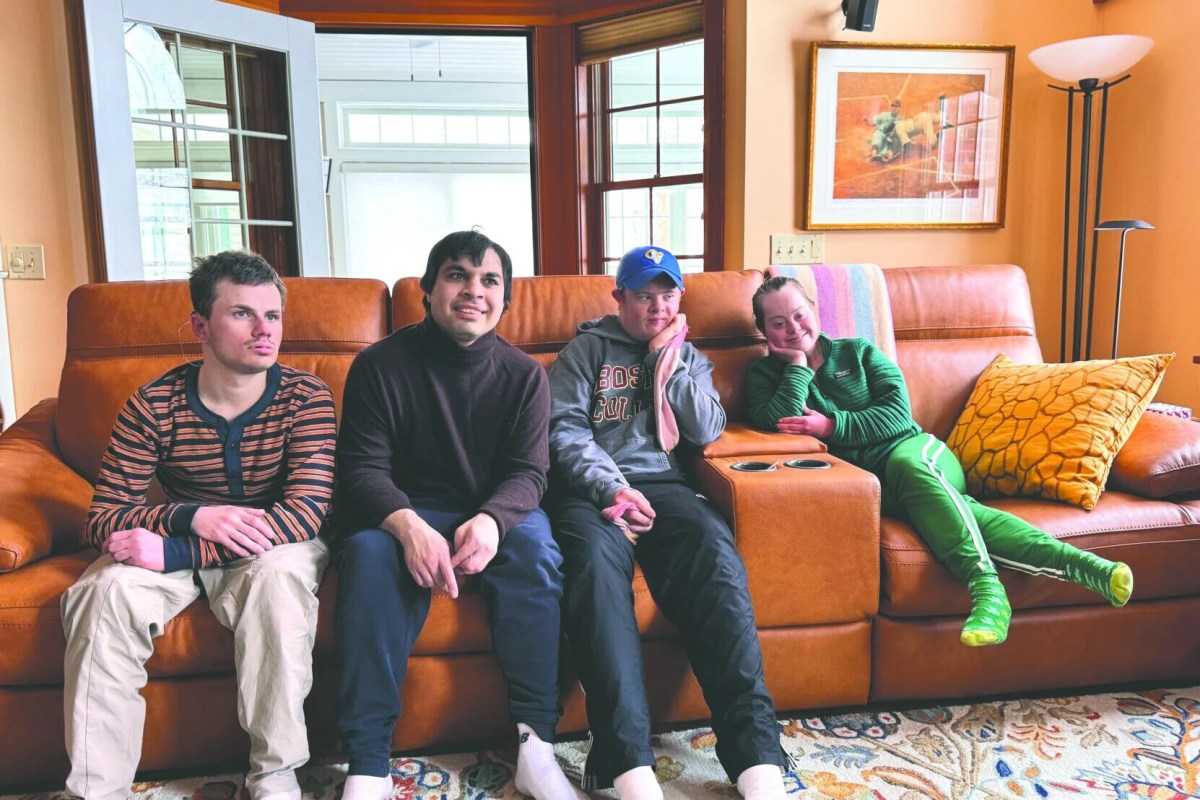
This story by Jason Starr was first published in the Williston Observer on March 6, 2026.
For Donna Savage and other parents of Vermont’s young adults with developmental disabilities, the day-to-day challenges of helping their kids find their way in the adult world after so many years in the care of public schools can be overwhelming.
Yet they are also finding the time and summoning the energy to promote a novel idea for the state: a group living model where adults with disabilities can live together as peers supported by professional caregiving staff.
The families have formed a Developmental Disabilities Housing Initiative (DDHI). It consists of about 175 families whose collective voice has been growing stronger in the halls of the Statehouse. Members have tabled at the Statehouse weekly during the legislative session and hosted an annual ice cream social, where lawmakers meet and mingle with some of the estimated 600 adults with developmental disabilities for whom parents are seeking new housing solutions.
“I just no longer want to wake up in the middle of the night and think ‘what is going to happen to him when I’m not here,’” Savage said of her son, Jack. “We are motivated to make change happen. We need to know our kids are going to be OK.”
Jack Savage was part of the CVU High School community until age 22. He turns 25 this March. To Donna, his graduation three years ago felt like the edge of a cliff.
“It was all that community — all the kids and having friends and aides at school and getting out and doing things — and it just ended,” she said.
Jack needs around-the-clock support with what caregivers call “activities of daily living.” He spends 13 hours a week with a visiting staff member from the Howard Center and works at a grocery store for one hour a week. Donna has cut back on her work hours to fill in the gaps.
“He is home a lot,” she said. “His options are limited.”
Cultivating State Support
The DDHI group began to make headway with the Legislature in 2021. By 2022, they had won the passage of Act 186, which set in motion three pilot projects to model the service supported group housing concept. The Riverflow Community opened with several rooms in Monkton in 2024, a 10-room home in Burlington is nearing completion and a smaller project in a Randolph farmhouse is in the works.
It’s a small fraction of the need and has not slowed the DDHI group’s advocacy efforts. They continue to lobby for state support in the form of housing staff in the Agency of Human Services, housing vouchers and the empaneling of an advisory committee to ensure follow through on future projects.
“I feel like we’re finally getting the Legislature to be very aware of (the issue),” Savage said. “We have the state’s attention now, but it’s a battle.”
Aside from living with parents, the only other option for Vermont adults with developmental disabilities has been a foster care model. Foster families receive compensation from the state for providing living space and care in their homes. It’s an arrangement that is inherently unstable and hard for the state to oversee.
“If you are in foster care, and the person decides they don’t want to do it anymore, it’s over,” said Marla McQuiston, a mother of a 28-year-old CVU graduate with Down syndrome. “Moving is very destabilizing.”
Savage describes the foster care model as “being a stranger in a series of people’s homes.”
“It’s working for some, but for someone with higher needs, it doesn’t work well. It’s almost kind of cruel,” she said. “The state needs to do better … Our kids deserve forever homes.”
It takes a village
McQuiston and Savage live in the same Williston neighborhood and help lead a Chittenden County subgroup of the DDHI. McQuiston is a member of the Williston Housing Committee. They are always on the lookout for property that could be the site of a service supported group home, either through new construction or a retrofit of an existing building.
“We’ve been reaching out to the various developers, and they’ve been supportive but have not necessarily had something to (offer),” McQuiston said.
Their ideal would be to find a setting in Williston, near the commercial center of Taft Corners, for developmentally disabled people who come through the Champlain Valley School District to settle into as adults.
“Our kids have grown up here all the way from elementary, to middle school, to high school,” said Savage. “They know each other, and people in the community know them. It would be very nice if they could stay in their community.”
The Williston subgroup has reached out to the Williston Selectboard and has ongoing conversations with the Champlain Housing Trust to identify possible parcels.
“If you might have land to donate for a wonderful cause, we have one,” they wrote in an appeal to landowners. “We are wondering if there is some land suitable for building that might be donated or offered at a discounted price to build a residence in Williston … This is one of those efforts that takes a village!”
