

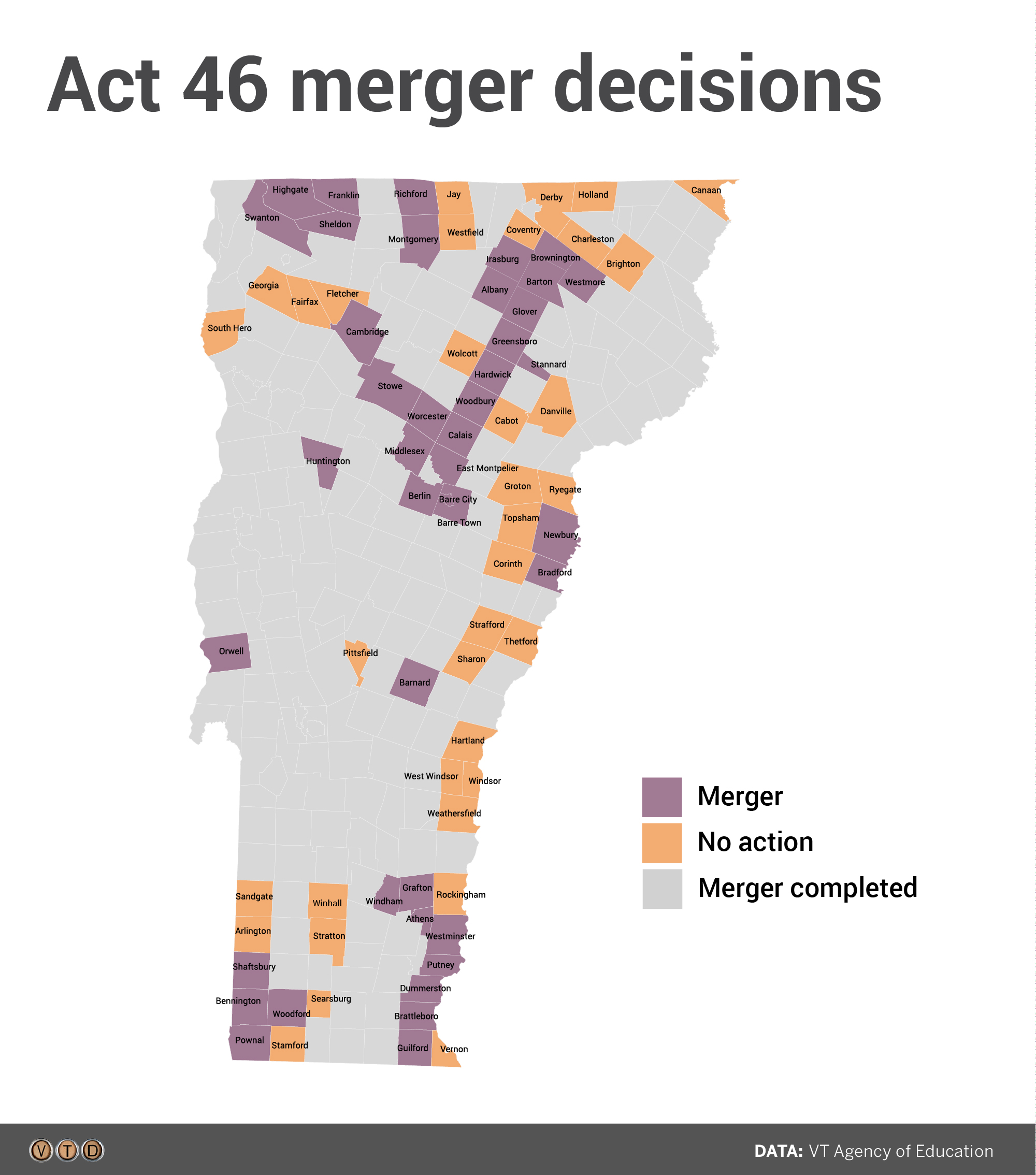
[T]he State Board of Education has adopted its final plan to reorganize school districts under Act 46, redrawing the school governance map to dissolve 50 districts and create 18 new merged entities.
The plan, which was adopted on a 7-2 vote, with state board vice chair Bill Mathis and board member John Carroll dissenting, also let 44 existing districts remain as-is.
Except for a small minority of cases, the state board only allowed districts to remain independent when there weren’t legally compatible partners nearby. For a majority of districts where mergers were possible, the state board opted for consolidation, even when local school boards and community had voted against mergers.
The fact that the state board was acting against the expressed desire of community members wasn’t lost on board members, who debated at length – not for the first time – about how much weight to lend local pushback.
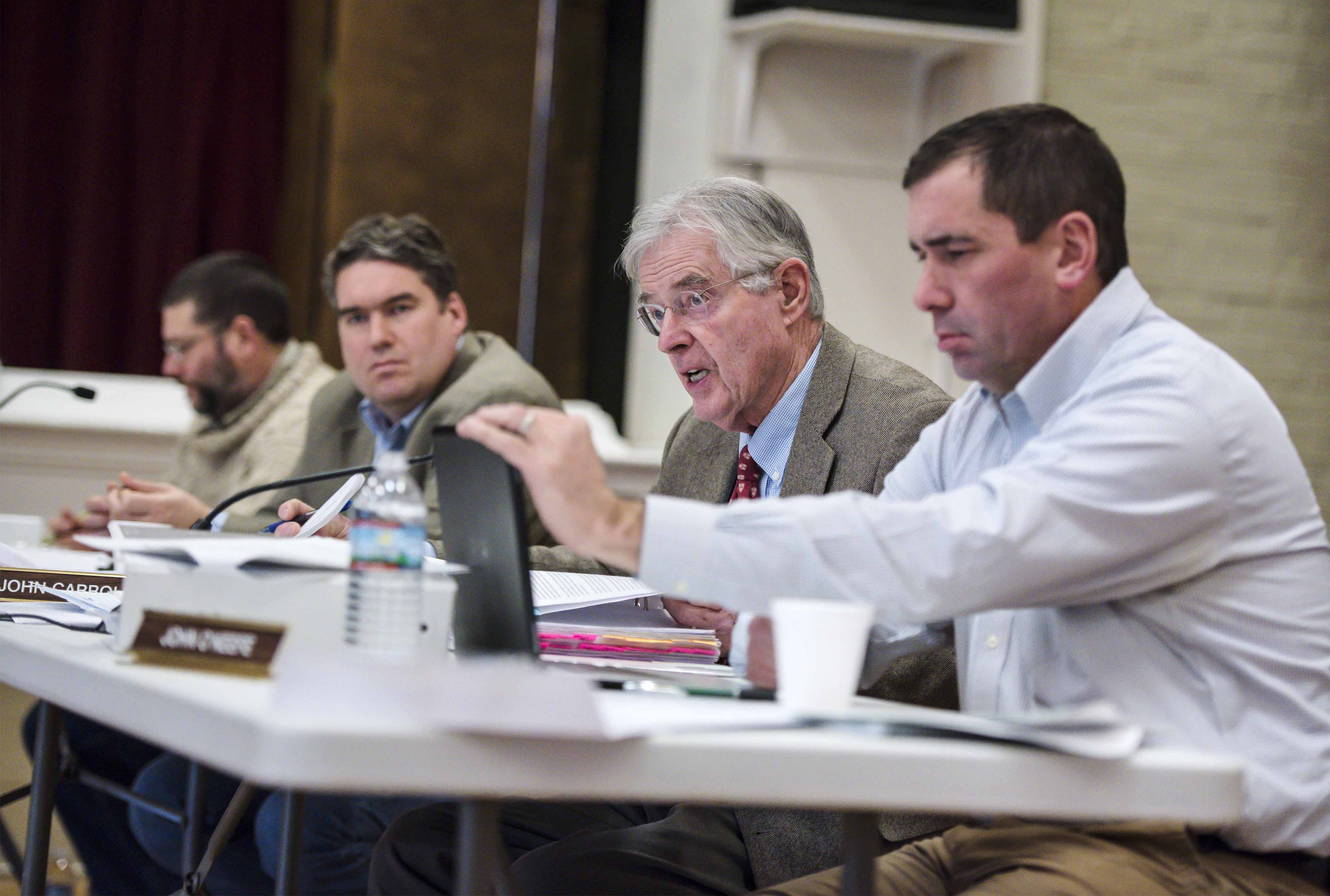
State board member John Carroll argued passionately against adopting the plan, and said the board’s entire process had been paternalistically biased in favor of consolidation.
“Until I caught myself about this, I tended to have a somewhat dismissive attitude toward the proposals of people far away, in small towns,” he said.

Mathis echoed Carroll’s concerns, and said the board hadn’t thoroughly vetted the alternatives to mergers that districts had provided. But Mathis and Carroll were the lone voices of dissent, and a majority of board members argued consolidated entities would be better able to offer students more opportunities in an era of shrinking enrollment.
“We’ve had a lot of discussions – and it’s been an adult discussion – about what we’re doing in terms of local control and whatnot,” said board member Peter Peltz. “But very little about what, from the children’s standpoint, the student standpoint, what’s in their best interest.”
The board’s actions conclude a sweeping governance reform initiated in 2015 when the Legislature first passed the controversial consolidation law. During the law’s voluntary phases, in which school districts could access tax incentives to merge, voters in 146 towns merged 157 independent school districts into 39 new, consolidated entities. Act 46 tasked the state board with deciding what to do with districts that hadn’t merged by choice, and gave the body until Nov. 30 to act.
Vermont has a long history of debating – and rejecting – consolidation efforts. Two voluntary merger laws were passed in 2010 and 2012, but few districts took up the offer. The reorganization completed on Wednesday represents the single largest school governance reform in Vermont since the 19th century, when the so-called “Vicious Act of 1892” cut the number of school districts in the state from over 2,000 to under 300.
Although the state board’s work, after months of marathon meetings, is finally done, theirs is unlikely to be the last word on Act 46. A coalition of communities unhappy with being told to merge have vowed to take their case to court, and 27 school boards to date have voted to sue jointly, according to Margaret MacLean, a leading member of Vermonters for Schools and Community, a group fighting the forced mergers.

David Kelley, an attorney based out of Craftsbury Common, is volunteering on the lawsuit effort. He declined to offer specifics about the impending litigation, except to say the group would act soon.
“There’s a lot of people that are going to have a lot of discussions and we’ll make decisions about what we’ll do in the next two or three weeks,” he said.
But Kelley added he was grateful that two state board members had ultimately voted against the plan.
“I certainly admire Bill and John for recognizing that in Vermont, votes count,” he said.
State lawmakers from communities facing forced mergers are also expected to introduce legislation to write additional leniency into the law or to delay implementation. By law, districts created by state board action under Act 46 are supposed to come online July 1, 2019. But even if legislation makes it through both chambers of the General Assembly, Gov. Phil Scott has indicated he’s unlikely to support off-ramps to consolidation.
In Windham, voters have given their school board the authority to shut down the local elementary to block a state-imposed merger with the West River unified school district. The school board has said they’ll only resort to closing if litigation and legislation can’t successfully stop consolidation, but the Agency of Education has said Windham’s legal strategy behind closing won’t work anyway.
It’s unclear, however, if the agency believes action by the school board to close would simply be null, or if the school could close and a merger also occur. Agency officials have so far declined to say what they think will happen if Windham’s school board moves to close the school. And state board chair Krista Huling said Wednesday it was unclear to her what that scenario would bring.
“I really don’t know,” Huling said. “Those are the sort of repercussions that are going to unfold that I wouldn’t even try to predict how that’s going to play out.”
A meeting has been scheduled for Friday, the legal deadline for the body to act on the consolidation law, in case any last-minute changes need to be made. But the final map is not expected to be altered, and the Agency of Education plans to publish a final plan, with edits made Wednesday, by the end of the week on the agency website.
CORRECTION: The map originally misrepresented the town of Winhall.
