


[C]hristine Hallquist doesn’t know what’s next.
Fresh off of her run for governor, which ended with a loss to Gov. Phil Scott, Hallquist said she’s still thinking through her plans for the future.
“I certainly haven’t ruled out running again,” the Democrat said in an interview this week. “But of course I’ve got to figure out how to make a living as well.”
Hallquist, the former CEO of the Vermont Electric Cooperative, stepped down from her role at the company in March to begin campaigning in the Democratic primary. She won the party’s nomination, but ended up losing to Scott, the Republican incumbent, by a 15 point margin.
After the loss, Hallquist doesn’t plan on returning to VEC, where she had been the chief executive since 2005. She said she will begin looking for a leadership role elsewhere in the electric utility industry in the coming weeks.
Hallquist isn’t limiting her search to Vermont. She’d be open to positions across the country, but wants to find an electric utility that is “interested in solving climate change.” However, she’s concerned that she may have trouble landing a leadership role in the male-dominated utility world because of her gender identity.

Hallquist, who is transgender, began her transition in 2015, when she was already in charge at VEC. “I am going to target the electric utility industry. Of course, the question I’m having is if anyone’s going to hire a transgender CEO,” she said.
Though she might be open to running for governor again, she said that her “preference in the political world” would be to become active in Washington D.C, where she hopes to work on federal policy to fight climate change.
If Hallquist did decide to run for public office in Vermont again, she said she would only be interested in the governor’s office.
“For me it’s about making the biggest impact I think is possible and, you know, I think from a standpoint of climate change and rural development…I can make a bigger impact by just working those issues independently,” Hallquist said.
As the first openly transgender person to get major party backing in a U.S. gubernatorial race, Hallquist’s run garnered national attention. She ran on progressive platform, pitching proposals like free college tuition for low and middle income Vermonters, paid for through a reduction in the state’s prison population. Her signature issue and a plan to connect every home and business in the state to high-speed broadband.
Before her campaign, Hallquist had no political experience and low name recognition. Scott, the popular Republican incumbent governor, was able to cruise to reelection despite polls in mid-2018 showing that his own approval rating plummeted within his own party after he signed new gun control bills.
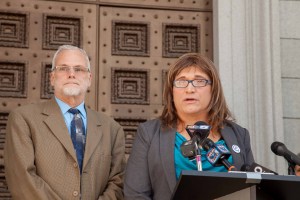
Terje Anderson, chair of the Vermont Democratic Party, said a major challenge of Hallquist’s campaign was fundraising. The party had expected more donations to pour in for Hallquist because of attention her candidacy had attracted around the world. But Democratic donors in Vermont and across the country were more focused on Congressional midterm races, he said.
“We had higher hopes hat we’d get more money because of the nature of her candidacy and that didn’t happen,” he said.
Anderson said the state party is looking for roles she could fill going forward, and would be supportive if she decided to run for governor again.
“I don’t know what’s going to happen in 2020 but she’d certainly be a very credible candidate for governor if she chose to run for that,” he said.
While Hallquist never focused on her gender identity on the campaign trail, it became the focus of media coverage around the country.
Being transgender, Hallquist said, was an “additional hurdle” she had to overcome on the campaign trail.
Taylor Small, the Pride Center of Vermont’s director of health and wellness, agreed that Hallquist’s gender identity was an obstacle in her race.
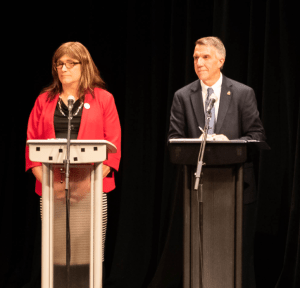
Small said that Vermont was not immune from the transphobia that exists across the country.
Hallquist received violent threats shortly after being confirmed as the Democratic nominee, and transphobic slurs followed her campaign in online comments and social media posts.
But Small believes that Hallquist’s campaign was ultimately a step forward for recognition of Vermont’s trans community.
“It showed: trans people exist here in Vermont, plain and simple,” Small said. “She got a backlash, but she started a lot of conversations.”
Though Hallquist became known across the country for breaking barriers as a transgender politician, she suggested that her advocacy going forward will continue to be centered on the issues she focused on during the campaign: broadband access and climate change, in particular.
Looking back on the campaign, Hallquist said she wishes that she had entered into the race earlier. She would have benefited from more time to work out her policies, she said. Many of her proposals, such as her broadband plan and plan to form a Medicare-for-all system with other states, were widely criticized for failing to identify funding sources.
“I think it’s fair criticism,” she said.
But she believes if she had given herself more time to flesh out the policies, and more time for Vermonters to get know her, her odds on election day would have been better.
“If I had to do it differently and had been in the race six months earlier, I think I could have won. More time to parse out the policies,” she said. “People were naturally skeptics.”
Mike Dougherty contributed reporting.

