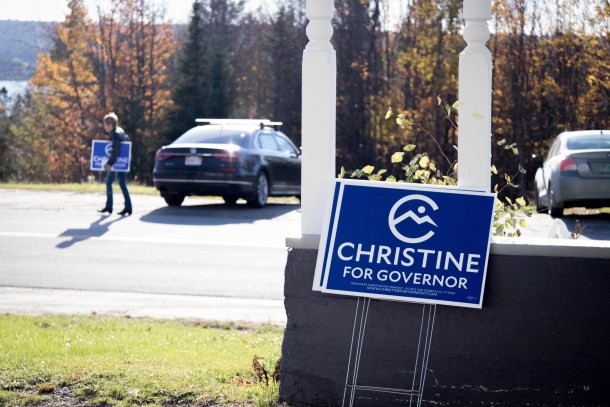
[P]assing through North Wolcott, riding shotgun in an orange Jeep Renegade, Christine Hallquist pointed to a run-down general store on an empty thoroughfare.
Bound for a campaign event in Newport, Hallquist, the Democratic nominee for governor, noted that the internet connection in this rural area was “practically non-existent.”
“Every time it rains it knocks out,” she said. “You could never run a business up here.”
With less than a month until the election, Hallquist says she has been spending a lot of time on the road, crisscrossing the state, making her pitch to voters in Vermont’s most rural communities.
On the campaign trail, Hallquist touts her plan to rejuvenate the state’s struggling rural economy. The cornerstone of that plan is a promise to connect every home and business in the state to the internet, a proposal she is billing as a panacea for many of the state’s financial problems.
Ensuring all corners of Vermont have high speed internet connection will attract new residents and businesses, she says, which in turn will lead to increased enrollment in small school districts. The state will have a larger tax base, and struggling farmers will have new ways to sell and market their products.
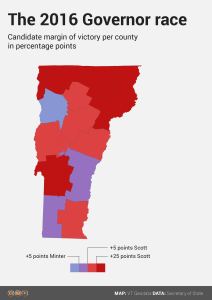
On the morning of Oct. 19, Hallquist was headed to back-to-back campaign events in Orleans County, a part of the state where Republican Gov. Phil Scott won big in his 2016 election victory over Democrat Sue Minter.
Pollsters and political analysts predict that Scott’s spot in the governor’s office is likely safe and that Hallquist’s path to victory is narrow and an uphill battle.
Hallquist, 62, who until March was CEO of the Vermont Electric Cooperative, says she’s not putting stock in polls and acknowledged that her bid for the governor’s office is a tough climb.
If she does win, she said, it will be because of the “blue wave”: Democrats turning out in higher numbers than usual, largely because they are dissatisfied with President Donald Trump.
“I’m not naive. No one’s beaten an incumbent since 1962,” she said, referring to the election when Vermonters unseated a sitting governor, F. Ray Keyser Jr., and elected Phil Hoff. “If it does happen it will be because of the wave.”

Hallquist also thinks that voters will be inspired by her economic message, and criticism of Scott. She has called the governor a “passive” leader, whose focus on keeping tax increases at bay has prohibited economic development.
“These people who are going to get out and vote against Donald Trump are likely to go out and vote against Phil,” she said. “I think it’s deserved because he hasn’t done anything.”
In the final weeks leading up to the election, Hallquist’s campaign staffers and volunteers, based out of Burlington, have been working to call voters throughout the state and knock on doors in Chittenden County.
This has freed Hallquist up to spend her time outside of the state’s solidly Democratic and most densely populated region—where she will likely perform well in November — and stump in towns around the state.
Her chances of victory in the general election, though, hinge on her ability to turn out voters in rural districts, and convince moderate Democrats who may have supported Scott in the last election to vote for her.
Turning those voters from Scott in the waning weeks of the election cycle may prove difficult, as the governor maintains a leg up in fundraising, and is receiving a boost from the Republican Governors Association, which has spent thousands on television and online advertising for his campaign.
Hallquist, who is the first openly transgender person to run for governor, has received widespread, international media coverage, which has inspired a flurry of hundreds of small donations, including many from around the country, to pour in.
But as of the latest campaign finance filings on Oct. 15, she still trailed Scott. Hallquist had raised about $440,000, according to filings, while Scott had raised about $566,000.
Hallquist acknowledged last Friday that her campaign’s fundraising has fallen short of what she had expected when she launched her bid earlier this year.
At the outset of the campaign, she hoped she would be able to raise more than $2 million.
“We had much higher expectations, much higher expectations,” Hallquist said.
Her benchmark for fundraising estimates, she said, came from the 2016 gubernatorial races — that year Scott raised $1.5 million and Minter raised $2.1 million. In 2016, the state saw the most expensive governor’s race in Vermont’s history with candidates and outside groups spending a total of $13 million. It was also a year where candidates were competing for an open seat, after Gov. Peter Shumlin declined to run for re-election.
Part of the difficulty in fundraising this year, Hallquist said, is that many of Vermont’s biggest, politically active donors are spending money on competitive out-of-state races. She pointed in particular to the U.S. Senate race in Texas where Congressman Beto O’Rourke, a Democrat, is challenging Republican incumbent Sen. Ted Cruz.
As recently as September, the Hallquist campaign had planned on buying television advertisements. But now she says it can’t afford them. The campaign has only been able to buy ads on online and on the radio.
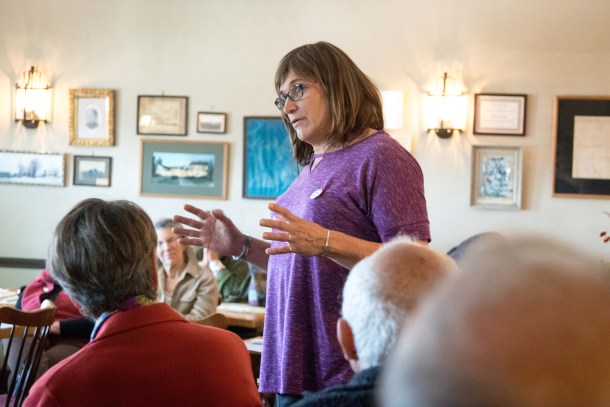
On a Friday morning in Newport last week, Hallquist stood behind the bar at East Side Restaurant and Pub and spoke before a group of about 30 people. To encourage audience members to donate, she mentioned that she had sworn off corporate donations and highlighted that the Republican Governors Association was spending big on Scott.
The organization is funded by donors including the Koch brothers, Pfizer, AT&T and other corporations.
“We saw last week the Koch brothers are spending $70,000 on Phil Scott’s campaign,” Hallquist said, referring to money that has largely been used to bankroll television and online ads.
“We’d like to get up on television,” she said a few moments later.
Before she started speaking, Hallquist made an effort to introduce herself to nearly every member of the crowd and shake their hands.
Among those in the audience was Frank Davis, an independent who is running for a House seat in Derby. Davis, who has a progressive platform and has run for the House three times and lost, said that it’s difficult for Democrats to woo voters in Orleans County. Republicans are well-organized and financed throughout the region.
“It’s uphill when you’re around here,” he said. “She’s not going to win the county.”
But statewide, Davis thinks Hallquist has a shot. He pointed to her background as CEO at the Vermont Electric Cooperative and how the company was in much better financial shape when she left than when she took it over.
When the candidate asked her Newport audience how many were members of the cooperative, nearly half of the people sitting in the bar raised their hands.
“What she has going for her is her success in business,” Davis said.
At the event in Newport, Hallquist ran through her talking points about her time at the VEC, and how she turned the company around during her tenure as CEO.
She told voters of her plans to enact a paid family leave program for workers, offer free college tuition to Vermont college students, raise the minimum wage to $15 an hour, and establish a Medicare-for-all health care system as part of a coalition of other states.
Throughout her campaign, Hallquist’s specifics on how the state would fund such programs have been minimal or general. At the same time she has avoided saying that she would support raising new taxes.
On the campaign trail, Scott has used this ambiguity to his advantage, by implying that Hallquist’s governorship would lead to massive tax increases for Vermonters.
“A lot of promises made in this campaign, free college, paid family leave, universal broadband, $40 million for child care, single payer … These sound nice, nice sound bites, but Vermonters are going to pay,” Scott said during a debate with Hallquist on WCAX earlier this month.
John Wilson, a former Newport City Council member who heard Hallquist speak, also questioned how she would fund her initiatives.
“You can have all these programs, but where’s the money coming from?” he said. “It’s easy to come in and say ‘If I’m elected I’m going to give everyone free education — who the hell is going to pay for that?’”
At her next stop of the day, Parker Pie Co., an artsy pizza joint in West Glover, a small crowd of about 15 people sat around glossy wooden tables, eating slices and drinking beer while Hallquist spoke. Hallquist and two of her campaign staffers ordered a pizza topped with spinach, bacon, onions, garlic and maple syrup.
Her stop at the restaurant brought out Rebecca and Ted Young, who voted for Scott in 2016, but have decided to support Hallquist this time around.
Young said she’s not voting for Scott, in part, because of his decision in May to pitch lawmakers his five-year plan to reform the education system, with only a few weeks left in the legislative session. She called the move an effort to “skirt” the legislative process.
“It’s just not the way it’s done,” she said.
Young also supports Hallquist’s rural economic development proposals, particularly her broadband plan.
“I believe that connectivity is going to be the key to making it happen,” she said.
Hallquist has compared the proposal to connect every home and business to high speed broadband to the electrification of rural areas in the 1930s.
“You cannot build an economy if you don’t have fiber,” she said. “It puzzles me that it’s sometimes difficult for people to understand.”
She has said her plan won’t involve added costs for taxpayers. It calls for changing utility regulations to require electric companies to hang broadband cables, rather than internet companies, a shift she says will lower the cost of expanding internet access throughout the state.
In fact, because it will inspire more people to move to rural areas, she says it will create a larger tax base for the state, which can be used to fund other initiatives.
When asked how she was going to afford increasing the state’s spending on child care by more than $40 million, for example, she answered with the broadband plan.
“That’s why we’re going to grow the economy,” she said. “That’s why we’re going to connect every home and business in Vermont.”
After Hallquist’s last event of the day at the Highland Lodge, a bed and breakfast in Greensboro, walking to his car, Paul Fixx, who attended, said he supported Hallquist.
“I think she’s talking the talk. It remains to be seen whether she’s walking the walk, but I think she has a better chance of getting the state where it needs to be than Phil Scott.”
But if he had anything to critique about her platform, he said he thought she may be putting too much stock in the broadband plan.
He has connection where he lives in Hardwick, and although it may not be as fast as the internet service Hallquist is pledging to bring, there are other important issues like rural transportation and affordable housing he’d like to see addressed.
“I think it’s important. I think she may overstate some it,” he said. “If I had to pick nits.”