WILLISTON — Outside a barn on rolling farmland, as smoke from barbecuing pork wafted through the crowd, Lt. Gov. David Zuckerman worked the crowd, shaking hands.
Droves of the progressive leader’s supporters had gathered at the Isham Family Farm on a Sunday earlier this month for a fundraiser and series of stump speeches to drum up enthusiasm for the Democrats on the November ballot.
The crowd slowly swelled throughout the afternoon, awaiting the speeches and the arrival of Zuckerman’s most high-profile ally — the politician who first inspired the ponytailed, 47-year-old incumbent lieutenant governor to run for office 20-plus years ago: Vermont’s independent senator, Bernie Sanders.
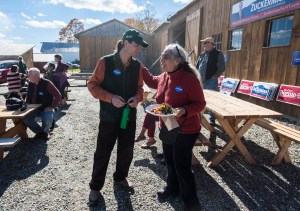
Sitting around picnic tables outside the barn, many at the event — billed as a “Pig and Veggie Roast” — were eating pulled pork, fresh from the grill.
Zuckerman and his wife, Rachel Nevitt, had been working since 5:30 a.m. to prepare the dish, using a recipe with garlic, salt, cumin and pork from the Hinesburg-based Full Moon Farm, which the couple owns.
Those who don’t know Zuckerman holds the No. 2 post may know him as the cheerful organic farmer they’ve met at his stand at the Burlington Farmers Market, where he can often be found selling produce and talking politics on Saturday mornings.
About a quarter mile from the farm, marked by Sanders and Zuckerman lawn signs, drivers coming from the north were greeted by a much larger blue sign. “Elect Don Turner,” it read.
Turner, the outgoing House minority leader, is mounting an energetic campaign to oust Zuckerman in the upcoming election.
The Republican has outraised the incumbent by about $80,000, and has also received financial backing from outside groups like the National Association of Realtors, which spent more than $50,000 on advertisements for Turner’s campaign earlier this month.

Turner and Zuckerman fall on opposite ends of Vermont’s political spectrum. Like Gov. Phil Scott, Turner is running on a platform of affordability, pledging to oppose new tax increases.
Zuckerman is an outspoken critic of the governor. He has championed proposals to raise the minimum wage to $15 an hour and establish a statewide paid family leave program, which Scott vetoed in the spring.
As minority leader, Turner consistently rallied Republican support in the House to carry out the will of the governor, and quash attempts by Democrats to override vetoes.
Standing outside the barn Sunday afternoon, Mike Hennessy, a Zuckerman supporter, said he was concerned about Turner and the money pouring from out of state into the Republican’s race.
“I don’t think there’s an easy way to influence Vermont’s politics other than this race,” Hennessey said.
“Don has a shot because of the money,” he continued. “I don’t think it’s easy to take down an incumbent, but who knows?”
The latest VPR-Vermont PBS poll published Monday shows Zuckerman with a strong lead over Turner. Out of 496 respondents polled, 47 percent said they would vote for Zuckerman, while 30 percent said they would vote for Turner.
In between greeting members of the crowd, sporting a green vest and a hat that said “Make America Green Again,” Zuckerman admitted that Turner’s financial support gives his opponent a boost.
“Vermont is an inexpensive place to buy influence,” he said.
But, he said calmly, he believes it’s hardly the only factor in the race.
“It’s about people more than money.”

After serving nearly two decades in the Legislature, Zuckerman was elected lieutenant governor in 2016, beating a variety of opponents in a hotly contested primary before defeating Randy Brock, a Republican state senator, in the general election.
Former House Speaker Shap Smith, who finished second to Zuckerman in the 2016 Democratic primary, said his opponent had a broader coalition of grassroots support than many had expected at the time.
Much of the enthusiasm for Zuckerman, according to Smith, stems from his work on issues in the Legislature like cannabis reform and GMO labeling.
“I think that he actually had a wider base that people were less cognizant of,” Smith said, speaking about the perception of Zuckerman during the Democratic 2016 primary race.
“A lot of people made the assumption that he was not well known outside of Chittenden County and that that would be a problem for him,” Smith said.

Zuckerman’s 2016 bid for the lieutenant governor’s office was also buoyed by a seal of approval from Sanders, who endorsed him over his competitors, Smith and Kesha Ram, a state rep from Burlington. Zuckerman acknowledges that receiving the independent senator’s selective endorsement was a “big factor” in his victory.
Brock agrees. He lost the race by a 50-43 margin.
“David did, I think, line himself up with Bernie, as one of Bernie’s proteges, and I believe that that helped him in many circles,” Brock said.
Television crews dotted the crowd at the farm, and although local stations interviewed Zuckerman briefly, most didn’t seem to show up for him.
When Sanders arrived at the pig roast, flanked by staffers, the crowd thronged around him, reaching out for handshakes. Camera operators jockeyed for good angles as Sanders walked through the packed barn.
Later, when the senator took to the cramped indoor stage and delivered his stump speech, like many of the speakers before him, including Congressman Peter Welch and Zuckerman, the focus was less about politics in Vermont, and more about resisting the headwinds coming out of Washington, D.C.
“We are horrified by Trump because he lies every single day … massive tax breaks to the rich, ignoring the needs of working families, a budget that would have cut Medicaid by a trillion dollars,” Sanders said.
Sanders urged the crowd to vote and encourage others to do so to prevent the lackluster turnout the state saw during the last midterm elections — the worst it had seen in about 70 years, he said.
“This is in fact the most important midterm election in the modern history of this country and our job is to have the largest voter turnout in midterm history in the state of Vermont,” Sanders said.

Zuckerman volunteered for Sanders’ congressional campaign in 1992, when he was a student at the University of Vermont, and likes to tell the story how Sanders is the one who first ignited his interest in seeking office.
“This gentleman is the person that inspired me back in 1992, as a cynical college student at UVM, who thought politics was all taken over by corporate interests and corporate money,” Zuckerman said, onstage at the pig roast, introducing Sanders.
This year, once again, Sanders has endorsed Zuckerman in his race.
Since his election in 2016, it has been Zuckerman’s job to preside over the Vermont Senate. But like lieutenant governors before him, he has used his role as a platform to champion pet issues and his party’s priorities. Early in his tenure, his command of procedural rules appeared rocky at times.
Most notably, in the last legislative session, he orchestrated an eleventh hour revival of a House proposal to pave the way for a legal market to tax and regulate recreational marijuana, just a few months after the bill legalizing the drug became law.
Turner, who opposed legalization, but is in favor of creating a legal market for the drug, at first collaborated with Zuckerman on the plan, offering to propose an amendment with tax and regulate language.
But Turner has said he backed out of the plan after he learned House leadership wasn’t in favor of the measure. Zuckerman said Turner’s pivot sunk the only chance the bill had of passing.
“Once the minority party leader was no longer helping lead that effort, that changed that equation,” Zuckerman said.
Zuckerman’s maneuvering on marijuana was somewhat of an exception. He said he picks his battles in the Legislature carefully and avoids wading into issues or availing his support to lawmakers before receiving the approval of key Statehouse leaders.
“It’s not the lieutenant governor’s job to go in and start poking all over the Senate, or House in particular, without checking in,” he said in an interview this month. “Am I perfect at that? No, of course not.”

Outside of the Legislature, he says he has used his role to engage more Vermonters in the political process: hosting coffee hours and movie nights with constituents, live-streaming town hall discussions about policy and social issues, and blasting out a lieutenant governor newsletter to about 20,000 readers each week.
On the campaign trail, Turner’s leading line of attack against Zuckerman is a charge that the incumbent hasn’t made efforts to work with politicians outside his party.
“What I’ve seen in the lieutenant governor’s office is far more partisanship than I’ve seen in past lieutenant governor’s offices,” Turner said during a VPR-Vermont PBS debate earlier this month.
Turner noted that Zuckerman hadn’t invited him to his office until this spring, when they started discussing the plan to revive the tax and regulate pot legislation.
Zuckerman refutes the charge, and says that he has always advocated appointing Republicans as chairs on Senate committees, and included politicians and others with opposing viewpoints during his discussions with the public on policy matters.
During the debate, he added that Republican state senators, like Richard Westman R-Lamoille, and Senate Minority Leader Joe Benning, R-Caledonia, are frequently in his office.
In an interview, Benning said he does visit Zuckerman’s office on occasion, but not usually because he’s invited, or for the purpose of discussing legislation. He sometimes finds himself the room because it has the fixings to make tea and coffee.
“It’s just the nature of the beast,” Benning said. “He has a tea and coffee operation there and I come in from time to time and grab a cup of tea.”
“I don’t feel as if I’ve been excluded from David’s office, but by the same token I haven’t been invited in to talk about legislation, other than the marijuana situation.”
Zuckerman has said that in his earlier days as lieutenant governor, he went out of his way to find opportunities to collaborate with Scott.
He said he pitched Scott a few projects for the two to tackle together — among them were searching for a way to find savings in school spending on social services and funding a new research position at the University of Vermont to study Lyme disease, he noted. Zuckerman’s wife, Rachel, has Lyme disease.
“I went to the governor … and said I’ve got three ideas to work on with you, let’s show this country in this hyperpartisan world we’re in that a Republican governor and a Progressive Democrat lieutenant governor, once elected, can work on those same visions and goals,” Zuckerman said.

But Zuckerman maintains Scott never followed up with him and that instead, the governor or his administration put up a “barrier to cooperation.”
Brittney Wilson, Scott’s campaign manager and spokesperson, said the governor has never stood in the way of Zuckerman’s opportunities to work with state agencies, nonprofits and private partners.
“There are various opportunities for the lieutenant governor to take a lead on initiatives,” she said. “So I think blaming the governor and the administration for possibly a lack of progress on his part is disingenuous.”
Many of Vermont’s past lieutenant governors have gone on to seek higher office. Scott is one of many lieutenant governors who has made a bid to be the state’s chief executive officer.
Former lieutenant governors Doug Racine, a Democrat, and Brian Dubie, a Republican, also both ran for governor, but lost. Howard Dean was lieutenant governor before he became governor in 1991, after Richard Snelling’s sudden death.

Zuckerman said a run for even higher office could be in the cards someday, if he sees an opportunity and receives encouragement from his supporters to do so.
“I’m prepared to serve in whatever role both other people and myself feel is the best way to serve Vermont,” he said.
Standing outside the barn at Isham’s farm on the crisp fall afternoon, Eric Weiss, a retired school teacher and Zuckerman backer, said he opposed Turner, largely because of his stance on policies like education finance and testing in schools.
One day, he said, he’d like Zuckerman to run for governor.
“I don’t know that he wants to,” Weiss said. “I would certainly like to see him do it.”
He sees Zuckerman as a leader with progressive bona fides who might be able to make a dent in addressing other issues he cares about, like income inequality. But perhaps not at the moment. Zuckerman’s current post, particularly with a Republican governor in office, has its limits, he said.
“I’m not sure that his present position as lieutenant governor gives him much power to do that.”