


Editor’s note: This story by Andrew Martin was published by the News & Citizen on Sept 27
[A] court decision could spell the end for a treasured body of water, the 653-acre Green River Reservoir, and the isolated, pristine 5,110-acre state park surrounding it in Hyde Park.
Two years after Morrisville Water & Light appealed state-imposed conditions regulating how it operates three dams in Lamoille County, an environmental court judge has finally issued a ruling in the case.
On Sept. 18, Judge Thomas G. Walsh issued his decision — a mixed bag of good and bad for both Morrisville Water & Light and the Agency of Natural Resources, the state agency spearheading the drive to impose stricter standards on the Morrisville utility’s hydro facilities.
Walsh ruled in Morrisville’s favor in terms of how much water the utility allows to bypass its dams in Morrisville village and Cadys Falls on the Lamoille River.
But, he sided with the state agency in limiting the amount of water Morrisville can draw down from the Green River Reservoir each winter, a condition that the utility says will make the Green River dam unprofitable, and possibly unsafe.

“At Green River Reservoir, it was disappointing. The limited drawdown really makes it uneconomic for us to operate it,” Craig Myotte, general manager of the Morrisville utility, said Tuesday. He and his staff have repeatedly said over the last few years that they won’t operate the dam at a loss, and they’ve raised the possibility of draining the reservoir and decommissioning the dam as a possible solution.
That would eliminate one of the most extraordinary outdoor locations in Vermont.
It wasn’t all bad news for the Morrisville utility, though.
“We were pretty happy with Cadys Falls and Morrisville; they ended up accepting our recommendations” at those two dams, Myotte said. The two Lamoille River dams account for 9 million of the 10 million kilowatt-hours of electricity that Morrisville generates at its three hydro facilities each year. The other 1 million kilowatt-hours are generated at the Green River dam.
State officials don’t appear pleased with any portion of the ruling.
“We’re still in the process of reviewing the decisions,” Matt Chapman, general counsel with the Agency of Natural Resources, said on Tuesday. “On the whole, we’re generally disappointed with it.”
Chapman and other agency leaders had no specific comments to make at press time; they were still reviewing Walsh’s ruling before deciding whether to appeal. The appeal deadline is 30 days after Sept. 18, the date of Walsh’s decision.
Reservoir in peril
Over the past five years, Myotte and his staff have repeatedly stated that if they are not allowed to perform a significant drawdown at Green River Reservoir each year, then the facility becomes unprofitable.
They normally draw down up to 10 feet of water every winter, and use that water flow to produce about one-third of the hydro dam’s total electricity output.

Morrisville had proposed to limit its drawdown to 6 feet each winter, but Walsh ruled in favor of the state-proposed drawdown of just 18 inches.
Morrisville says that could cut the dam’s electricity output by up to 300,000 kilowatt-hours, nearly one-third of the annual output, making it unprofitable to continue operating.
It has also raised the possibility that not drawing down water levels several feet every winter to allow room for spring runoff could lead to safety concerns at the dam, but no safety study has been done yet.
“I don’t know what we’re going to do yet, but we have to figure that out,” Myotte said Tuesday. In the past, the utility has raised the possibility of transferring ownership of the dam or decommissioning it and draining the reservoir, a move that would shock the more than 10,000 visitors the park draws each year.
The future of the Green River Reservoir and the surrounding state park has been a topic ever since Morrisville and the agency have been at odds. But state officials don’t appear to have any plans for what to do if Morrisville really does decide to decommission the dam or turn it over to someone else.
“We will be looking for them to say what the next steps will be before planning further,” Chapman said.

All about water flow
Morrisville Water & Light’s standoff with the Vermont Agency of Natural Resources ended up in environmental court when the utility appealed the water quality certificate issued by the state agency in August 2016.
The certificate lays out how Morrisville should operate its three hydro facilities. The agency’s comments are part of Morrisville’s relicensing of the three hydro dams with the Federal Energy Regulatory Commission.
For the two dams on the Lamoille River, the main point of contention was how much water should be allowed to bypass each facility. Allowing more water to bypass the dam allows for a healthier river and better aquatic habitat downstream, but it also cuts into Morrisville’s hydropower output.
For the Green River Reservoir, the main sticking point was how far Morrisville should be allowed to draw down the reservoir’s water level every winter.
Walsh did favor parts of Morrisville’s proposal for operating the dam at Green River Reservoir, but he sided with the state on sharply limiting the drawdown of the water level every winter.
State officials think drawdowns of several feet expose too much aquatic habitat to Vermont’s extreme winter temperatures, so the agency’s proposal allowed for only an 18-inch drawdown each winter.
Morrisville had countered with a maximum drawdown of 6 feet, but Walsh wrote that “does not sufficiently support high-quality aquatic habitat,” and sided with the state agency instead.
For the two dams on the Lamoille River, Walsh determined that the bypass flows, measured in cubic feet per second, proposed by Morrisville comply with current Vermont water quality standards. For the Morrisville village facility, the utility was proposing a minimum bypass flow of 43 cfs, more than triple the 12 cfs required by the utility’s old license. The agency’s water quality certificate proposed a minimum flow of 70 cfs and also requested that 1 inch of water be allowed to spill over the dam at all times for aesthetic purposes.
Walsh ruled that the state conditions “exceed what is necessary to comply” with Vermont’s water quality standards.
He made a similar ruling for the Cadys Falls dam, where Morrisville is not required to bypass any water under its current license. The utility proposed a bypass flow of 65.5 cfs, a sharp increase but still less than the state’s proposal of 100 cfs. The same aesthetic clause was included in the state’s proposal for the Cadys Falls project, but Walsh again decided to adopt Morrisville’s proposal instead.
“That was the other big benefit, not asking for any aesthetic flow over the dams,” Myotte said.
Whitewater exception
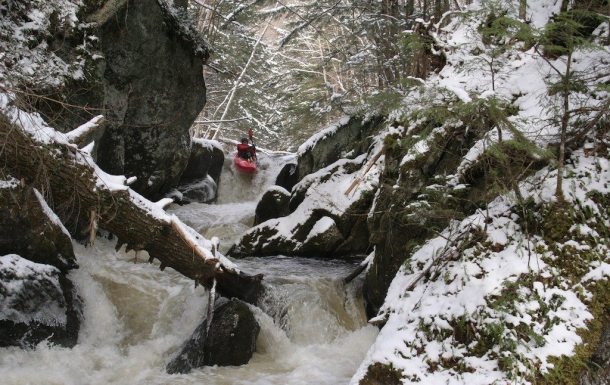
Walsh included one other condition in his ruling: The existing recreational use of whitewater kayaking on the Green River below Morrisville’s dam must be allowed to continue. For that reason, three scheduled releases of at least six hours must be held each year to allow for whitewater rafting on the river.
That shows the court “recognized that this (the Green River) is a very valuable whitewater boating resource,” said Bob Nasdor, northeast director for American Whitewater, one of the organizations that filed a cross-appeal in the case.
“Scheduled releases can draw over 100 people. It’s just a beautiful river that provides whitewater boating opportunities that are unique to the region,” Nasdor said. “I think overall this will result in a better managed river and preserve a recreational resource.”
What’s next?
Myotte planned to confer with lawyers on Walsh’s ruling.
Any appeal by Morrisville Water & Light, the Agency of Natural Resources or any of the other involved parties would send the case to the Vermont Supreme Court, where Myotte expects the case would be tied up for three to five years.
One organization that filed a cross-appeal in the case, the Vermont Natural Resources Council, is “very concerned with the judge’s ruling,” said Jon Groveman, the council’s water program director.
His organization thinks Walsh’s ruling could set a dangerous precedent of allowing hydro facilities as a protected use under Vermont’s water quality standards — something Morrisville argued for.
Groveman considers that a “radical shift” from past policy. So, his organization is now “considering all our options, including whether or not it needs to be appealed to the Supreme Court,” Groveman said.
If no one appeals the decision, Myotte believes Morrisville will receive its new license from the Federal Energy Regulatory Commission sometime in 2019. That license could be good for 30 to 50 years, he said; Morrisville’s old federal license expired in April 2015 and the utility has been operating under its grandfathered conditions since then.
Myotte and his staff had asked for 10 years to implement all the changes required by the conditions of the new license, but Walsh ruled that four years would be sufficient.
