

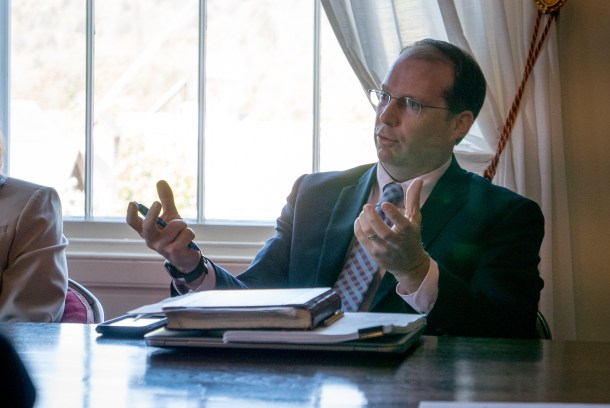
Gov. Phil Scott’s top aide is continuing his offensive against the Joint Fiscal Office.
Scott’s chief of staff, Jason Gibbs, accused the JFO earlier this month of being partisan in its critique of the plan, which projects $300 million in future savings that the JFO says simply doesn’t add up.
While the governor apologized, Gibbs has continued to level criticism at the nonpartisan financial research arm of the Legislature.
During an interview Wednesday, Gibbs said the dispute over the projections in the administration’s plan, which is at the center of ongoing political gridlock in Montpelier, had caused deep distrust between economic analysts working for the administration and their colleagues working for the Legislature.
“The relationship between their analysts and our analysts has deteriorated to the point where our analysts don’t feel comfortable presenting that information unless it is in a public forum,” Gibbs said.
Gibbs, a chief architect and pitchman for the plan, said the JFO has yet to demonstrate that the Scott administration’s presumptions are incorrect.
“Has JFO presented any actual math? Any work product? The type of mathematical analysis that we have on our cost containment provisions to support their critique of our cost containment proposal?” Gibbs asked. “If you look carefully at how much math is in the document they have provided, there is virtually none.”
Officials with the Joint Fiscal Office have said that the administration has not fully disclosed financial information for an estimated $300 million in savings from reforms to the education system.
The Scott administration and Democratic leadership are at odds over the school tax bill because lawmakers would raise homestead property taxes to cover school budgets, which would violate the governor’s campaign pledge not to raise taxes. Scott also says raising taxes is unnecessary when the state has $160 million in unexpected revenue in the next fiscal year.
The JFO and its consultants gave a series of presentations to lawmakers last week when they returned for a special session called by Scott. The fiscal office released a memo listing concerns with saving projections in Gov. Phil Scott’s five-year plan to keep taxes flat while saving money to reinvest in schools.
The main upshot of their analysis was that Scott’s plan severely overestimated savings, undermining the administration’s claim that the $44 million in one-time money required under the plan would easily be paid back over five years.
The administration vehemently disagrees, and believes news coverage of the Legislature’s process is hurting their case because it gives the General Assembly more influence over public opinion, Gibbs said.
“From our perspective there is so much emphasis and coverage on this process that the prospective is influenced by this body’s [the Legislature’s] view of the process more than it is our view,” Gibbs said.
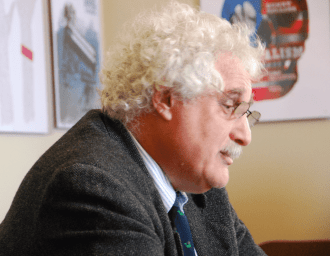
Stephen Klein, chief financial officer for JFO, said he was surprised by Gibbs’ assertion and said his counterparts haven’t shared any sort of bad feelings with his team. He said the JFO has been forthright with their concerns and supporting math as they digest the administration’s plan.
“We have done everything we could in terms of sending them analysis, and I thought they were productive conversations. This is the first time I’m hearing otherwise, and I’m sorry they feel that way. That is really unfortunate,” Klein said.
Klein said the JFO had provided the administration with all of the spreadsheets and other documents supporting its criticism of the governor’s plan, and that analysts were still trying to get on the same page with their colleagues in the executive branch.
“In some areas we are close,” Klein said, especially on teacher health care and special education savings. “On the other issues, we haven’t reached a point where we are anywhere close.”
He said that if it’s true that the administration has been forthcoming with their documentation supporting their projections, then the plan is short on specifics.
“I know what they have given us, and it is not too extensive,” Klein said. “I don’t know what they have done other than what they have given to us. If we have all of it then it leaves out a lot of detail.”
JFO has questioned the math and assumptions in five-year projections. Analysts have only done a completely separate review of the statewide teacher health plan. There are six more areas in the Scott administration’s plan that JFO is concerned with and Klein said his staff met with administration officials for three hours on those issues.
Klein said the JFO wants to reach an agreement on the numbers so that lawmakers can debate the policy, but he thinks it will be difficult to reach consensus. Part of the reason: the administration still hasn’t shared the information addressing the JFO’s concerns, he said.
Gibbs claimed that the administration was shut out of committee meetings on Tuesday where the JFO presented its critique of the plan.
“We asked to present our own mathematical calculations and explanations in testimony and that request was denied,” Gibbs said.
The administration is frustrated that it hasn’t been invited to appear before committees to make their case, he continued.
“If they don’t invite us to participate we can’t participate. This is their process, their agenda. If they don’t invite us we can’t contribute,” Gibbs said.
Rebecca Kelley, Gov. Phil Scott’s spokesperson, said Brad Ferland, deputy secretary of administration, asked to testify to refute some of the concerns raised but was denied the chance before the House panel voted approved a new budget without any of the Scott’s cost containment pieces.
“We would have liked to immediately address the questions raised yesterday, because they voted,” Kelley said.
Rep. Kitty Toll, D-Danville, who chairs the House Appropriations Committee, said that she asked her committee assistant to schedule a time for Ferland to testify as soon as she received his request, and that he testified Wednesday afternoon.
“No they were not denied,” she said. “The information we needed is relevant to the education pieces that are still in negotiation and not part of the budget passed yesterday.”
The new proposed budget is a temporary plan to keep government running while negotiations continue over more controversial parts of the budget and tax bills, such as the use of one-time money and the property tax rates for next year.
One thing the JFO and the administration agree on? This whole process has been atypical.
“This is usually collaborative; we have very experienced career analysts that have worked on this for weeks,” said Kelley. “It is unclear why now there seems to be less openness to working with those career experts and valuing their work.”
Klein said the JFO has only been raising legitimate questions.
“It would behoove everyone to work together to find agreed upon numbers. It’s hard to believe this is the one area we can’t, it seems odd since we do consensus reviews and forecasts, but somehow this seems different,” he said.

