[E]nvironmental advocates aren’t buying a warning from New England’s electrical grid operator that ratepayers in the region must subsidize a Massachusetts gas-fired power plant or risk rolling blackouts in 2024.
In a report released earlier this month, the groups argue that the dire prediction fails to account for investments in improved energy efficiency and renewable-energy measures.
ISO-New England, the nonprofit entity that the Federal Energy Regulatory Commission created to ensure the reliability of the region’s electrical grid, published a report in January on the security of the grid’s fuel supply.
It called for construction of more natural gas pipelines to serve the gas-fired plants that have come to predominate in New England over the past two decades. Natural gas accounted for 15 percent of the region’s electricity in 2000, and by 2016 fueled 49 percent of New England’s electric supply, according to an ISO-NE analysis.
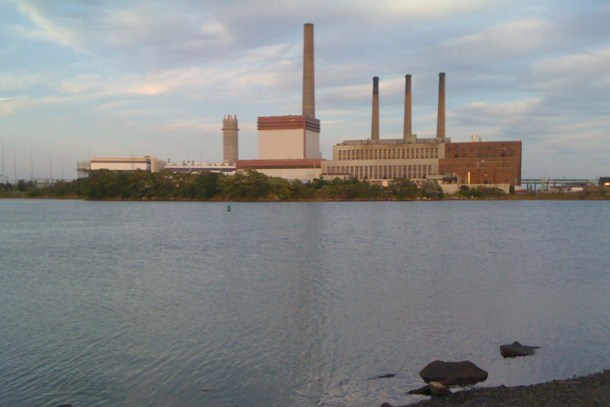
In line with that push, ISO-NE this month filed a motion with FERC asking the commission to approve up to three years of subsidized rates for the gas-fired Mystic Generating Station in Everett, Massachusetts.
The Mystic plant can’t continue to operate profitably beyond 2022 without public subsidies, operators say, and the New England grid can’t handle the Mystic plant going off line, according to ISO-NE.
Failing to subsidize the plants would “pose an unacceptable fuel security risk to the region during the winter months,” according to an ISO-NE memo published last month.
But environmental advocates say New Englanders have demonstrated — most emphatically through progressive energy policies adopted by every state in the region — that they no longer wish to publicly subsidize fossil fuel companies and prefer to use renewable energy instead.
Dave Westman, director of regulatory affairs with Vermont’s energy-efficiency utility, Efficiency Vermont, said fossil fuel plants are going out of business “because they’re no longer economical.”
“As they’re going out of business … the grid operators are using fuel security as justification for maintaining these dirty fossil-fuel plants even though they’re no longer economically viable to operate,” Westman said.
Part of the reason for pressing concern regarding New England’s electricity network is efforts by Exelon, the company that owns the Mystic plant, to acquire Distrigas, a critical natural gas supplier for the state whose biggest customer is the Mystic station.
If the Mystic plant goes out of business, so too would Distrigas, once Exelon completes its purchase, ISO-NE’s attorneys argue, meaning the security of the region’s natural gas supply rests on the venture remaining viable.
Department of Energy Secretary Rick Perry last year used fuel security as justification to seek more than $10 billion in new annual public subsidies for coal and nuclear plants.
Recent estimates have pegged U.S. fossil-fuel subsidies at around $600 billion annually.
While the FERC in January rejected Perry’s proposal as counter to the principles of a free-market economy, the commission in its decision called for the country’s ISOs and similar organizations to conduct analyses of their fuel security.
ISO-NE was the first to file one of these analyses in mid-January, which called for more natural gas infrastructure. The CEO of the regional utility, Gordon van Welie has been pressing for more natural gas capacity for years.
But the ISO-NE analysis fails to properly account for energy-efficiency and renewable-energy measures that by law must be put in place before the 2024-2025 winter season, Westman said.
“FERC is evaluating fuel security and reliability concerns in the federal regulatory space right now, and we as Vermonters need to be clear that clean energy and energy efficiency need to be recognized for the value they’re providing, and these uneconomical plants shouldn’t be allowed to operate if they’re costing ratepayers money,” Westman said.
A report commissioned by groups, including Efficiency Vermont, published May 3 found that ISO-NE had dramatically understated the role that energy efficiency and renewable energy will play in New England’s fuel portfolios by 2024, Westman said.
That report said ISO-NE used “unreasonable assumptions” and extreme scenarios to portray an unlikely disaster scenario resulting from constraints in the region’s fossil-fuel supply by 2024.
If New England policymakers take their lead from the ISO-NE fuel-security analysis, residents will pay subsidies to the same fossil-fuel companies that states are trying to curb reliance on, according to the report.
“Relying solely on the ISO’s worst-case scenarios could result in unnecessary costs for the region’s electric ratepayers,” the report states.
“Reliable electricity service, with no rolling blackouts, is likely in an extreme 2024/25 winter without any increase in regional gas infrastructure if states continue to implement current policies,” it states.
Representatives from ISO-New England and the Department of Energy did not respond Wednesday to request for comment.