

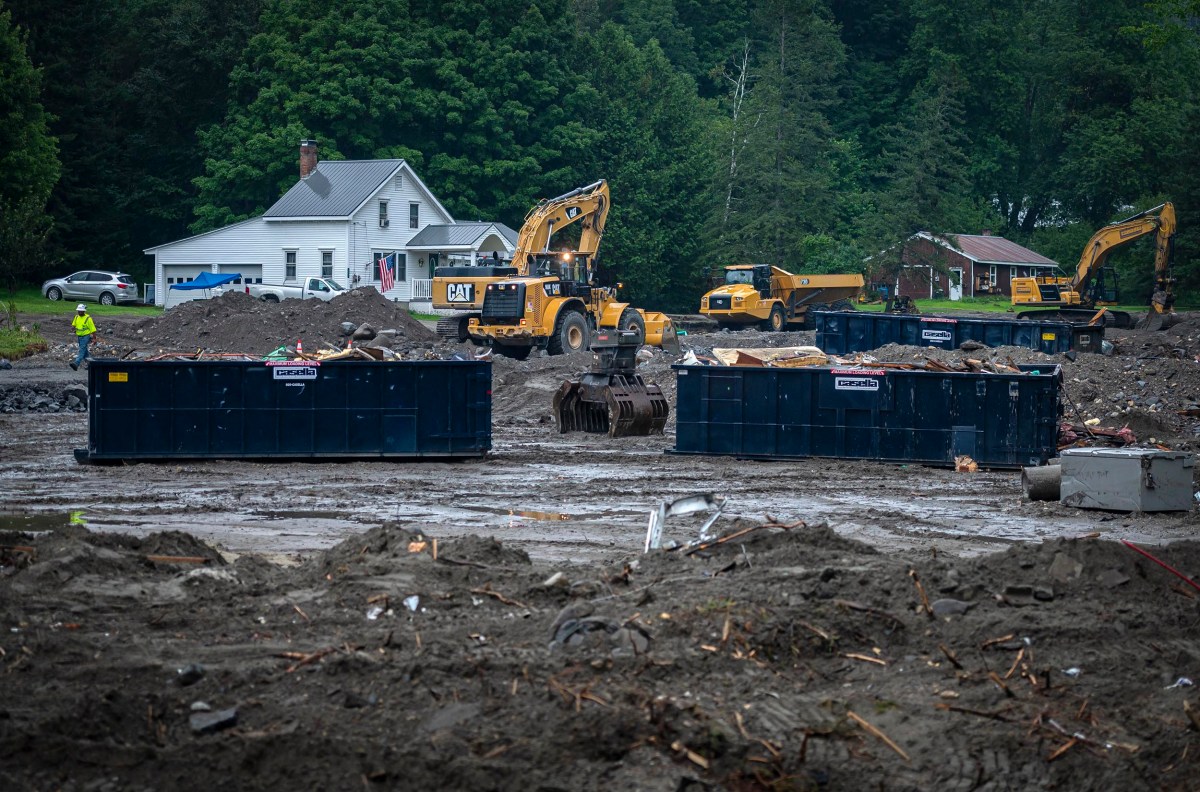
The Federal Emergency Management Agency announced $2 million in funding for flood recovery projects in Vermont on Friday — and the state’s chief recovery officer is hopeful that more money is on the way soon.
The announcement includes funding for the state as well as the town of Royalton to cover the costs of infrastructure damage sustained during the catastrophic flooding in 2023. It does not include money for FEMA assistance to individuals from that disaster.
Specifically, the Vermont Agency of Transportation received $1 million to fund repairs to a segment of railroad tracks and a bridge on Route 103 in Chester. Royalton got a similar amount of money for repairs to Broad Brook Road, according to a FEMA press release.
Vermont’s funding is a slice of about $1 billion that the agency announced Friday for projects managed by state and local governments around the country. Those projects are part of a FEMA program known as Public Assistance. The press release also said that, as it released the funds, FEMA was “working diligently to address” a backlog of public aid requests.
That backlog stems, at least in part, from extra scrutiny that then-U.S. Department of Homeland Security Secretary Kristi Noem ordered last year for FEMA aid requests above $100,000. The New York Times reported earlier this year that Noem, under that policy, had held up about $17 billion in disaster assistance.
But after Trump ousted Noem in March, her replacement, Markwayne Mullin, rescinded that policy.
Doug Farnham, Vermont’s chief recovery officer, said the state and local governments continued to receive awards from FEMA over the past year despite that additional review, covering damage from both the 2023 and 2024 major floods.
However, “almost every project we had was being delayed approval by that policy,” sometimes for weeks or months, he said.
According to data compiled by a state contractor, before Noem’s order took effect last June, Public Assistance projects in Vermont spent on average eight to nine days in a final FEMA review stage before the state or municipalities could be certain they’d see their awards. After the order, though, that time in limbo jumped up to an average of 61 days.
No project has been canceled outright after getting additional scrutiny, Farnham said — which made him question why a longer process was needed.
“I do feel like it wasn’t a necessary review,” he said Friday.
The ongoing lapse in congressionally approved funding for the Homeland Security Department, which started in mid-February, has played a larger role in slowing approval for state and local awards more recently, Farnham said. But he thinks Friday’s announcement is “a positive indicator” of more progress on Vermont’s outstanding aid applications to come.
As of this week, about 140 Public Assistance projects are still awaiting final approval from the state’s 2023 and 2024 flooding, out of 2,375 total projects, according to the contractor’s data. The data were compiled before FEMA’s Friday announcement.
However, that 5% of outstanding projects amounts to an estimated half of the total value of potential awards that the state and towns have applied for, data shows. The total dollar value is about $645 million, though the final amount will be different, Farnham said.
That means some of the remaining projects that still need final approval — including repairs to the “capitol complex” of state buildings in downtown Montpelier — are among the most expensive.
