

[T]he Vermont Senate gave preliminary approval Tuesday to domestic terrorism legislation that would criminalize the conduct of taking substantial steps toward carrying out a mass shooting.
The Senate voted 30 to 0 to advance to the legislation making changes to the state’s domestic terrorism laws in the light of a Vermont Supreme Court ruling in the case of Jack Sawyer, 18, accused by police of planning to shoot up his former high school in Fair Haven.
A third and final reading in the Senate is set for Wednesday. The legislation would then head to the House for consideration.
A three-justice panel of the high court issued a ruling earlier this month in Sawyer’s case that said merely planning or preparing to commit a crime did not rise to an attempt offense, citing a century of state case law.
Prosecutors this week have dropped the most serious charges against Sawyer, including three counts of attempted murder, citing the high court decision as making continued prosecution of those counts “untenable.”
The changes to the domestic terrorism statute passed unanimously out of the Senate Judiciary Committee last week.
According to the legislation, “domestic terrorism” means “engaging in, or taking substantial steps to commit” a crime involving:
• causing death or serious bodily injury to multiple people.
• threatening any civilian population with mass destruction, mass killing or kidnapping.
The legislation states that a “Substantial step” means “conduct that is strongly corroborative of the actor’s intent to complete the commission of the offense.”
The maximum punishment for the offense is up to 20 years in prison.
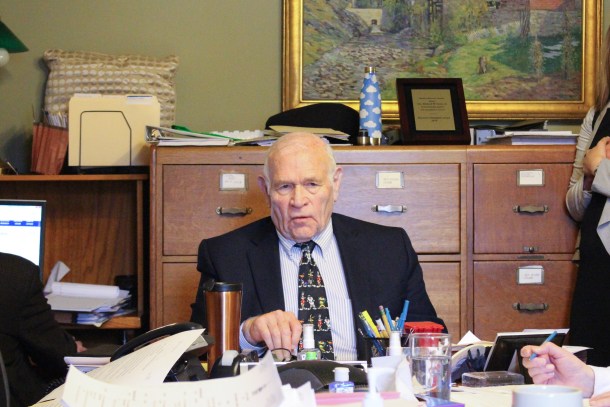
Sen. Dick Sears, D-Bennington and chair of the Senate Judiciary Committee, said Tuesday on the chamber’s floor that the legislation is needed to hold accountable a person “who exhibits the kind of behavior that was exhibited by the potential shooter in Fair Haven.”

Sears said the Senate Judiciary Committee looked at making revisions to the state’s attempt laws but decided that was too complex an undertaking with not much time remaining in the legislative session.
He added that the terrorism statute appeared to be a better fit for the type of actions they were trying to address. Sears talked of a group of students, staff and faculty from Fair Haven Union High School who expressed to the committee the “terror” they felt as a result of the case.
Any changes in legislation could not retroactively be applied to Sawyer.
The House Judiciary Committee has been taking testimony over the past week regarding making changes to the attempt statute. Also last week, the House panel heard from Vermont Public Safety Commissioner Thomas Anderson on the making the revisions to the state’s domestic terrorism statutes.
While Sears said the Senate proposal would leave determining what would constitute substantial steps up to a judge based on the individual facts of a case, Anderson said his version provided some “guidance.”
Anderson’s proposal was similar to the one passed by the Senate, though he went further in defining the meaning of substantial steps to include “the obtaining, collecting, purchasing, or fabrication of materials to be employed in the commission of the offense.”
Also, Anderson, a former federal prosecutor, said he would change the wording from actions that are “strongly corroborative of the actor’s intent to complete the commission of the offense,” to “intent to commit the commission of the offense.”
He told the committee, “It seems to me that the actor’s intent to complete the crime is pretty far down the road.”
Sears, speaking on the Senate floor Tuesday, also said his committee has made changes to the state’s criminal threatening statute as part of a bill, H.675, that includes other provisions aimed at school safety.
The bill is currently in the Senate Education Committee. The change to the criminal threatening statute adds a provision regarding someone threatening “to use a firearm or an explosive device to harm another person in a school building, on school property, or in an institution of higher education” The maximum penalty for that offense would be five years in prison.
Vermont Defender General Matthew Valerio, whose office is defending Sawyer, urged both House and Senate judiciary committees last week to use caution rather than rush to change a law in response to a single case.
“All I’m asking you to take a step back and make a decision based upon study and not upon emotion of a case that you don’t know how it will even come out,” he said. “I think I know how it’s going to come up, but that being said, I don’t know.”
He has said from the outset that the case had been overcharged, as it was more a mental health matter than a criminal one.
Sawyer is currently being held at the Rutland jail for lack of $100,000 bail. A hearing is set for Wednesday in Rutland Superior criminal court to review that bail in the wake of the decision by the prosecutor to dismiss the four felony charges against him.
He still faces two misdemeanor offenses: criminal threatening and carrying a dangerous weapon with the avowed purpose to commit serious injury or death, which together carry up to three years in prison.
His attorneys are arguing to have those offenses thrown out as well and are seeking their client’s release.
Sawyer was arrested on Feb. 15 after authorities said he had plans to cause “mass casualties” at Fair Haven Union High School, where he formerly went to the school. His purchase of a shotgun and ammunition in Rutland in the days leading up to his arrest showed his intentions to carrying out the shooting, prosecutors argued.
Gov. Phil Scott issued a statement following the Vermont Supreme Court ruling in the Sawyer case saying he was “appalled” that Sawyer may be released. He urged to the Legislature to revise the state’s attempt and domestic terrorism laws to address such cases.
Scott has cited the Sawyer case for the shift in his stance on gun laws, paving the way for increased restrictions on firearms in legislation signed by the governor earlier this month.
