

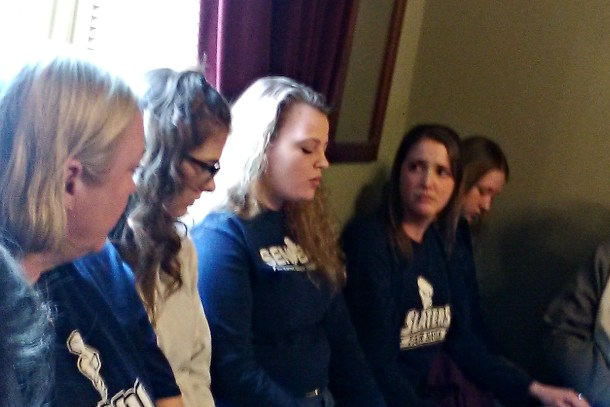
[E]lyza Bird told the Senate Judiciary Committee on Wednesday that she doesn’t understand how a person accused of planning to shoot up her school may soon be released and have serious charges brought against him thrown out.
“Since when do we allow a threat to be made against a school of more than 400 students and faculty members with no punishment,” Bird, a senior at Fair Haven Union High School, asked the Senate panel’s five members.
“Are you really prepared to wait for bullets to fly and people to lose their lives before you see that is an issue that needs to be addressed?”
Bird was among about 15 students, teachers and staff members who traveled to Montpelier from the western Rutland County high school to urge a change in Vermont’s “attempt” law in light of a recent state Supreme Court ruling.
A decision issued last week by a three-justice panel of the state’s high court found that four “attempted” felony charges brought in mid-February against 18-year-old Jack Sawyer didn’t meet the standard of an “attempted” crime under Vermont case law.
That’s because, according to the decision, merely planning and preparing to commit a crime didn’t rise to the level of an attempt.
Sen. Dick Sears, D-Bennington, and the Senate Judiciary Committee chair, told Bird and others who traveled to Montpelier with her from Fair Haven, that lawmakers understood their frustration and are working to address the situation.
Gov. Phil Scott late last week asked the Legislature to act “quickly” so legislation could be in effect by the time students return from April vacation on Monday.
Sears said at the committee meeting Wednesday that as lawmakers work to meet that deadline they need to take care in making sure that whatever they do will work.
“We can do something tomorrow,” he added, “but it may not be effective.”
And, he said, there is no guarantee that any law would stop a person bent on carrying out a crime.
“Whatever we do is not going to be retroactive to what Jack Sawyer did in the past,” Sears added. “My goal is to do something that would impact Jack Sawyer were he to exhibit the same behavior as he did one month ago, two months ago, and anybody else out there who might exhibit the same behavior.”

Bird, and others, told the Senate committee that the entire school community has been living in fear for the past two months, with little excitement for taking part in educational special events and constant concern for their safety.
“I am no longer excited for prom,” she told the panel. “Instead, I’ll be watching the exits and hope I make it home.”
Julia Adams, a FHUHS social studies teacher, told the panel that she can no longer do her job “to the best of my ability” due to students being afraid to come to school and parents in fear of sending their children to classes.
Adams said she and others feel let down by the courts and lawmakers, and will continue to speak up until there are changes.
“I will be their voice,” she said of students at the school. “I am their social studies teacher and this is a civic lesson in real life. We are not going to stop. “
Rutland County State’s Attorney Rose Kennedy, who is prosecuting Sawyer, also attended the Senate committee meeting and pleaded with lawmakers to make changes to the law.
“I am literally here to beg for an attempt statute that will work,” Kennedy said.
Sawyer had been held without bail since his arrest Feb. 15. However, the Supreme Court ruled the allegations against him didn’t support holding him without bail.
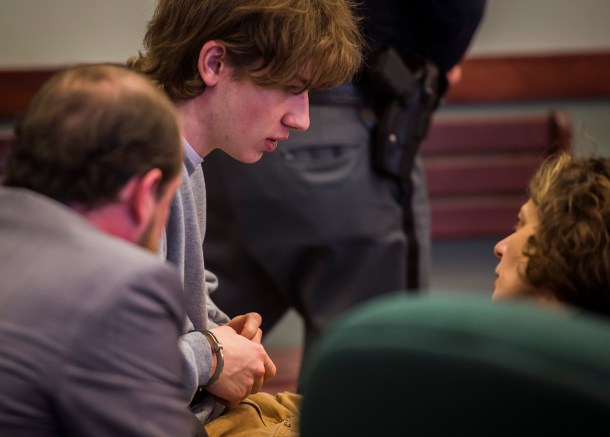
A Rutland judge set bail for Sawyer following a hearing Tuesday at $100,000, and his father testified in court that he was ready to post $50,000 and take his son to the Brattleboro Retreat for inpatient psychiatric care.
However, Sawyer’s father wouldn’t comment following the hearing if he had the $100,000 needed to gain the release of his son on bail.
Sawyer was still listed as incarcerated at the Rutland jail as of late Wednesday afternoon, according to the state’s online inmate locator.
The Senate and House judiciary committees have both held sessions Tuesday and Wednesday as they work to meet the governor’s deadline for a new law.
A proposal drafted by the Department of State’s Attorneys and Sheriffs looks at making reforms to the attempt statute by lowering the threshold for what it would take for prosecutors to prove an “attempt” offense.
Instead of prosecutors having to prove that an “overt” act was taken toward carrying out a crime, they could apply a “substantial step” analysis, according to that proposal.
Vermont Defender General Matthew Valerio, whose office is defending Sawyer, testified Wednesday before the Senate panel that making wholesale revisions to more than a 100 years of settled case law regarding the attempt statute in response to one case wasn’t the way to go.
“Even if you change law there is no guarantee whatsoever that what you do would impact in any way the result of a case like the Sawyer case,” he told the panel. “It’s very, in my view, inappropriate to immediately on short notice to change over 100 years of settled law on attempt where nobody before now has coming in clamoring for a change in the attempt law.”
He added of the Sawyer case, “The only reason we are arguing about this is because of the way it was charged.”

Instead of changing the attempt law, Valerio talked of making revisions to anti-terrorism laws, suggesting adding provisions to address person using, or intending to use, a firearm to kill or strike fear in a large group of people.
Sears, following the Senate Judiciary Committee session Wednesday, said he was more inclined to move forward on making changes to domestic terrorism laws than the attempt statute, at least at this point.
“Right now, I would say, looking at the attempt statutes may not get us where we want to be,” Sears said. “It seems to me, looking at domestic terrorism, which this certainly is, is a better place to focus our time to get something out as soon as possible to the governor’s desk.”
Sears added that he wasn’t “throwing out” the idea of making any changes to the attempt statute and understood that is what Fair Haven students and faculty had been asking for it, but he said such a change based on testimony he had heard so far would take a long time.
“Right now they are focused on attempts,” he said of those who came to Wednesday’s meeting from Fair Haven, “but I hope they will understand we’re working toward the same goal, that is to hold people accountable without having it overturned by the Supreme Court.”
He asked legislative counsel to work on a draft of a domestic terrorism statute that included provisions regarding firearms and threats of multiple killings, or placing people in fear.
The Senate committee is expected to continue reviewing that statute Thursday.
Meanwhile, the House Judiciary Committee, during its session Wednesday, didn’t talk about the domestic terrorism statute at all, focusing only reforming attempt law. They heard similar testimony from Valerio as he provided earlier in the day to the Senate panel.
The defender general also urged that panel to use caution rather than rush to change a law in response to a single case.
“All I’m asking you to take a step back and make a decision based upon study and not upon emotion of a case that you don’t know how it will even come out,” he said. “I think I know how it’s going to come up, but that being said, I don’t know.”
Rep. Chip Conquest, D-Wells River, the committee’s vice chair, said he wondered if waiting another year was just delaying a needed change.
“I would feel at least more comfortable that the impacts would be more fleshed out the governor saying, ‘I want a law by Friday,’” Valerio responded.
The House committee is expected to take additional testimony Thursday as well.
