

[T]he state Senate president says Vermont may not be ready for a taxpayer-funded system of primary health care.
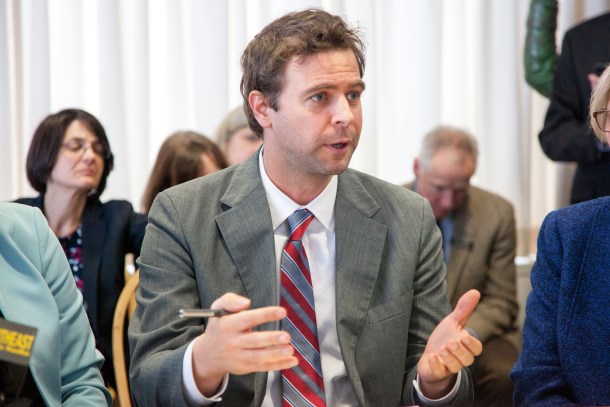
Senate President Pro Tem Tim Ashe on Tuesday defended a new version of S.53 that calls for a study of how the state might “achieve universal coverage for primary care services” but doesn’t support a way of paying for the coverage.
The revision, approved by the Senate Appropriations Committee Friday night, is a sharp departure from an earlier version of the bill that explicitly endorsed publicly financed health care with no cost-sharing.
Ashe said he’s not convinced such a system is feasible. He said there are “a number of questions” that must be addressed before the state commits to universal primary care coverage.
“It’s an ultra-complicated system,” Ashe told the Senate Health and Welfare Committee. “If it was easy, it would’ve been done already.”
There has been a recent push for a broad expansion of primary care in Vermont. Advocates say better access to primary care would improve Vermonters’ health and, by addressing problems “before they become more serious and more costly,” eventually lower the cost of overall heath care.
In January, universal primary care supporters crowded the House chamber to lobby the House Health Care and Senate Health and Welfare committees.
Earlier this month, the Senate Health and Welfare Committee approved S.53 unanimously. That version of the bill called for several years of study and work toward creating a new primary care system that would take effect in 2022.
The bill declared in its first paragraph that “it is the intent of the general assembly to create and implement a program of universal, publicly financed primary care for all Vermont residents.”
But the Appropriations Committee recommended striking out such language. The wording of the committee’s amendment is the Green Mountain Care Board and “interested stakeholders” should develop recommendations on what constitutes primary care; how to make such services universally available; and how to make those services “affordable.”
It might happen via “income-sensitized, state-funded cost-sharing assistance,” the bill says. But there is no specific push for taxpayer financing: The bill says primary care might be “publicly financed or covered by health insurance or other means.”
The revision drew criticism from some supporters of universal primary care. The president of the Vermont State Labor Council and the Vermont chapter of the American Civil Liberties Union took to social media to urge defeat of the Appropriations Committee’s amendment.
Dr. Allan Ramsay, a former Green Mountain Care Board member and persistent backer of universal primary care, said S.53 had been watered down.
“The principle of eliminating cost-sharing and treating primary care differently is kind of lost,” Ramsay said.
Sen. Claire Ayer, D-Addison, who is chair of the Health and Welfare Committee, said the Appropriations Committee amendment takes S.53’s commitment to publicly financed primary care and “pretty much makes it a study.”

She also said the newest version of the bill places too many burdens on the Green Mountain Care Board. “I’m worried that they don’t have the assets or the resources to do this,” Ayer said.
Ashe said the Appropriations Committee, of which he is a member, didn’t have much time to consider S.53 and couldn’t endorse public financing.
“We’re all for increasing primary care coverage and primary care services, shifting that balance away from hospitalization and towards preventive and primary care,” he said. “But we have not yet reached a point where we’re capable of saying that we intend to do it this particular way.”
Authorizing a more generalized study of primary care options “was the simplest way to keep the bill alive and moving through the process,” he said.
He also sought to deflect criticism from Sen. Jane Kitchel, D-Caledonia and chair of Senate Appropriations. Some critics have been referring to the revision of S.53 as the “Kitchel amendment.”
“It was an Appropriations Committee amendment,” Ashe said. “And if you want to blame any one particular person, blame me. I’m happy to absorb whatever concerns people have in the public. I stand behind my particular position.”
Ayer on Tuesday proposed her own amendment for S.53.
Rather than restoring the original bill, Ayer’s proposal builds on the Appropriations Committee’s version by calling for draft and final operational plans “if the Green Mountain Care Board determines that achieving universal coverage for primary care in Vermont is feasible and that the benefits to Vermont residents outweigh the estimated financial costs.”
It also calls for the Legislature “to provide sufficient resources” to the Green Mountain Care Board to complete its work related to universal primary care.
But there’s no commitment to public financing. That disappointed Sen. Dick McCormack, D-Windsor, who voted for the initial version of S.53 in Senate Health and Welfare.
“I would prefer to fight for truth, justice and the American way,” McCormack said. “I would like to go to the floor and oppose the Appropriations Committee and pass the bill as we passed it.”
But Ayer said she wasn’t sure that battle could be won. Instead, she said she would work with Ashe and the Appropriations Committee to find a path forward for S.53.
The bill, pending further revision, may come up for a Senate vote this week.

