

[T]he leader of the Senate picked a fight Thursday with Gov. Phil Scott over the administration’s oft-used slogan 6-3-1.
The six stands for the number of workers the state loses every day; the three represents the number of students disappearing from schools across the state on a daily basis; and the one refers to the number of babies born each day to a mother addicted to drugs.
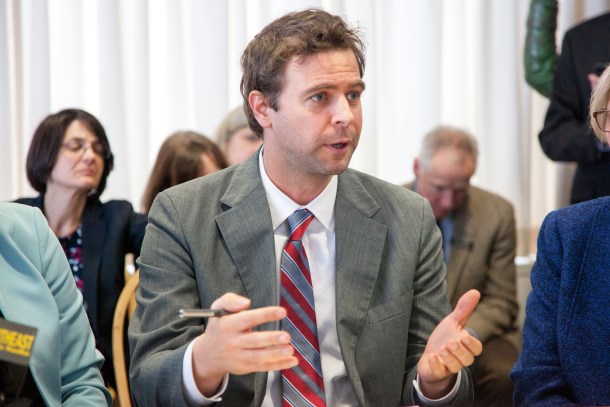
Senate President Pro Tem Tim Ashe says that the first statistic in the governor’s metric is “completely incorrect” because it is based on “dated information” that was “cherry picked.”
“For the last year and a half we’re getting an average of 2.3 people in the labor force,” Ashe said. “It’s not the same as six leaving the labor force. Six can’t be leaving if we have two coming every day.”
Ashe said labor force gains should be celebrated. Instead, the administration continues to paint a dire picture of the state’s economy. “It just sends a very different message,” Ashe said. “We all need to know what the facts are.”
The Senate leader backed up his assertion with an analysis from Tom Kavet, the economist for the Legislature. In the years following the Great Recession, between 2009 and 2016, the state lost a total of about 13,000 workers. Recent gains have been modest. The data shows that over the past 18 months the state has seen an increase of about 1,609 workers on average, or 2.3 a day.
The Senate leader’s attack on the Scott administration’s core political message immediately drew a vociferous response.
In a statement, Scott described Ashe’s claim as a Washington, D.C., style attack. The governor said Ashe, with assistance from the legislative economist, was deliberately attempting “to mislead Vermonters about these facts by intentionally using a smaller timeframe to skew the numbers. I find this deeply disappointing and concerning.”
“Cherry-picking from a small window to deny the demographic crisis we’re seeing is like claiming that a few subzero days in January indicate climate change isn’t real (which we know is not accurate), because it’s a deliberately imprecise way to try to obscure a clear trend,” Scott said.
The governor said he doesn’t have time “for their political games because we have an immediate need to address this crisis.”
The size of the state’s workforce as a percent of the population “is the crux of every problem we face,” Scott said. Expansion of the workforce is the key to generating enough revenue to pay for the state’s social safety net, early childhood education, water quality protections, broadband and “virtually every other priority of our state.”
“Frankly, it’s this type of partisanship that has allowed this problem to fester and, as a result, we’re just 3 to 4 years from having only one worker for every child, retiree and dependent of the state, when you exclude the Burlington area,” Scott said. “And we’re 7 to 8 from that bad dependency ratio when you include the Burlington area.
The 6-3-1 message is so important that Scott and his administration use it as a touchstone. The figures are a way for the administration to boil down and translate into policy what Scott talked about on the campaign trail — growing the economy, making Vermont more affordable, protecting the most vulnerable.
The three-number rubric was featured in the governor’s State of the State address and his budget address, and he refers to it in nearly every press event. The governor’s office sports a Vermont license plate emblazoned with 6-3-1.
Ashe says that’s the problem. The governor continues to use an obsolete statistic that is misleading, he said. “I kind of feel like we need to get a new license plate that strikes the six because the six because they cherry-picked the data,” Ashe told reporters.
The Scott administration disputes that claim and says the statistic holds true. The governor says from 2009 to the time he took office in 2016, the state was losing six workers a day.
Ashe says that may have been true then, but it’s not accurate now. “Almost every month we see positive gains in the labor force,” he said.
The governor’s messaging is directly related to policymaking, the Senate leader said, and that’s why, he believes, the message should change to reflect the new reality.
“Every speech about the spending priorities of the administration is focused on three statistics,” Ashe said, “and what we’re suggesting is, one of the statistics is completely incorrect at this time, and it raises questions about whether you would craft policy exactly the same way if the number is headed in the wrong direction.
“We’re not losing six people in the labor force every day, so the strategies that are being devised by the administration about a reduction in the labor force is solving a problem that doesn’t exist,” Ashe said.
