

[B]ARRE — The State Board of Education is asking lawmakers to put the brakes on new initiatives and think about price tags, saying schools and communities are overwhelmed and overtaxed. Board members also are questioning a policy that would keep some small schools afloat with state money.
Wednesday’s monthly meeting came as the board prepared for the start of the legislative session and the next phase of school district consolidation.
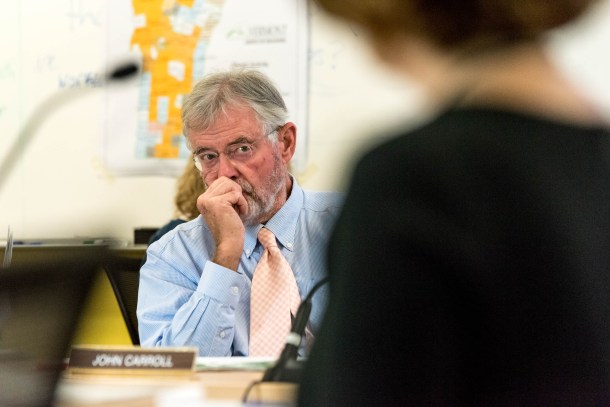
John Carroll, a member appointed by Gov. Phil Scott, said the board going forward is not advocating for anything except “to slow down initiatives.”
In recent years the General Assembly has required sweeping changes to school governance, mandated that schools shift from traditional learning to proficiency-based systems, and required universal early education.
School board members, teachers, administrators and students “are almost underwater with demands and expectations from policymakers,” said Carroll.
Three of the four pages of an annual letter to the governor and lawmakers contain a list of legislation and policy expectations cranked out over the last four years. Carroll said their message to lawmakers is: “Tread lightly, go easy, be careful. People are already struggling to meet these requirements, so be careful with any bright new initiatives.”
In addition to the current policy burden, many communities are faced with opiate addiction, there’s a greater divide between rich and poor, and most can barely afford their school taxes, according to the board.
Members urged lawmakers to take into account how much any new ideas would cost communities.
The administration has projected a 7 percent increase in statewide education property tax rates in the coming year to cover a $47 million hole in the education fund. Local increases could go higher.
Meanwhile, the state board is embarking on an effort to highlight efficiency, or the cost of education. It plans to view all proposals and legislation through the lens of equity, excellence and efficiency.
Pinpointing the intersection where effective schools are economical will be a new mission, according to Carroll. “To some extent this is a manifesto,” he said.

But schools aren’t getting cheaper; they are getting smaller and more expensive. Since Act 68 of 2003, Vermont has given a grant to schools with an average of 20 students or fewer in each grade. Over the last 20 years the number of schools qualifying has risen because student enrollments keep falling off.
In July 2019, any districts that have not merged will have to reapply yearly to be able to keep the grant. About 40 districts currently getting a grant chose not to merge.
The Act 46 school district consolidation law requires the board to come up with a way to determine eligibility for small-school grants based on either geographic isolation or strong academic performance by July. Under a temporary set of criteria adopted in September, only seven of those roughly 40 districts would be considered geographically isolated.
But on Wednesday, Carroll called the task “dubious” and said it’s inconsistent with the goals of Act 46 because it will keep afloat some seriously shrinking schools. We are “in an era of head count reductions, and on the other side, pumping money into schools regardless of that,” he said.
Huling said it is interesting that the new definition will apply only to schools in districts that chose not to merge. “It is a very distinct group,” she said.
Another board member appointed by Scott, John O’Keefe, said it is obvious the Legislature “punted” the decision. “I do have concerns about taxpayers paying to hold up local schools,” he said.
Peter Peltz, a former legislator who hails from a district with a small school, urged caution. “Schools in these communities are precious. They are very sacred to the well-being of the communities,” he said.
The board’s job is to look at things from the perspective of the state’s best interest, but this is a local and very political decision, according to Carroll. “We are being asked to be complicit, to help districts that chose not to merge under Act 46,” he said. “This is something we shouldn’t numbly plow ahead and do what we have been ordered to do.”
O’Keefe recommended making the bar high since these districts had the chance to merge and keep their grants but didn’t. “Some of them may have been hoping this whole thing would go away,” he said.
Vermont is heading into the next phase of Act 46. Districts that haven’t merged are expected to provide a self-evaluation by Dec. 26 showing they already meet the goals of the law or explaining how they will do so. These Section 9, or alternative structure, proposals could include some merging, according to Donna Russo-Savage, the Education Agency’s Act 46 specialist.
The plans are not binding and won’t go to a vote, but they will guide Education Secretary Rebecca Holcombe and the state board when they draft a final plan for statewide school governance. From now until the summer, Holcombe will be in conversations with local school boards to find out what they want to do.
The agency has received about eight plans so far, according to Russo-Savage. They will be divided into regions for board consideration.
Over the summer and through next fall, the board will take testimony from districts as they plot out the statewide plan that is due Nov. 30.
“You always want to work with local intent,” said Holcombe.

