

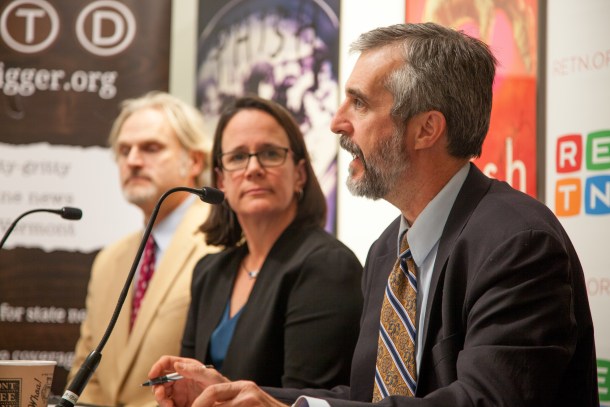
[B]URLINGTON — Agency of Natural Resources chief Julie Moore gamely insisted that Vermont’s worsening water pollution, and the bacterial outbreaks caused by that pollution across the state, are difficult issues that will require time and patience.
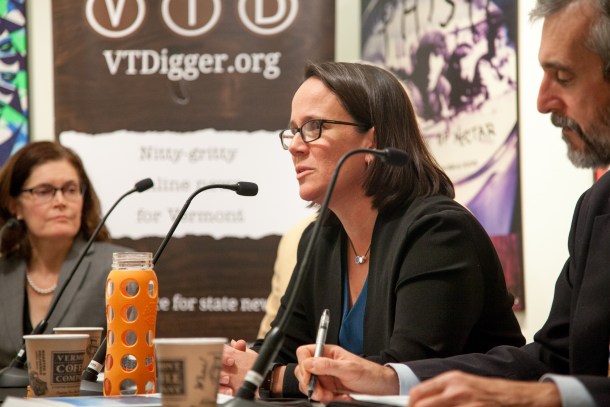
Speaking at a water quality forum at the Flynn Center Thursday evening, Moore’s position drew ardent criticism from David Mears, the former head of the Department of Environmental Conservation who now runs Vermont Law School’s environmental program, and Chris Kilian, the Vermont director of New England’s leading environmental-law advocacy group. The Conservation Law Foundation filed the lawsuit that led to the EPA-mandated cleanup of Lake Champlain.
The state must step up enforcement of the Clean Water Act and adequately fund clean up efforts, Kilian and Mears said. ANR has failed over the past 30 years to do either, they said.
The VTDigger sponsored forum at the Flynn Center in Burlington was held in the wake of the months-long closure of Lake Carmi and beach closures on Lake Champlain, both of which were caused by toxic bacterial blooms from farm runoff and other sources.
Last month, Gov. Phil Scott’s administrators failed to come up with a statutorily required recommendation for a long-term funding source to clean up the lake.
Kilian said state officials have failed to enforce state and federal clean water laws that have been on the books for decades.
The state needs a dedicated source of funding for clean water efforts, Mears said, and both polluters and politicians both need to be held accountable.
Moore provided the most forcefully countered Kilian’s argument for enforcement. She maintained that the state’s environmental regulators are already working hard to reverse the effects of decades of water pollution.
The agency secretary came under fire in recent weeks when a group of Scott’s administrators led by her did not identify a suitable source of long-term funding for Vermont’s clean water efforts, as had been mandated by the Legislature in state statute.
Instead, Moore’s group said that no new taxes or fees would be needed to deal with the problem for several years. Her stance coincides with Scott’s campaign pledge against raising taxes.
The state needs to come up with $100 million a year in private, state and local funds to comply with state and federal water quality laws, according to state Treasurer Beth Pearce. There is currently a gap in funding of $25 million a year. The Scott administration has agreed with Pearce’s estimates, but the group decided that it’s best to wait another five years before identifying a new revenue source to fill the $25 million a year gap.
The panelists did not discuss the financing issue in depth. Instead, they focused on the scope of the clean up effort, which includes upgrades to municipal stormwater systems, changes to the way dirt roads are managed by towns, mitigating manure and commercial fertilizer runoff from farms, and requiring developers to pay for stormwater systems around large parking lots.
In general terms, Mears and Kilian said polluters should pay for the cost of cleanup, but the public at-large is also responsible to the extent that residents use roads and parking lots, and contribute to stormwater runoff.
State bonding should continue to be a major source of funding for lake cleanup, Kilian said. Mears said a per parcel fee, as described in Pearce’s study, should also be considered as a new source of funding.
Kilian accused Moore — who under the Douglas administration led a $100 million water quality program — of failing to exercise the authority Vermonters have invested in her to uphold the state’s environmental laws.
He said the state needs to adopt a sense of urgency regarding the toxic algae blooms in Lake Champlain, which he described as an environmental emergency. Lake Carmi, which is wholly covered by cyanobacteria, is a harbinger of what is to come for Lake Champlain if the state doesn’t act now.
“On the way up here I was running through how many agency secretaries I’ve had this conversation with, and I came up with 11 — which is on average one every two years since I started working in the state — and countless Department of Environmental Conservation commissioners, multiple governors, multiple federal administrations, and the one thing I would ask of my colleagues at the table is to jettison the message that we have to be patient,” Kilian said.
“To stop telling people that we need to wait 30 years, or 50 years — ‘It took a long time for it to get this polluted, and it’s going to take a long time, so the green water that’s coming out of your tap on Lake Carmi, you’re just going to have to live with that because it’s really hard and it takes a long time’ — that is the wrong message,” he said.
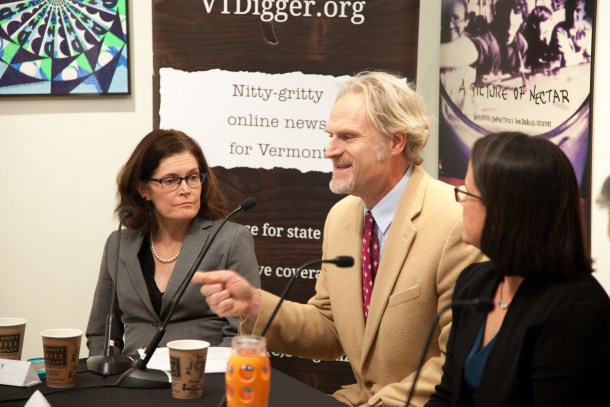
Kilian said meanwhile “all of these waters have become more and more and more foul, and we’ve studied and re-studied, and studied it again, and adopted flawed studies that everyone knew was flawed and had to be overturned by federal judges after millions of dollars of litigation,” Kilian said. “It’s got to stop.”
Polluters, Kilian said, must pay for the harms they cause to public water.
Mears took a more tempered approach. Although there are a few identifiable major polluters, such as farms and paved spaces, everyone in Vermont contributes to the problem to some extent, Mears said. Those contributions add up, even if they’re hard to attribute to specific individuals.
That’s why Vermonters should focus on figuring out an equitable way to fund the steps necessary to reduce pollution, rather than simply pointing fingers at farmers and parking lots, he said.
“I have committed my career to the concept that the policy of ‘polluter pays’ is good fundamental policy — it’s a policy we adopted starting in the late ‘60s and have adhered to, to greater or lesser degrees, since,” Mears said. “But stormwater runoff is a harder one to puzzle over, when you talk about ‘Who is the polluter?’ True, the large box stores, and the gas stations, and the farms are all polluters, but all of us have a responsibility, all of us that drive on the roads, that use these facilities, that have put fertilizer in our yards, that have homes and driveways — so we need to think about funding sources.
“We need to talk about sources of funding that do go to the places of impact — which are not just a set of box stores,” he said. “It also includes all of us that have driveways, roofs and the like, and that drive on our roads.”
Moore didn’t single out funding or enforcement. Instead she talked about the complexity of the problem, and she urged the public to be patient.
What’s needed, she said at one point, is akin to a three-legged stool, propped up by technical know-how, and by “financial capability, and that’s one we’re building, and also the political will.”
Vermont’s waters are generally in excellent shape, Moore said, but they are at risk. The risks go beyond the phosphorus pollution that’s driving cyanobacteria outbreaks across the state, she said — the risks include industrial practices that poisoned hundreds of wells in Bennington County.
The state needs a commitment to a long-term effort, she said. State agencies need to commit to accountability first, she said.
The root of the problem, Moore said, is weather, and the solution lies in nature, and there are innumerable examples of such solutions already in place around the state.
“My agency is deeply engaged in the science and engineering of water quality and water quality solutions, and we know that the only way to figure out what’s happening on our planet, in our state, in our communities, right down to our streams, rivers, lakes and ponds, is to measure it, and to measure it systematically and as quantitatively as possible, and we need to track change year over year,” Moore said.
“Much of Vermont’s water pollution … is attributable to wet weather events — it’s stormwater runoff, snowmelt and flood-related erosion, and we also know that weather is variable from year to year, so sometimes the trends we’re looking for can be really hard to discern in the noise of the variability and weather,” she said.
“Further, many of the best strategies for addressing these wet-weather pollution sources rely on natural solutions, allowing woody vegetation to re-establish along our stream banks and rivers, installing rain gardens and what we often refer to as ‘green infrastructure’ practices, to intercept and store stormwater, and plugging ditches on marginal farmland to allow the wetlands that were once there to re-form and re-vegetate, and we have examples of all those projects and more on our landscape,” Moore said.
The forum was moderated by VTDigger founder Anne Galloway.
Hear highlights from Thursday’s panel on this week’s Deeper Dig podcast:

